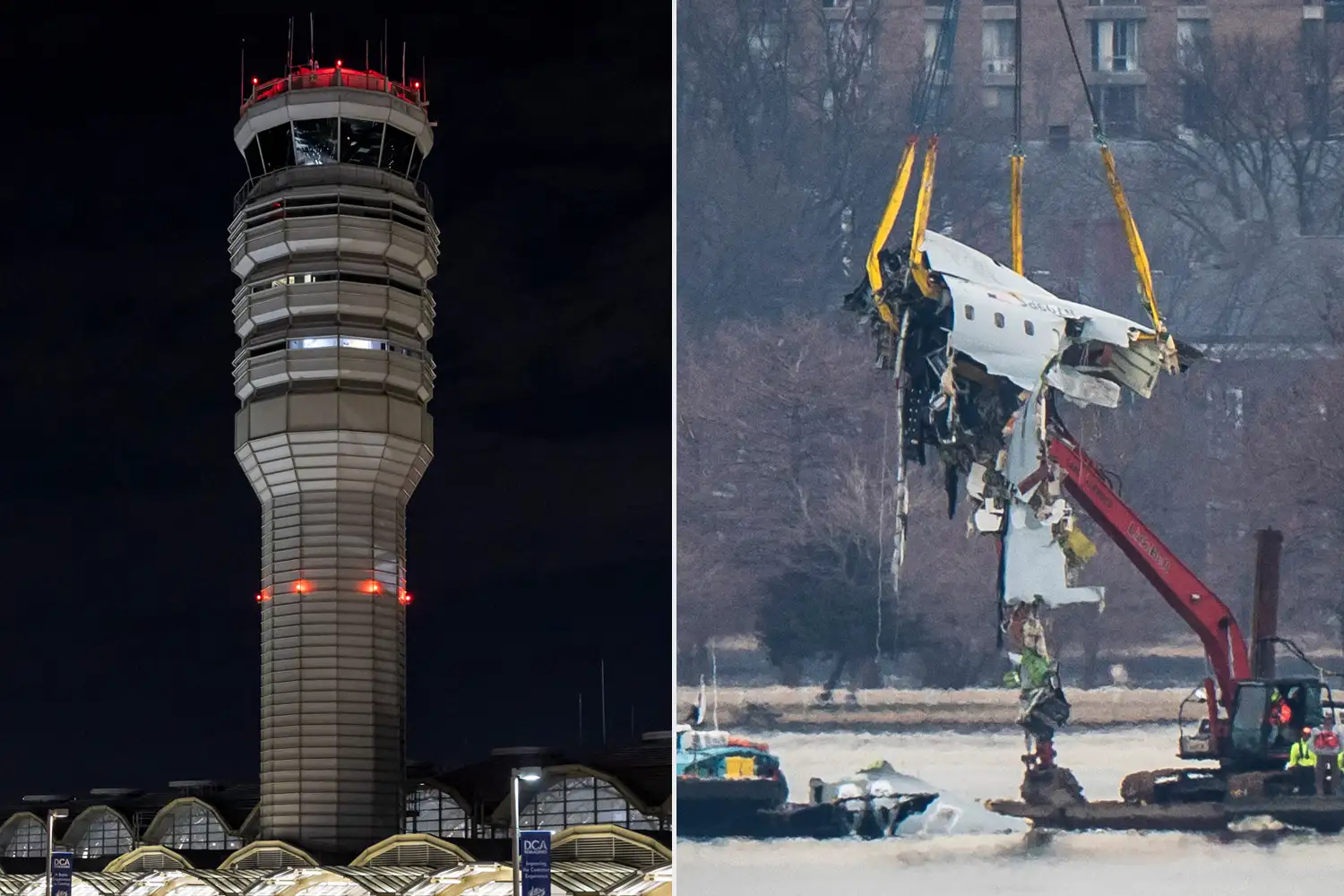

Earlier this year — two days after the deadliest aviation disaster in the U.S. in decades — the primary air traffic controller involved spent nearly three and a half hours in a formal interview with federal investigators.
The controller, whose identity has not been disclosed, discussed their aviation background and detailed their decisions on Jan. 29, the night a Black Hawk military helicopter collided with an American Airlines jet near Washington, D.C., killing 67 people in a catastrophic explosion.
The interview was released publicly in late July alongside thousands of pages of newly unveiled documents as part of a National Transportation Safety Board (NTSB) hearing.
These records provide the most comprehensive view yet of the small group of individuals who were directly connected to the events that unfolded that night.
The pilots of American Airlines Flight 5342 and the three-person Army crew aboard the helicopter did not survive. Cockpit voice recorder transcripts have revealed some insight into their final moments.
The NTSB investigation remains ongoing.
Thus far, findings and hearings have raised significant concerns about the helicopter’s flight path — indicating it flew too high and too close to the airliner, seemingly unaware of the looming danger — as well as broader risks created by the crowded airspace around Ronald Reagan Washington National Airport, where civilian aircraft and military helicopters routinely share tight corridors.
During the interview — conducted Jan. 31 at the FAA headquarters — the controller walked investigators through their actions that evening: how they guided both aircraft in the minutes leading up to the crash, when they realized something was wrong, and what key decisions were made.
The controller also reflected on certain choices that could have altered the outcome, including switching the airliner to a different runway shortly before the crash and not informing the pilots about the nearby helicopter.
Multiple times, the controller said they relied heavily on the Army crew’s repeated statements that they had the commercial jet in sight and would maintain visual separation.
The Air Traffic Controller’s Background
A nearly decade-long FAA employee, the controller described a lifelong passion for aviation.
“As a little kid, I’ve always been infatuated with airplanes,” they told investigators.
The 36-year-old graduated from Middle Tennessee State University, earned both private and commercial pilot licenses, completed an internship with FedEx, and later attended the FAA academy in Oklahoma City.
They joined the FAA in 2016 and previously worked in Delaware and Florida before being assigned to Reagan National.
They said their favorite role is working local control in the tower: “Sometimes to me it feels like a video game.”
They reported no previous disciplinary or health issues.
When asked about the 72 hours leading to the crash, the controller described typical days of working, exercising, and spending time with friends.
What Happened on Jan. 29 — and Their View of It
American Airlines Flight 5342 was arriving from Wichita, Kansas, carrying passengers including a group of young figure skaters returning from a prestigious camp.
Meanwhile, an Army Black Hawk helicopter, with pilot Capt. Rebecca Lobach undergoing a night-time evaluation, was headed back toward Fort Belvoir along a flight path near the Potomac River.
The controller said they first heard from the helicopter crew regarding their planned route along the river, which loops around the airport’s runways.
Separately, they redirected the incoming American Airlines flight to a different runway to allow other departures to continue — a change the pilots accepted.
The controller described the traffic level as “a little bit heavier than normal” and the complexity as “between a three and a four” out of five — though conditions were easing just before the incident.
They were handling both airplane and helicopter traffic, which was somewhat demanding, but said the workload had improved shortly beforehand.
According to the controller, both aircraft were flying normally until the helicopter approached Runway 33 and became visible from the tower.
“I saw a potential conflict,” they recalled. The commercial jet was in a critical phase of flight, so the controller issued instructions to the helicopter — which responded that it had the jet in sight and would maintain separation.
Unsatisfied, the controller pressed them again to confirm visual contact, and again the Army crew insisted they did.
The controller then instructed the helicopter to pass behind the airliner. However, according to cockpit transcripts, that directive was not recorded in the helicopter due to an audio interruption.
What happened next unfolded directly in front of the tower: the aircraft collided, shattered, and plunged into the dark river before erupting into flames.
Reflection: What They Would Have Done Differently
Near the end of the interview, the controller identified one change they believe might have prevented the disaster:
“If I would have just kept them on Runway 1, that would have changed the whole situation,” they said of the airliner.
They did not express regret about other decisions.
Although the helicopter was warned multiple times about the plane, the reverse did not occur. The controller said they had intended to notify the American Airlines pilots but were occupied with other urgent duties — and believed the helicopter already had clear responsibility for avoiding the airliner.
They acknowledged another option: directing the helicopter to hold its position. That did not happen.
Even if they had issued a traffic advisory to the jet, the controller wasn’t sure the pilots would have spotted the dark-colored aircraft in the pitch-black river corridor.
Current Status
The FAA declined to comment. The National Air Traffic Controllers Association, which supported the controller through the interview process, has also declined, citing the ongoing investigation.
According to a report published over the summer by The New York Times, the controller remains on leave.