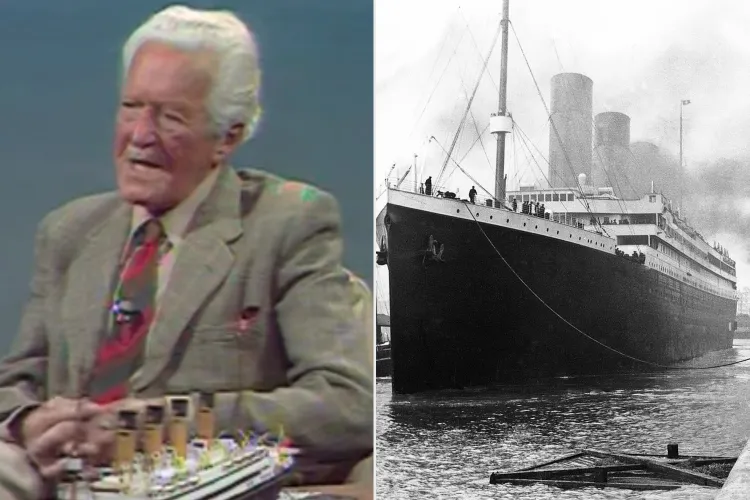

Major Frank Winnold Prentice, an assistant storekeeper aboard the RMS Titanic, shared his gripping story of survival decades after the ship’s 1912 sinking. In a 1979 BBC interview, he opened up about the split-second decision that saved his life. Prentice was only 23 when the ocean liner struck an iceberg on its maiden voyage, leading to the deaths of about 1,500 people while roughly 700 survived.
“We came to a sudden stop,” he said of the collision. “It was just like jamming your brakes on a car. There was no great impact.” But confusion quickly turned to panic. “Everybody was crying, praying, trying to get into the few lifeboats that were left,” he recalled. “It was pretty sad at the end.”
As the ship plunged deeper into the freezing Atlantic, Prentice clung to hope — and to the very back of the vessel. “I dropped off the stern just before she sank,” he explained. The ship was nearly vertical, and he hung onto a warning board near the propellers before letting go. He narrowly avoided the massive blades during his 100-foot plunge into waters filled with ice.
Despite the shock, he managed to reach a lifeboat and was reunited with first-class passenger Virginia Estelle Clark, whom he had earlier helped secure a life jacket. Her husband did not survive. “She wrapped a blanket around me and tried to keep me a bit warm,” he said. “I was nearly frozen solid.” He was one of only seven swimmers rescued by that boat; two later died from exposure.
Prentice admitted that fear caught up to him only once he was alone in the icy darkness. “Everybody else seemed to be dead around me,” he said. “And then I thought I was going to die.” With a life jacket and another cushion for support, he paddled toward the lifeboats until he was pulled aboard.
Looking back, he placed full blame for the disaster on White Star Line chairman J. Bruce Ismay, who survived the sinking. Prentice believed Ismay urged Captain Edward John Smith to maintain dangerous speed despite repeated iceberg warnings. “There was ice all over the place,” he said. “We went straight ahead as if there was nothing there.”
Even years later, the memory lingered. “Tonight I shall think a lot about it,” he admitted. “Can’t help it, can you?”
Prentice continued a maritime career after the tragedy, serving on the RMS Oceanic during World War I and later transferring into the Royal Engineers and Royal Tank Corps. He even returned to sea aboard the RMS Olympic — Titanic’s sister ship.
When he died in 1982 at age 93, he was the second-to-last surviving Titanic crew member. The wreck would not be found until three years later. His dramatic escape inspired a moment in the 1997 film Titanic, when a man is shown jumping from the stern near the propellers — just as Prentice once did in real life.