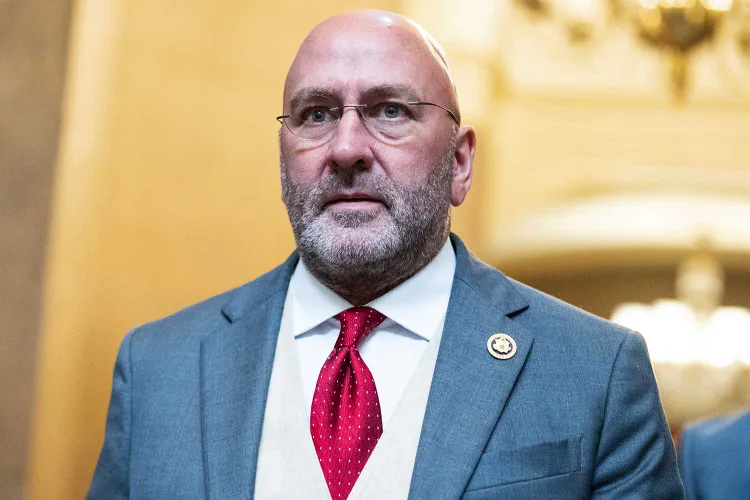

While the U.S. House of Representatives voted overwhelmingly on Tuesday, Nov. 18, to approve a bill demanding the release of the Epstein files, one lawmaker broke with the near-unanimous consensus.
Rep. Clay Higgins, a Republican from Louisiana, cast the lone opposing vote, as 427 of his colleagues from both parties backed the measure.
In a post shared on X the same day, Higgins said he had been “a principled ‘NO’ on this bill from the beginning.”
“What was wrong with the bill three months ago is still wrong today. It abandons 250 years of criminal justice procedure in America,” he argued. “As written, this bill reveals and injures thousands of innocent people – witnesses, people who provided alibis, family members, etc.”
He went on to warn that, “If enacted in its current form, this type of broad reveal of criminal investigative files, released to a rabid media, will absolutely result in innocent people being hurt,” adding, “Not by my vote.”
Higgins, 64, also pointed to the recent release of thousands of documents by the House Oversight Committee, which included emails from Jeffrey Epstein in which he allegedly described the president as “borderline insane” and claimed Trump “knew about the girls.”
:max_bytes(150000):strip_icc():focal(749x0:751x2):format(webp)/donald-trump-jeffrey-epstein-1-071725-ccd7fc2be6ef4cc1a3016f54ef4dae20.jpg)
“The Oversight Committee is conducting a thorough investigation that has already released well over 60,000 pages of documents from the Epstein case,” Higgins wrote on X. “That effort will continue in a manner that provides all due protections for innocent Americans.”
He added that he would reconsider his position if the legislation is revised: “If the Senate amends the bill to properly address privacy of victims and other Americans, who are named but not criminally implicated, then I will vote for that bill when it comes back to the House.”
According to The New York Times, Higgins “has a history of embracing unsupported theories that often portray law enforcement and the government in a conspiratorial light.” The outlet described him as a “hard-right” politician, while The Associated Press has called him “a fervent supporter of Trump.”
The president previously tried to block a vote on releasing the files, but then appeared to reverse course. On Sunday, Nov. 16, he urged House Republicans to support the bill after it had already gained broad backing.
“House Republicans should vote to release the Epstein files, because we have nothing to hide, and it’s time to move on from this Democrat Hoax,” the president, 79, wrote on Truth Social.
:max_bytes(150000):strip_icc():focal(999x0:1001x2):format(webp)/US-House-Speaker-Mike-Johnson-111225-091f38af6a954d2f81dd1b0d0a6d95b6.jpg)
Although the bill has now cleared the House, it must still pass the Senate and then be signed by Trump before becoming law. Senate Majority Leader John Thune said the upper chamber could vote on the measure as soon as Tuesday evening.
Ahead of the House vote, Speaker Mike Johnson reportedly called the measure a “political exercise” and argued that the bill contains “serious deficiencies,” according to ABC News. Johnson said he hoped the Senate would improve the language but insisted the president “has nothing to hide.”
The House legislation, formally known as the Epstein Files Transparency Act, directs the Justice Department to release its records related to Epstein. It was introduced by Democratic Rep. Ro Khanna and cosponsored by Republican Rep. Thomas Massie.
Republican Rep. Marjorie Taylor Greene of Georgia emerged as one of the most outspoken advocates for releasing the files — a stance that has drawn sharp criticism from Trump, who has labeled her a “traitor.” Once a strong ally of the president, Greene has repeatedly demanded that the records be unsealed, even as he initially opposed their release.
Even if the bill becomes law, the Justice Department would not be required to make every detail public. The measure allows the department to withhold information that is classified, that would identify victims, or that could interfere with an ongoing federal investigation.
Last week, before he ultimately backed the House bill, Trump directed the DOJ to launch a federal investigation into whether Bill Clinton and other Democrats had improper ties to Epstein, raising questions about whether such an inquiry could be used as a rationale to limit the release of certain materials.
The legislation does, however, specify that information cannot be withheld or redacted “on the basis of embarrassment, reputational harm, or political sensitivity, including to any government official, public figure, or foreign dignitary.”