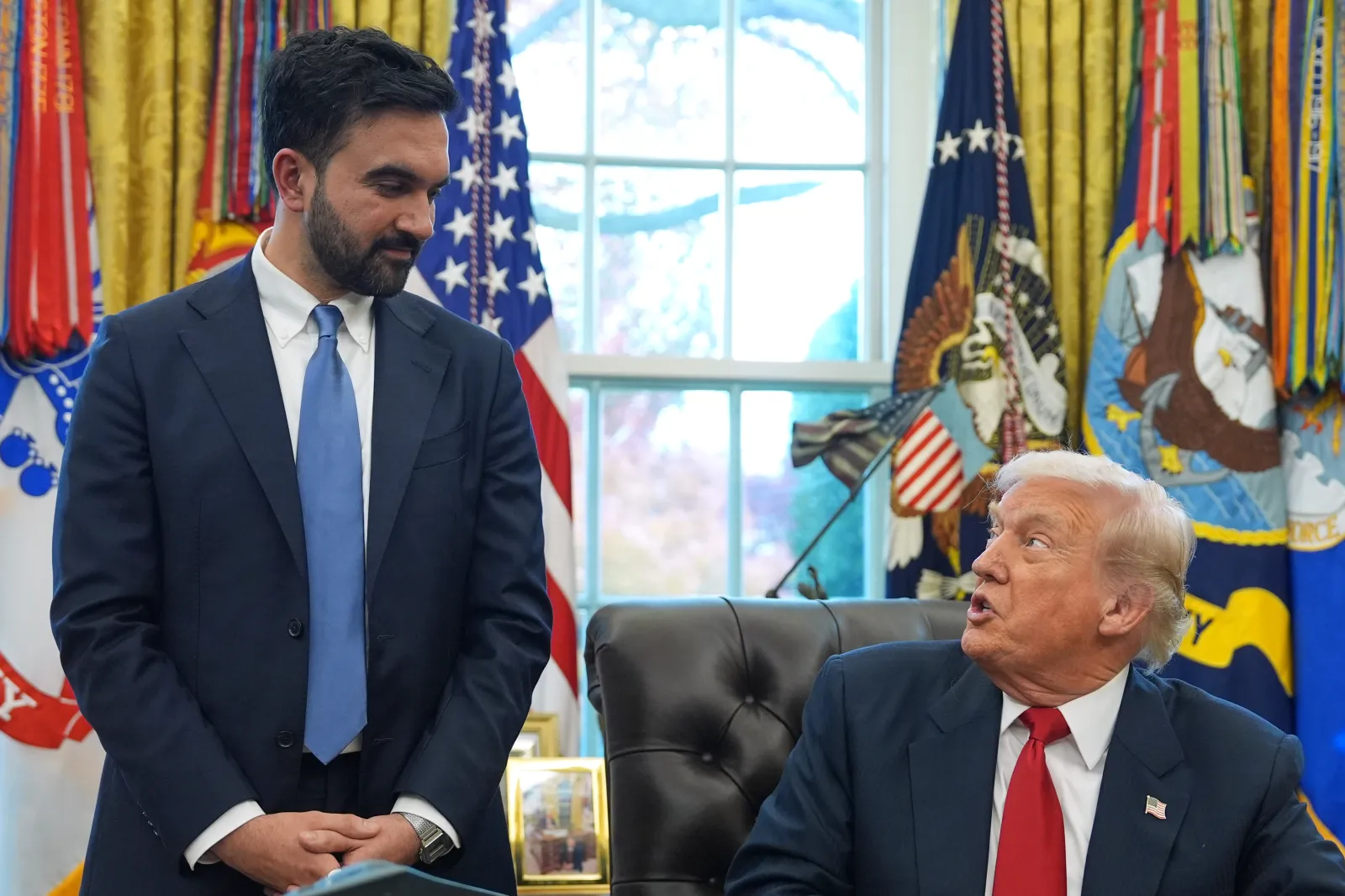

President Donald Trump and New York City Mayor-elect Zohran Mamdani set aside months of sharp rhetoric on Friday, turning their first Oval Office meeting into an unexpectedly friendly exchange focused on affordability and housing.
When a reporter asked Mamdani about previously describing Trump as a “despot,” the president jumped in with a smile.
“I’ve been called much worse than a despot. So it’s not that insulting,” Trump said.
Soon after, another question referenced Mamdani’s past use of the word “fascist.” Trump leaned into the moment again, grinning and patting Mamdani’s arm: “That’s OK, you can just say it — I don’t mind.”
The light back-and-forth contrasted with their campaign-season posture. Trump has repeatedly labeled Mamdani a “communist” and a “nut job.” Mamdani, a democratic socialist who once called himself “Donald Trump’s worst nightmare,” has criticized Trump as “authoritarian” and condemned the administration’s deportation tactics in harsh terms.
Still, both men emphasized common ground after a private conversation that aides said centered on the economic pressures facing New Yorkers.
“We’re going to be helping him, to make everybody’s dream come true, having a strong and very safe New York,” Trump told reporters, with Mamdani standing beside him.
Mamdani, who takes office in January, said he came to Washington to push the affordability agenda that powered his insurgent campaign—echoing themes that helped Trump in 2024.
“What I really appreciate about the president is that the meeting focused not on places of disagreement…but on the shared purpose that we have in serving New Yorkers,” Mamdani said.
Asked about a House resolution condemning socialism that passed earlier in the day, Mamdani downplayed its importance.
“I have to be honest with you, I focus very little on resolutions, frankly,” he said. “I think the focus is on the work at hand. I can tell you I am someone who is a democratic socialist. I’ve been very open about that. I know there might be differences about ideology, but the place of agreement is the work that needs to be done to make New York City affordable. That’s what I look forward to.”
Trump suggested that executive responsibility can temper politics over time, and hinted Mamdani might surprise some skeptics.
“I think he is going to surprise some conservative people, actually,” Trump said, brushing aside reminders of Mamdani’s earlier criticism.
Political Stakes for Both Sides
For Mamdani, the sit-down was a high-profile chance to introduce himself nationally as more than an upstart state lawmaker, and to frame his leadership as practical and city-first. During the race, he defeated former Gov. Andrew Cuomo while promising to “stand up to Donald Trump and actually deliver.”
For Trump, the moment offered a platform to underline cost-of-living concerns at a time when voters are demanding clearer moves on inflation and affordability. He even claimed that some of Mamdani’s proposals “are really the same ideas that I have.”
What People Are Saying
The exchange quickly lit up social media.
Vice President JD Vance wrote on X: “POTUS has a lot of good moments but this is an all-timer.”
Media personality Piers Morgan posted: “This is amazing. Kudos to Trump & Mamdani on coming together. We need more of this. @ZohranKMamdani @realDonaldTrump”
MS NOW’s Symone D. Sanders Townsend added: “My takeaway from this Trump meeting with Mayor-elect Mamdani: Republicans are going to need a new bogeyman for 2026”
What Happens Next
Despite the cordial optics, underlying tensions remain. Trump has previously threatened to withhold federal funds from New York and has questioned Mamdani’s citizenship—attacks Mamdani has dismissed as political theater. A senior administration official said funding threats are still possible, even if they weren’t the focus of Friday’s conversation.
Background on Mamdani
Mamdani was born in Kampala, Uganda, to Indian-born parents who later immigrated to the United States. His family moved frequently before settling in New York City, where he built his political career. He has often said his upbringing as the child of immigrants shaped his focus on tenants, working-class families, and immigrant communities in Queens.
Mamdani has lived in the U.S. since childhood and became a naturalized citizen after college—an experience he describes as central to both his identity and his emphasis on equitable, affordability-driven public policy.