
President Donald Trump has recently faced especially tense exchanges with the White House press corps as he navigates several sensitive issues — most notably, questions about his stance on releasing the Epstein files.
Trump has long been known, and even cheered by some supporters, for mocking political opponents with nicknames like “Crooked Hillary,” “Sleepy Joe,” “Governor Newscum,” “Kamabla” and “Marjorie Traitor Greene.” But his rhetoric toward journalists has grown sharper and more personal, turning routine press gaggles into combative showdowns. In many of the most heated moments, it has been women in the press corps at the center of his attacks.
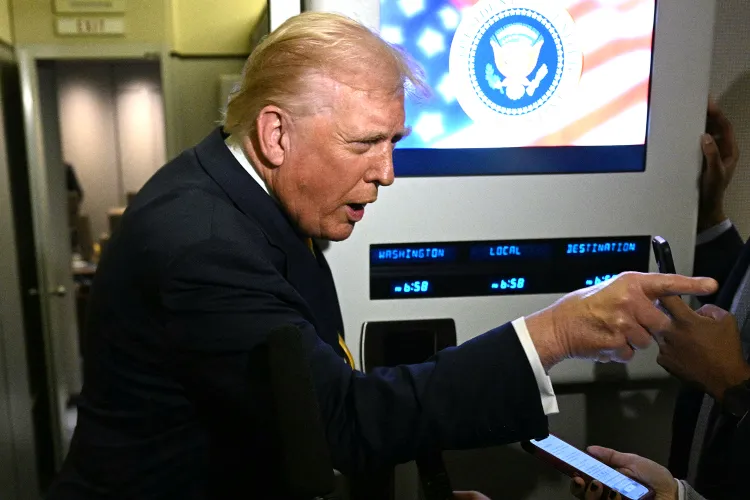
The most recent string of incidents began aboard Air Force One on Friday, Nov. 14. While Trump, 79, was fielding questions from a group of reporters, Bloomberg’s Catherine Lucey asked whether there was anything “incriminating” in the Epstein emails.
Trump responded by jabbing a finger in her direction and snapping, “Quiet. Quiet, Piggy.”
The insult is one of his long-standing favorites, but hearing it from a sitting president in response to a legitimate question still shocked many observers.
In a subsequent statement, a White House official defended Trump’s reaction, claiming that Lucey “behaved in an inappropriate and unprofessional way towards her colleagues on the plane,” and adding, “If you’re going to give it, you have to be able to take.” The official did not explain what behavior they were referring to. CNN’s Kaitlan Collins, a prominent member of the White House press corps, publicly backed Lucey, saying she does “a great job.”
:max_bytes(150000):strip_icc():focal(784x157:786x159):format(webp)/donald-trump-air-force-one-110325-9d600087a0d146c99a747dca6fdf7441.jpg)
White House press secretary Karoline Leavitt later reinforced the president’s remarks when asked about the “piggy” comment in a press briefing, framing it as a sign of his blunt honesty.
“He calls out fake news when he sees it. He gets frustrated with reporters when you lie about him, when you spread fake news about him and his administration,” Leavitt, 28, said. “But he also is the most transparent president in history, and he gives all of you in this room, as you all know, unprecedented access.”
“I think the president being frank and open and honest to your faces, rather than hiding behind your backs, is frankly a lot more respectful than what you saw in the last administration,” she continued. “I think everyone in this room should appreciate the frankness and the openness that you get from President Trump on a near-daily basis.”
Two days after the “piggy” remark, as Trump and reporters returned from a weekend trip to his Mar-a-Lago resort in Florida, he clashed again with a female journalist while answering a question about Tucker Carlson’s recent interview with far-right podcaster Nick Fuentes.
“Well, I found him to be good. I mean, he’s said good things about me over the years. He’s, I think he’s good,” Trump said of Carlson. “We’ve had some good interviews. I did an interview with him where we had 300 million hits.”
When a woman attempted a follow-up, Trump paused, visibly irritated. “Will you let me finish my statement? You are the worst.”
“You’re with Bloomberg, right?” he continued. “You are the worst. I don’t know why they even have you.”
The cameras did not show which reporter he was addressing, leaving it unclear whether he was once again going after Lucey or targeting another woman in the press pool.
Trump’s combative approach continued during an Oval Office press conference with Saudi Arabian Crown Prince Mohammed bin Salman on Nov. 18. As ABC News’ Mary Bruce tried to ask a question about Epstein, Trump quickly turned his attention on her.
“You know, it’s not the question that I mind. It’s your attitude,” he told Bruce. “I think you are a terrible reporter. It’s the way you ask these questions…”
“You’re a terrible person and a terrible reporter,” he added later in the exchange. “As far as the Epstein files, I have nothing to do with Jeffrey Epstein. I threw him out of my club many years ago because I thought he was a sick pervert.”
“People are wise to your hoax,” Trump said, before shifting to a threat aimed at her employer: “I think the license should be taken away from ABC because your news is so fake and is so wrong. And we have a great commissioner, a chairman, who should look at that.”
Over the course of his response to Bruce, Trump told her she “ought to go back and learn how to be a reporter” and announced that he was finished taking her questions.
On Wednesday, Nov. 26, Trump moved the fight to social media, lashing out at The New York Times and its White House correspondent Katie Rogers on Truth Social. He appeared to be reacting to a story she helped write about him confronting the “realities of aging in office.” The article mentioned a viral clip in which Trump looked as if he might be dozing off during an official event — a characterization he has denied.
“The Creeps at the Failing New York Times are at it again,” Trump wrote. “The writer of the story, Katie Rogers, who is assigned to write only bad things about me, is a third rate reporter who is ugly, both inside and out.”
He described the piece as a “hit” job and labeled the Times an “ENEMY OF THE PEOPLE.”
The New York Times responded in a statement issued later the same day: “The Times’s reporting is accurate and built on firsthand reporting of the facts. Name-calling and personal insults don’t change that, nor will our journalists hesitate to cover this administration in the face of intimidation tactics like this.”
The statement went on: “Expert and thorough reporters like Katie Rogers exemplify how an independent and free press helps the American people better understand their government and its leaders.”
The White House, meanwhile, offered its own statement: “President Trump has never been politically correct, never holds back, and in large part, the American people re-elected him for his transparency.
“This has nothing to do with gender,” the spokesperson added. “It has everything to do with the fact that the President’s and the public’s trust in the media is at all time lows.”
:max_bytes(150000):strip_icc():focal(745x227:747x229):format(webp)/donald-trump-katie-rogers-112625-86c4df1599d341a4aca5c4e7b932baf8.jpg)
Trump’s hostility toward the press is hardly new — his “fake news” refrain is nearly a decade old — but these recent episodes underscore a longstanding pattern in how he talks to and about female journalists in particular.
That pattern stretches back to his first presidential run. During the 2016 Republican primaries, Fox News anchor Megyn Kelly moderated a debate and opened by asking Trump about his past comments on women. She quickly became a target.
“I have zero respect for Megyn Kelly,” Trump later said in an interview with Fox News. “I don’t think she is very good at what she does. She’s highly overrated.”
In another now-infamous moment, he implied she was menstruating during the debate: “There was blood coming out of her eyes, blood coming out of her wherever,” he told CNN.
In response to those attacks on Kelly, Elisa Lees Munoz, executive director of the International Women’s Media Foundation, told The Independent, “We know that he does not discriminate on gender with regards to his criticism and his attacks, but we have particularly noticed the way that he attacks female journalists.
“It is a very gendered attack, which really demonstrates some misogynistic tendencies that we see online and in the streets every day,” she added. “It is really designed to shut them up, to try to get them to stop working, to belittle, to humiliate.”
During Trump’s first term, his treatment of Black female reporters became a flashpoint. In November 2018 alone, three separate exchanges with Black women journalists went viral — notable in part because so few Black women are represented in the White House press corps.
:max_bytes(150000):strip_icc():focal(749x0:751x2):format(webp)/donald-trump-1-091725-26357d9ae1fc4a99af1651b34eff4902.jpg)
“When he goes after Black women because their numbers are so few, it just stands out more,” Northwestern journalism professor Ava Thompson Greenwell, Ph.D., told The Independent.
Two of those clashes occurred in the same Nov. 9 press conference. At one point, Trump launched into a tirade about CNN contributor April Ryan, then a White House correspondent for American Urban Radio Networks.
“You talk about somebody that’s a loser,” he said of Ryan. “She doesn’t know what the hell she’s doing.”
Later in that briefing, he turned on CNN’s Abby Phillip after she asked a question about special counsel Robert Mueller’s investigation into Russian interference in the 2016 election.
“What a stupid question that is. What a stupid question,” Trump said. “But I watch you a lot, you ask a lot of stupid questions.”
:max_bytes(150000):strip_icc():focal(749x0:751x2):format(webp)/donald-trump-karoline-leavitt-112625-1-e4bfb721117b4440b0689c0eda0c4ee5.jpg)
Phillip later said on CNN, “It’s part of a pattern and it is a really clear pattern that’s been going on for years now. He seems to not be tolerant of taking difficult questions, particularly from women.”
Another frequent target has been PBS journalist Yamiche Alcindor, also a Black woman. In November 2018, Trump accused her of being “racist” for asking whether his use of the word “nationalist” on the campaign trail could embolden White nationalists.
Two years later, at the height of the COVID era, Trump again went after Alcindor when she pressed him on the administration’s pandemic response, saying she was being “threatening” with her questions.
“It’s always getcha, getcha… And you know what? That’s why nobody trusts the media anymore,” he said. When she tried to clarify, he interrupted again.
“Excuse me. You didn’t hear me. That’s why you used to work for the Times and now you work for someone else,” Trump said. “Look, let me tell you something: Be nice… Don’t be threatening. Be nice.”
Thompson Greenwell says these interactions go beyond casual insults or offhand slights.
“What he does is what we would call a micro-assault,” she explained. “It’s not subtle at all. It’s direct, it’s in your face, it’s a tongue lashing, it’s meant to cause harm. And that’s the definition of a micro-assault.”