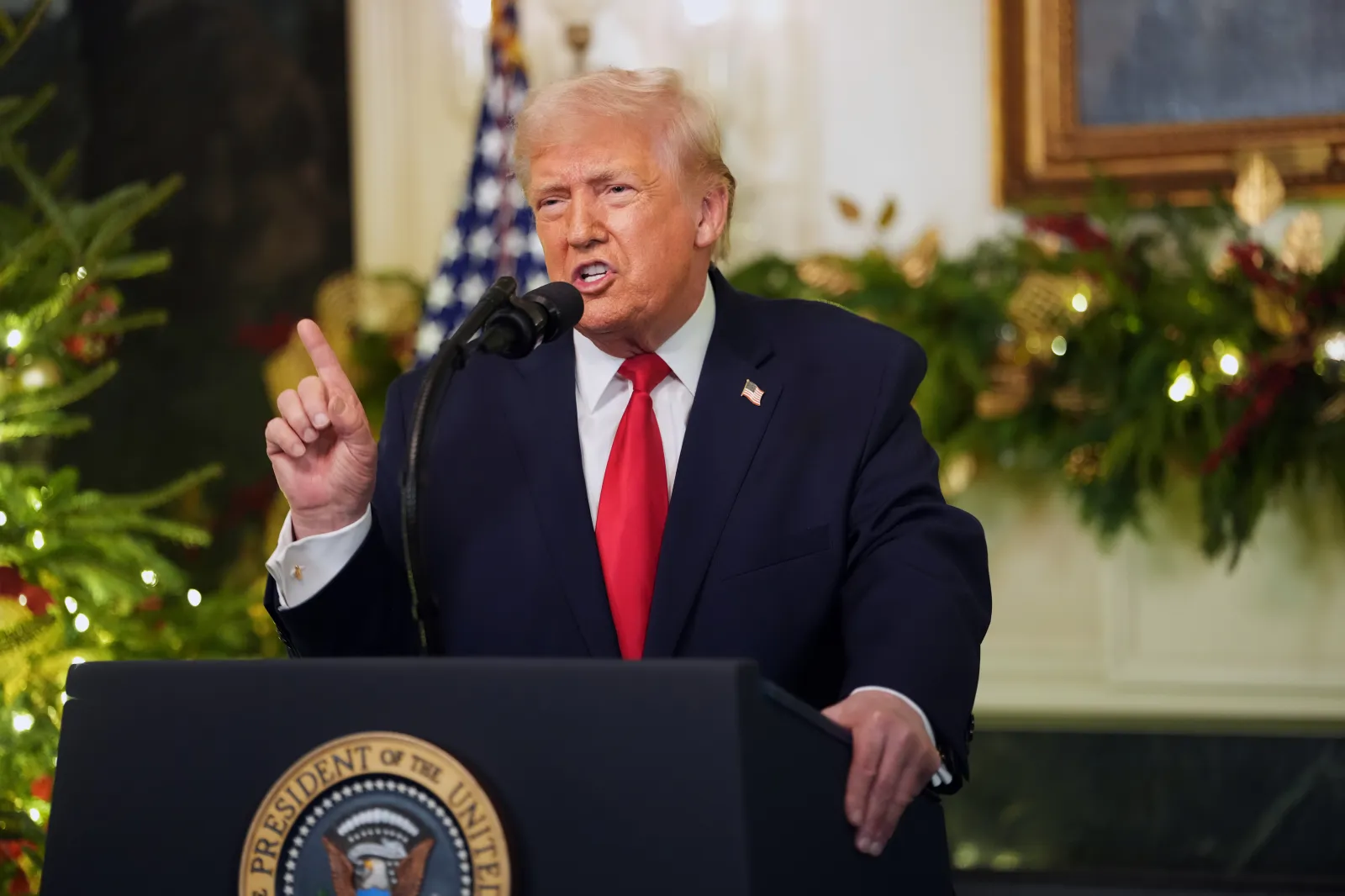

President Donald Trump opened his national address Wednesday night with a familiar line he’s used repeatedly since returning to office nearly a year ago: “I inherited a mess.”
In a fast-moving 18-minute speech that jumped from the economy to immigration, energy, housing, health care and crime, Trump portrayed the country as rebounding sharply under his leadership. He paired that message with a long run of promises—and boasts—about what he says the next year will bring.
The address came at a politically sensitive moment. Trump is facing slipping approval ratings and growing pressure from members of his own party to steady the economy and reconnect with voters frustrated by high costs. Polling continues to show inflation, slower hiring and affordability as key concerns, and some advisers have pushed him to sharpen his economic pitch ahead of the 2026 midterms.
Rather than laying out new policy in detail, Trump relied on sweeping statements about prices, border security, the job market and the 2024 election. He described a country that had been “absolutely dead” before his return—and now, he said, is “the hottest anywhere in the world.”
Some of the claims he highlighted were rooted in real data but framed in exaggerated terms. Others were misleading or not supported by publicly available information. Below are five examples that don’t hold up as presented.
Immigration: The ‘25 Million’ Figure Isn’t Supported by Available Data
Trump said 25 million migrants entered the U.S. under President Joe Biden, calling it an “invasion.” But U.S. Customs and Border Protection (CBP) recorded fewer than 11 million total encounters during the Biden administration, a number that includes millions of expulsions. Even adding the estimated 2.2 million “gotaways” cited by House Republicans, the total still falls well short of 25 million.
Trump also said 11,888 “murderers” entered the country. That number comes from a statistic used out of context: U.S. Immigration and Customs Enforcement has reported roughly 13,000 noncitizens with homicide convictions on its docket, but that figure spans more than four decades and includes people who are already incarcerated, deported, or otherwise not newly arriving.
Inflation: Cooling, Not ‘Stopped’
Trump told viewers he had “stopped” inflation after inheriting “the worst” in U.S. history. Government data does not support that claim. According to the Bureau of Labor Statistics (BLS), inflation was up 3 percent in the 12 months ending in September.
That’s lower than much of the 1970s and early 1980s, when year-over-year inflation peaked at 14.8 percent in 1980 under President Jimmy Carter. The highest recorded annual inflation in the U.S. was in 1920, when it reached 23.7 percent. Inflation has eased from its 2022 peak, but prices are still rising.
Gas Prices: $1.99 Isn’t a Statewide Average Anywhere
Trump claimed gasoline had fallen to $1.99 per gallon in “three or four states.” But the national average was $2.94 as of mid-December, according to AAA. Some individual stations did advertise prices below $2 in parts of Oklahoma, Texas, Mississippi and Missouri, but no state’s average price is anywhere near $1.99.
Investment: He Cited $18 Trillion, While the Administration’s Log Shows Far Less
Trump said his administration had secured $18 trillion in new U.S. investments since taking office. But a review of the White House figures posted online shows $9.6 trillion in investment announcements through December 10. Economists note that even that total includes early-stage pledges and proposals—not confirmed capital already flowing into the economy—and shouldn’t be treated as finalized investment.
Trump also called his tax cuts the “largest in American history,” a claim the record doesn’t support. While the 2025 tax law is significant, it is smaller than earlier packages, including President Ronald Reagan’s 1981 tax cut, which reduced taxes by about 3.5 percent of gross domestic product.
Jobs: A True Statement That Leaves Out Key Context
“More Americans are working today than at any time in the history of our country,” Trump said. The raw number is higher, largely because the population is larger. But a commonly used gauge—the employment-to-population ratio—has slipped slightly this year, falling from 60.1 percent in January to 59.7 percent in September, according to the BLS.
Where His Claims Had Some Basis—But Went Too Far
Not everything Trump said was flatly wrong. Several claims aligned with underlying trends, though the way he described them overstated the reality.
Egg prices have fallen sharply in 2025. According to the U.S. Department of Agriculture, the average wholesale price for a dozen large white eggs dropped more than 80 percent, driven largely by stabilizing supply after the avian flu outbreak. Retail prices also declined, though not as dramatically. The average price for a dozen Grade A eggs fell to about $3.48 in September, the lowest since November 2024.
Border crossings are down compared with earlier in the year. Trump reinstated strict “Remain in Mexico” asylum rules and other measures that reduced illegal crossings dramatically (reportedly by more than 90 percent). Internal Department of Homeland Security reports indicated daily border apprehensions fell by 96 percent compared with late 2022. But Trump’s claim that “zero illegal aliens” have entered the country for seven months isn’t accurate: CBP data shows some asylum-seekers are still being processed and paroled, though in smaller numbers than before.
Trump also said he had “settled eight wars,” pointing to places such as Gaza, the Caucasus and parts of Africa. The U.S. has participated in peace talks and supported ceasefires—including an agreement between Armenia and Azerbaijan—but many of the conflicts he cited remain active, and none were formally concluded with a peace treaty.
What He Didn’t Mention: Venezuela Went Unaddressed
Several major foreign policy issues were absent from Trump’s year-end address. Many observers expected comments on Venezuela, particularly after he announced a naval blockade just 24 hours earlier. He also did not address the war in Ukraine or outline the administration’s approach to China and Russia.