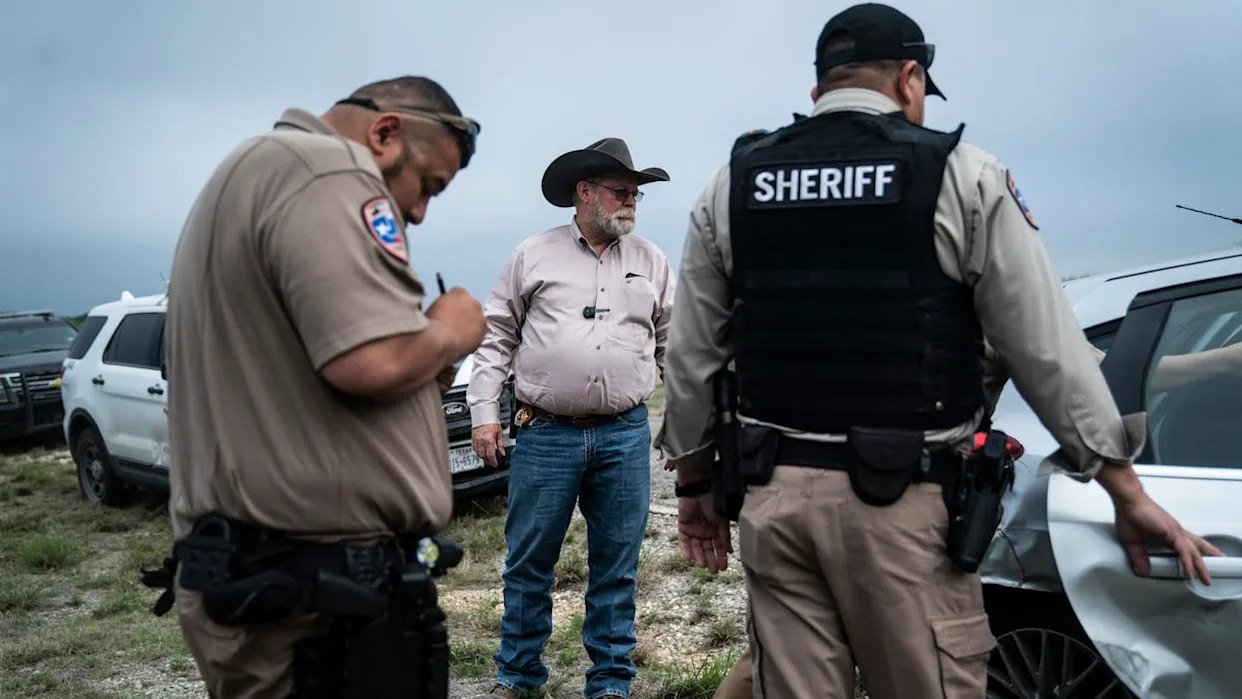

In the opening months of his second term, President Donald Trump has moved aggressively to scale up mass deportation efforts, promising what he calls “the largest deportation operation in the history of our country.” A key part of that operation is the expansion of the federal 287(g) program — a decades-old initiative that allows U.S. Immigration and Customs Enforcement (ICE) to deputize local law enforcement officers as immigration agents.
Originally created in 1996, the 287(g) program enables trained local officers to question people about their immigration status and detain them for ICE, often leading to deportation proceedings. Since Trump returned to office in January 2025, the number of 287(g) agreements has ballooned from 135 in 25 states to 628 agreements in 40 states as of late May — a nearly fivefold increase.
Supporters of the expansion say it’s necessary to secure communities and combat drug trafficking. “Illegal immigration has wide-ranging consequences, including a troubling surge of dangerous drugs into our state,” said Jacksonville, Florida Sheriff T.K. Waters in a February statement, defending his department’s participation in the program. “We remain committed to partnering with President Trump’s administration to protect Floridians.”
Departments from Jackson County, Texas, to Frederick County, Maryland, are following suit. But critics argue that expanding 287(g) will undermine public safety — not enhance it — by eroding trust between immigrant communities and law enforcement.
A Precedent with Consequences
Historically, the federal government has turned to local police to help enforce immigration laws during times of economic or political stress. In the 1930s, local agencies helped deport nearly 1.8 million people to Mexico during the Great Depression — including many U.S. citizens. And in 1954, President Dwight D. Eisenhower’s Operation Wetback resulted in over 1 million deportations, often with help from local police forces.
President Barack Obama also used 287(g) during his tenure, but with a more targeted focus on recently arrived immigrants or those already in custody. At its peak, the program had 76 agreements under Obama, later dropping to just 35 by the end of his presidency.
Still, the program has had a checkered history. A 2008 Justice Department investigation found the Maricopa County Sheriff’s Office in Arizona had violated the civil rights of Latinos through racial profiling and unconstitutional detentions under Sheriff Joe Arpaio’s aggressive 287(g) enforcement.
Community Policing in Jeopardy
For decades, police leaders in major cities have emphasized the importance of building trust with immigrant communities to fight crime more effectively. The 287(g) program, many argue, does the opposite.
In 1979, Los Angeles Police Chief Daryl Gates issued Special Order 40 to prohibit officers from enforcing immigration law — a move designed to encourage cooperation from immigrant residents. Cities like San Francisco, Chicago, and Seattle adopted similar policies. In 2016, then-Seattle Police Chief Kathleen O’Toole prohibited officers from even asking about a person’s immigration status. Milwaukee’s then-police chief Ed Flynn said his department refused to enforce immigration laws because doing so would erode public trust.
Even conservative voices like George Kelling, co-author of the influential “broken windows” theory of policing, opposed using local cops for immigration enforcement. In a 1999 study, he praised San Diego’s decision to prioritize community trust over immigration crackdowns.
William Bratton, former police chief in Boston, Los Angeles, and New York, warned in a 2009 op-ed that turning officers into immigration enforcers “undermines their core public safety mission.”
Do Deportations Make Communities Safer?
Despite President Trump’s repeated claims that undocumented immigrants pose a crime threat, research consistently finds that they commit crimes at lower rates than U.S.-born citizens. Studies also question the effectiveness of immigration enforcement programs like 287(g) in reducing crime.
A 2018 analysis from the libertarian Cato Institute found no link between 287(g) and crime reduction. Similarly, a 2014 study of the Secure Communities program — which requires local police to share arrestee data with ICE — found no measurable effect on crime rates in medium to large cities.
Nonetheless, Trump has revived and expanded these efforts, reversing a broader trend among big-city departments toward community-based policing. Critics say this threatens to alienate immigrant communities and make cities less safe overall.
“The expansion of 287(g) ignores decades of progress in policing and community trust,” one criminal justice scholar noted. “By deputizing local officers to enforce federal immigration law, we risk pushing entire communities further into the shadows — and making us all less safe in the process.”