
Federal authorities have made an arrest in the nearly five-year investigation into who planted pipe bombs in Washington, D.C., on the night before the Jan. 6, 2021, attack on the U.S. Capitol, a law enforcement official told The Associated Press.
It is the first time investigators have identified and detained a suspect in a case that has confounded authorities for years, fueled countless conspiracy theories and lingered as one of the most persistent mysteries tied to the violent Capitol riot.
The official, who spoke on condition of anonymity because the case has not yet been publicly announced, said the arrest took place Thursday morning and that the suspect is a man. No additional details were immediately available, including what charges he may face.
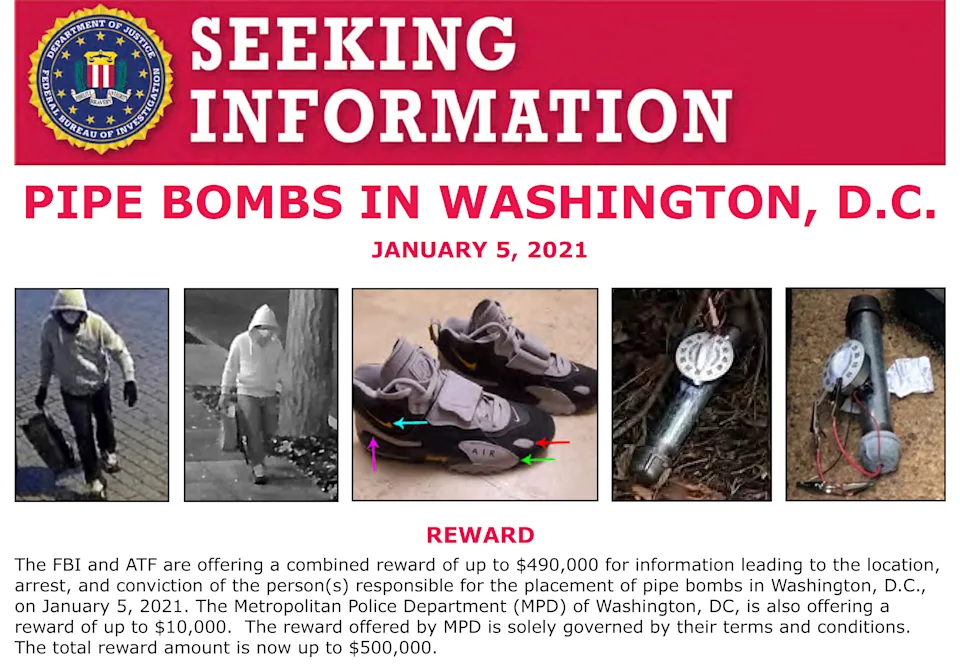
The two pipe bombs were placed on the evening of Jan. 5, 2021, near the headquarters of the Democratic National Committee and the Republican National Committee in Washington. Although no one was injured before bomb squads rendered the devices safe, the FBI has said both could have been deadly.
In the years since, investigators have repeatedly appealed to the public for help, releasing surveillance images and video of a hooded figure carrying a backpack and moving through the neighborhood. Yet even basic questions — the person’s gender, motive and whether the bombs were directly linked to the Capitol attack the next day — remained unanswered as supporters of then-President Donald Trump stormed the building in an attempt to block certification of his 2020 loss to Joe Biden.
Seeking fresh leads, the FBI last January released more information, including an estimate that the suspect was about 5 feet 7 inches tall and additional video showing the individual placing one of the devices.
Despite hundreds of tips, tens of thousands of video files reviewed and extensive interviews, the bureau had long struggled to zero in on a suspect.
In that vacuum, conspiracy theories flourished. Some Republican lawmakers and right-wing commentators questioned how law enforcement failed to find the devices for roughly 17 hours and suggested there might have been something more nefarious at play. Dan Bongino, now the FBI’s deputy director, suggested last year before taking his current role that the incident might have been an “inside job” and part of a “massive cover-up.”
Since joining the FBI in March, Bongino has tried to reassure skeptical voices on the far right by emphasizing that resolving the pipe bomb case would be a top priority and by defending the bureau’s efforts.
“We brought in new personnel to take a look at the case, we flew in police officers and detectives working as TFOs (task force officers) to review FBI work, we conducted multiple internal reviews, held countless in person and SVTC meetings with investigative team members, we dramatically increased investigative resources, and we increased the public award for information in the case to utilize crowd-sourcing leads,” he wrote in a lengthy post on X last month.