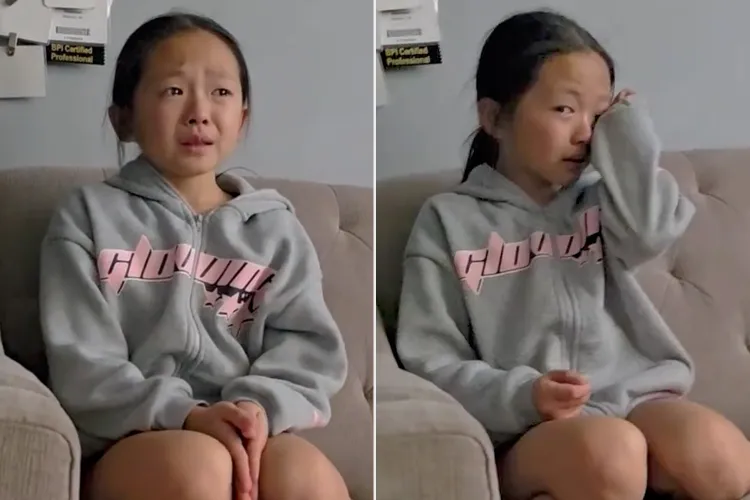

When Christa Thao picked up her daughter, Adi, from dance practice, she couldn’t wait to hear about her day.
But instead of Adi’s usual bubbly self, the elementary schooler sat quietly on the couch. After a long pause, she worked up the courage to ask a question that stopped her mom cold: “Mom… why are people mean to Asians?”
“At first, I was confused. I asked her what she meant,” Thao says. “That’s when she began to cry and told me that a group of girls she considered her friends had been making fun of her eyes — pulling their eyes back to mock Asian eyes.”
In a video that later drew 3.5 million views, Adi tearfully explained that the bullying wasn’t a one-time incident. She said it kept happening, including during gym and music class — and even in the classroom.
:max_bytes(150000):strip_icc():focal(399x0:401x2):format(webp)/christa-thao-adi-bullying-122325-4-bb29989e53054920a11f9078f9ac0987.jpg)
Thao says the students also made racist comments, including calling Adi and another Asian student “sisters” and pretending to confuse other Asian girls for her simply because they shared similar facial features.
“Adi loves her eyes. She loves being Hmong. She is proud of who she is,” Thao says. “What hurt her was not her identity… it was being made fun of for it. Through tears, she told me, ‘Mom, it hurt me.’ ”
Adi asked the girls to stop. Thao says it didn’t.
“This was not about ignorance or kids not knowing better,” she adds. “They knew it was racist.”
Seeing how deeply her daughter was hurting, Thao decided to record Adi’s reaction — not to put her on display, she says, but to capture what was happening and to help the school understand the real impact.
“I could have sent an email or written a message, but I didn’t believe words alone would show the depth of the hurt she was carrying,” Thao explains. “That video captured what a child in pain looks like when she finally feels safe enough to speak.”
:max_bytes(150000):strip_icc():focal(465x0:467x2):format(webp)/christa-thao-adi-bullying-122325-2-de6a994d9f2e4a489c06e3652d9dd412.jpg)
That night, around 8 p.m., Thao emailed the principal, associate principals, school counselors and superintendent.
She says the principal responded quickly and reiterated the school’s zero-tolerance stance on bullying. The following morning, an associate principal began an investigation.
“The school first met with Adi to ensure she felt heard, supported and protected,” Thao says. “Then they spoke with the students involved and notified their parents. Measures were put in place to monitor the situation and ensure the behavior does not continue.”
At home, Thao and her husband had a direct conversation with Adi about bullying — and what real friendship looks like.
“As an Asian-American mother, this experience reinforced something I already knew but never wanted my child to learn this way: intent does not erase impact,” she says. “Even when people try to minimize these actions, the hurt remains… especially for a child still learning who she is and where she belongs.”
:max_bytes(150000):strip_icc():focal(665x0:667x2):format(webp)/christa-thao-adi-bullying-122325-5-88404f5b803a459da857d952830c66fd.jpg)
They also emphasized that Adi could always come to them with anything on her mind.
“We reminded her that our Asian eyes are beautiful, that hers are perfect, and that no one should ever make her feel ashamed of who she is,” Thao says. “We told her how strong she is, how talented she is, and how deeply loved she is by her family.”
While she’s grateful for the school’s quick response, Thao says the experience highlights the need to confront “identity-based bullying” directly — and early.
“I shared her story because children experience this kind of harm quietly every day, often without the words or support to speak up,” she says. “If my daughter’s story helps even one child feel seen, or one adult take action sooner, then her voice mattered.”