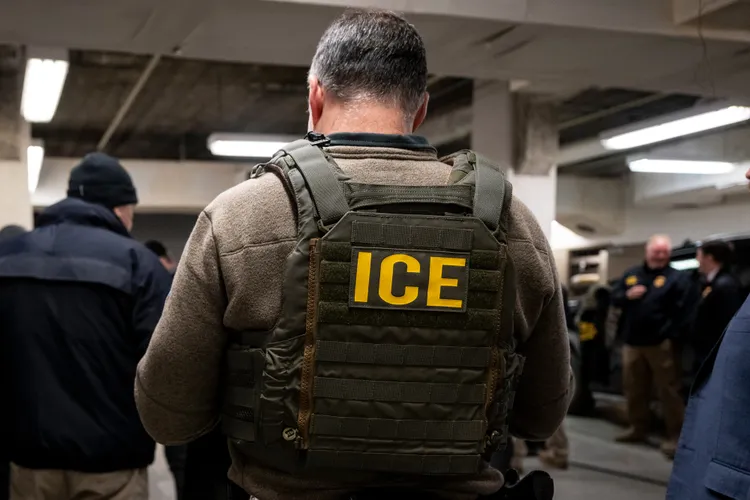

After a 37-year-old mother was shot and killed in Minneapolis on Jan. 7, renewed scrutiny is focusing on how Immigration and Customs Enforcement (ICE) is training new recruits — and whether those programs have been shortened.
An August 2025 report by The Atlantic’s Nick Miroff said new ICE deportation officers once received roughly five months of federal law-enforcement training, but that the administration reduced the length significantly, including by dropping Spanish-language instruction in favor of other approaches. The story also reported that academy training had been reduced to 47 days, a number the report said was selected because Donald Trump is the 47th president. It added that the updated schedule runs six days a week for eight weeks, citing DHS officials.
Asked about the training timeline, a senior DHS official disputed that it had been cut, saying training for Enforcement and Removal Operations officers is eight weeks long. No further clarification was immediately provided, even though eight weeks aligns with the timeframe described in The Atlantic report.
In a statement, DHS described an updated ICE training model that it said is designed to scale up hiring and modernize instruction. The official said the Federal Law Enforcement Training Centers (FLETC) are preparing to accommodate 11,000 new hires by early next year, and that ICE has “streamlined” its program to reduce redundancy while incorporating technology.
The official said no subject areas have been removed, and that candidates are still expected to meet longstanding standards. The statement said prior language classes — described as focused on a specific Spanish dialect — have been replaced by translation and interpretation services intended to support multiple languages.
:max_bytes(150000):strip_icc():focal(749x0:751x2):format(webp)/renee-nicole-good-vigil-010826-2-bf9154933795459aa102be56b68e5eeb.jpg)
DHS also said it is building a mandatory, tracked on-the-job training program, monitored online, aimed at helping new hires apply what they learn in training to real-world scenarios. The statement added that offices are staffed with senior personnel who mentor and coach officers, portraying ongoing training as central to agency standards.
The debate intensified after Homeland Security Secretary Kristi Noem said Thursday that the ICE officer who killed Renee Nicole Good in Minneapolis “followed his training.” Noem has faced criticism over what detractors describe as highly visible operations in the cities where federal agents are deployed.
A day before the Minneapolis enforcement actions that preceded Good’s death, the DHS account on X posted “GOOD MORNING MINNEAPOLIS!” to announce the arrival of officers. The Atlantic report also quoted an ICE official expressing frustration with what they characterized as a “cowboy” style of operations.
Good, a U.S. citizen, was shot while sitting in the driver’s seat of her vehicle during what appeared to be a confrontation with ICE agents, according to video captured from multiple angles. As the SUV moved forward, an agent fired multiple shots into the vehicle, fatally wounding her.
Following the shooting, DHS posted on X describing Good as a “domestic terrorist,” and said agents acted in self-defense.
Good’s mother, Donna Ganger, told The Minnesota Star Tribune that the circumstances of her daughter’s death were “so stupid,” and described her as deeply compassionate and caring.
ICE agents are also being accused of denying medical aid after the shooting.
Video obtained by The Huffington Post shows the moments after Good’s SUV crashed into a parked car. A man who identified himself as a physician asked officers if he could check Good’s pulse and was refused. In the brief clip, no one is seen providing medical treatment, though agents are heard saying emergency responders were on the way and that they had medics on scene.
On Jan. 8, multiple outlets reported that Minnesota investigators said the FBI was denying them access to evidence and refusing to conduct a joint investigation into the shooting.