
Unseating Venezuela’s president and installing more cooperative leadership looks like just the first step in what’s becoming one of the boldest U.S. energy bets in decades: trying to tap the country’s enormous resource base despite tight capital markets and a tangle of infrastructure damage and political risk.
Any lingering claim that Nicolás Maduro’s capture was solely about his alleged role in “narcoterrorism” against the U.S. faded quickly during President Donald Trump’s press conference on Saturday, held shortly after what he called an “extraordinary military operation.”
Within minutes, Trump pivoted to oil—mentioning it repeatedly as he described the nighttime raid, the lead-up, and his administration’s still-unclear plan to “run” the country after Maduro’s removal.
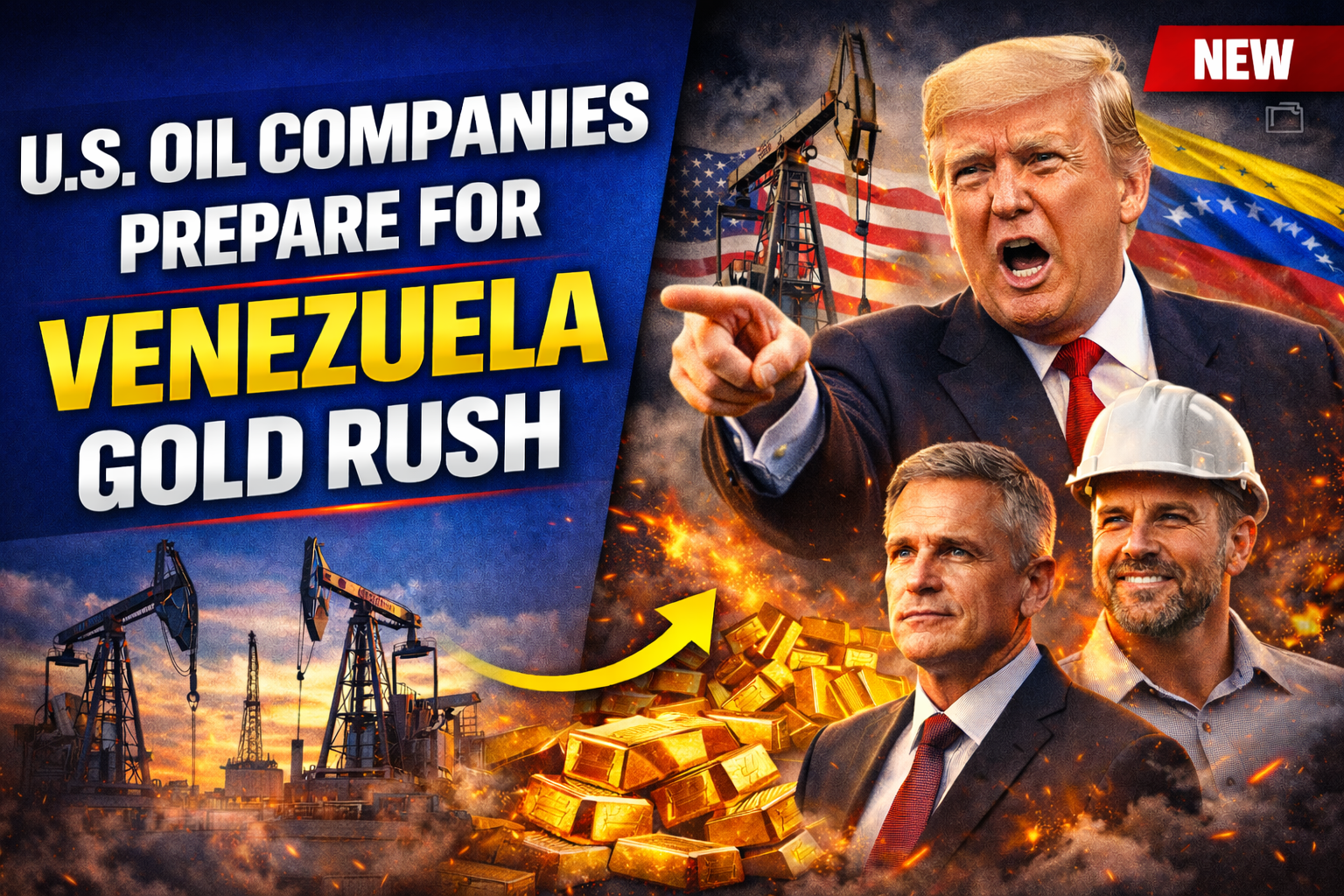
“We’re going to have our very large United States oil companies, the biggest anywhere in the world, go in, spend billions of dollars, fix the badly broken infrastructure, the oil infrastructure, and start making money for the country,” the president said.
He doubled down on Sunday aboard Air Force One, telling reporters he had spoken with U.S. firms “before and after” the operation and that Venezuela would soon see “big investments by the oil companies to bring back the infrastructure.”
Venezuela’s “Untapped” Bounty
Even before any public commitments from America’s oil majors, Trump has said Venezuela will be “turning over” up to 50 million barrels—worth more than $2 billion—to the U.S., with proceeds he claims would benefit citizens of both countries.
But rebuilding Venezuela’s battered energy system on the scale Trump describes would be enormously expensive. Rystad Energy estimates it could take about $183 billion to restore and modernize the sector. And despite Trump’s insistence that companies are eager—“they want to go in so badly,” he said Sunday—U.S. energy giants have so far been careful about signaling any rush into the country.
Chevron, the only American firm currently operating in Venezuela, said its focus is “the safety and well-being of our employees, as well as the integrity of our assets.” ConocoPhillips said it is “monitoring developments in Venezuela and their potential implications for global energy supply and stability,” but added that “it would be premature to speculate on any future business activities or investments.”
Security concerns remain acute, and the financial burden is massive. Still, Trump told NBC News that companies involved could potentially be reimbursed by the government for the “tremendous amount of money” needed to revive Venezuela’s oil industry.
The upside is hard to ignore. Venezuela holds the world’s largest proven reserves and sits relatively close to one of the world’s largest oil-consuming markets. For U.S. firms that can operate there safely and profitably, the payoff could be significant.
“U. S. oil companies, particularly those with a long history of operating in Venezuela, stand to benefit from access to the country’s substantial and largely untapped oil reserves,” said energy economist and policy adviser Carole Nakhle.
Nakhle, founder of the energy consultancy and research firm Crystol Energy, said companies like Chevron—already familiar with Venezuela’s fields—could potentially ramp up faster than newcomers. She noted that ExxonMobil and ConocoPhillips, which exited in 2007, still retain institutional knowledge of the geological and operational challenges that would have to be solved to unlock large-scale production.
Claudio Galimberti, chief economist at Rystad Energy, described the potential reward as a “big prize,” but emphasized it would be a long-term project. He argued it could still be strategically attractive because global oil supply and demand “will be in deficit already in the 2030s and 2040s under many scenarios.”
“Even though we will likely go through an oversupply phase in the second 2-4 quarters with low oil prices, in the long run, it makes sense to push for the development of Venezuela’s reserves,” he said.
There’s also unfinished business from Venezuela’s 2007 nationalization under President Hugo Chavez. ConocoPhillips and Exxon may seek to recover billions tied to debts and arbitration claims stemming from that period.
And the potential winners wouldn’t stop at the supermajors. Service and equipment providers that support drilling and refining—such as Halliburton, Baker Hughes, and Valero Energy—could also see gains if Venezuela opens up and production rises.
“I have owned Valero since 2020,” wrote “Big Short” investor Michael Burry in a Monday blog post, “and I am more resolved to holding it even longer after this weekend.”
The Hurdles for U.S. Oil Companies
Turning opportunity into production, however, would mean overcoming formidable obstacles.
“Significant capital will be needed to modernize outdated infrastructure, mitigate environmental concerns related to the country’s high-carbon heavy crude, and navigate the political and regulatory uncertainty that continues to surround the country,” Nakhle said.
Alan Gelder, senior vice president of Refining, Chemicals & Oil Markets at Wood Mackenzie, put it more bluntly: Venezuela offers the scale major producers want, but conditions on the ground make rapid expansion difficult. Heavy-crude economics at current prices, unresolved legal claims, and political uncertainty combine to create a risk profile that goes beyond typical operational challenges.
Galimberti described Venezuela’s infrastructure as being in “a horrific state after decades of mismanagement, underinvestment, and flight of know-how.” He also pointed to a classic “chicken and the egg” problem: major projects are costly and may deliver weak returns at today’s prices, which discourages investment—yet investment is exactly what’s needed to repair infrastructure and increase output.
“The new government will need to ensure law and order are reestablished and that it’s safe for foreign engineers and managers to work in the country,” he added. “The divestments by many [international oil companies] from places like sub-Saharan Africa over the past decade shows that law and order are critical conditions to be met for IOCs to operate in a country.”
Trump officials are reportedly already arranging meetings with energy executives to discuss Venezuela’s future, with the goal of moving quickly—possibly within an 18-month window Trump has floated—despite the scale of the challenge.
Galimberti said Rystad had “not yet” been consulted by the administration about a Venezuela initiative and, when asked whether the firm would participate, replied only: “It depends.”
“It is clear that growing curiosity exists across various sectors, not just oil, as the political and economic landscape shifts,” Nakhle said. “It will be interesting to see how this evolves over time.”
Still, Trump’s message about U.S. intent has been unmistakable. In a phone call with MS NOW’s Joe Scarborough on Monday, he told the Morning Joe host: “We’re going to keep the oil.”