
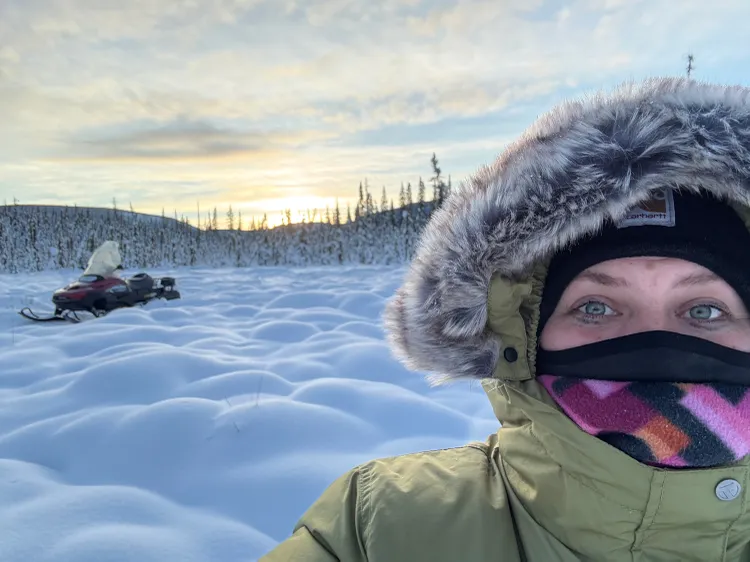

Olivia Jones and her family moved to Eagle, Alaska — a tiny community just past the end of State Highway 5 with roughly 100 residents — because they wanted to slow life down.
“The mile markers end and our house, you have to just keep going to get to us,” she says, describing how remote their home is. That detail also inspired her social media identity: on TikTok, she posts as @beyondthemilemarkers, sharing life on the edge of Alaska and the Canadian Yukon with 117,900 followers.
The family traded St. Louis, Missouri, for “The Last Frontier” after Jones’ husband’s IT job went remote during COVID. But the move wasn’t a sudden leap.
Jones had long ties to Alaska. Her grandfather went north in the 1970s for gold mining, and she grew up visiting. He stayed, and later her parents relocated too, settling in Alaska about 13 years ago. For Olivia and her husband, the idea of moving lingered for a while.
“We sat on it for quite a while, going back and forth, and trying to figure out: ‘What does it look like if we do this?’” she says.
:max_bytes(150000):strip_icc():focal(517x694:519x696):format(webp)/Alaska-Yukon-River-kids-012226-8b41629c13ce4217826d2a78d3a41515.jpg)
Choosing family time over busy time
The biggest question was how the change would affect their four children — and Jones says it did, “tremendously.” Back in Missouri, sports and coaching filled their schedule. In Eagle, the focus shifted.
“It changed from being on the sports field of family time to sitting at the table and playing board games and getting to know the kids,” she says.
The couple also wanted their kids to grow up with practical, hands-on skills that are part of daily life in their new environment.
“Coming here into the community, it just immerses you into hunting, fishing,” she explains. “People actually create their own everyday things in their life.”
Since arriving, the family has learned basket-weaving from a nearby Native village, along with knife-making, fur-sewing, and more — experiences Jones says feel more valuable than traditional extracurriculars.
“If you think about it, only 1% of kids get to go on and play further than high school,” she says. “And so we were like, OK, the first percentage is low, but we hope to set them up for a better life.”
:max_bytes(150000):strip_icc():focal(671x579:673x581):format(webp)/Alaska-sled-dogs-2-012226-85d42cd094a047a295267fea774d9752.jpg)
A school of 16 students — and K–12 learning together
Before committing, the family visited Eagle and toured the local school, which has only about 16 students. Jones says her kids were all in.
“They fell in love with it too,” she says.
Her mother is the teacher-principal, and the family likes the structure: students work independently on computers, then join a combined class where kindergarten through 12th grade learn together, with older kids helping the younger ones.
“They do their lesson on a computer, and then they shut it for the day and they do full class from K through 12 altogether,” she says.
One shared topic can become different assignments by age — from coloring worksheets for younger kids to capitals, governors, and deeper research for older students. Jones says the system has helped her kids thrive.
“They went out and actually did a plant ID class where everyone had to learn plants you can eat, plants you cannot,” she says, adding that they’re also learning how to read animal tracks in the snow — including what animal made them and how old they are.
:max_bytes(150000):strip_icc():focal(557x667:559x669):format(webp)/Alaska-building-012226-164cadc580b3408c8099b5b95067c31a.jpg)
The trade-offs: hauling water, heating with wood, and planning meals like logistics
Even with the benefits, Jones says the process of moving was “drawn out” because the sacrifices are real — and constant.
One early shock: their home isn’t on a well, so they haul “100%” of their water. There’s a free well in town, but it requires work. The family drives into Eagle, fills a built-in 125-gallon tank in their Bronco, then returns home and transfers the water into a holding tank in the basement.
Heating is another daily reality. A wood stove is the primary source, backed up by heating oil because Jones doesn’t feel comfortable relying only on wood — especially after a brutal stretch of cold.
“We just had the coldest December on record at 50 below for almost December,” she says. “The wood stove couldn’t keep up.”
Connectivity is limited too. Away from Wi-Fi, she says, there’s no calling and no service.
Food may be the biggest mental load. No fast food, no quick store runs — and cooking becomes non-optional.
“You genuinely have to think about, ‘OK, I have to lay out my meat to thaw.’ I have to prep and be ready because you’re not going to eat if you don’t have it ready to roll,” she says.
Once a year, they make a major supply trip. In September, Jones did what she calls the family’s last Costco run for the next 7–8 months, spending about $4,000 on staples like meat, flour, and sugar. The closest Costco — along with Walmart and fast food — is in Fairbanks, about 370 miles away and nearly nine hours of driving over three mountain ranges.
“The first half of the trip is completely on the side of a mountain,” she says. “It’s one lane, dirt road. It’s scary.”
For about seven months each year, that route is closed and unmaintained because conditions are too dangerous. During that period, they depend on a mail plane for supplies.
They place fresh grocery orders about once a month and pay by the pound to fly them in. Jones says the plane delivery fee runs about 78 cents per pound, and weather can cancel flights entirely.
Shopping took time to master. Now, Jones tracks everything with an Excel spreadsheet — counting pantry items, estimating usage per month, and planning future orders.
“Technically, we are non-residents still, so our hunting season didn’t happen for us this year, so we didn’t get any extra meat,” she says, meaning they may have to purchase meat later.
She estimates spending around $300 a month on mail plane orders, about $500 a month when breaking down the September Costco haul, and another $200 monthly via Walmart or Amazon.
:max_bytes(150000):strip_icc():focal(782x662:784x664):format(webp)/Alaska-cutting-fish-012226-fd3ab97725384d86a3528d77226990f2.jpg)
A town where people show up for each other
Jones says community support is what makes life work in Eagle. Volunteers drive the ambulance for emergencies. People step in to cook meals at the small school or help clean it. With no permanent doctor in town, medical and dental visits happen about every three months — and residents coordinate food and support for the visiting providers.
It also affects how the town handles hardship. During stretches of -50°F weather, Jones says rumors circulated about possible firewood theft — but she didn’t see that mindset locally.
“And, it’s like, ‘No, we are not.’ I will come drop you off a cord at your house,” she says.
Jones moved to Alaska hoping to slow down, and she admits it doesn’t always feel slow. But she says it feels focused.
Instead of simply doing less, the family feels they’re living with more purpose — “more intentional about life.”


