

MEXICO CITY—Ryan Wedding was on the run.
Mexican security forces were tightening the net around the 44-year-old Canadian, a former Olympic snowboarder who later landed on America’s most-wanted list. U.S. and Mexican officials familiar with the operation say Wedding is accused of overseeing a large cocaine-trafficking network and had long been protected by Mexico’s Sinaloa Cartel—until that protection evaporated.
When authorities caught up with him in Mexico last week, some of those officials said members of the FBI’s Hostage Rescue Team were also involved. Weeks earlier, the FBI’s elite, combat-trained unit participated in the capture of Venezuelan autocrat Nicolás Maduro at his heavily fortified compound in Caracas, those officials said.
Law-enforcement officers made contact with Wedding—who was considered armed and dangerous—and entered into intense negotiations, according to some of the officials. They told him that associates had been detained and millions of dollars in assets had been seized. Ultimately, said his attorney, Anthony Colombo, FBI agents handcuffed Wedding. He was then transported to California, where he pleaded not guilty in federal court to 17 felony charges, including murder.
The FBI’s role in the Jan. 22 operation was meant to remain highly classified, a U.S. official said. Mexican law prohibits foreign agents from being physically present in law-enforcement operations on Mexican soil or participating in detentions or raids. Mexico’s nationalist ruling party is especially sensitive to perceptions of foreign interference.

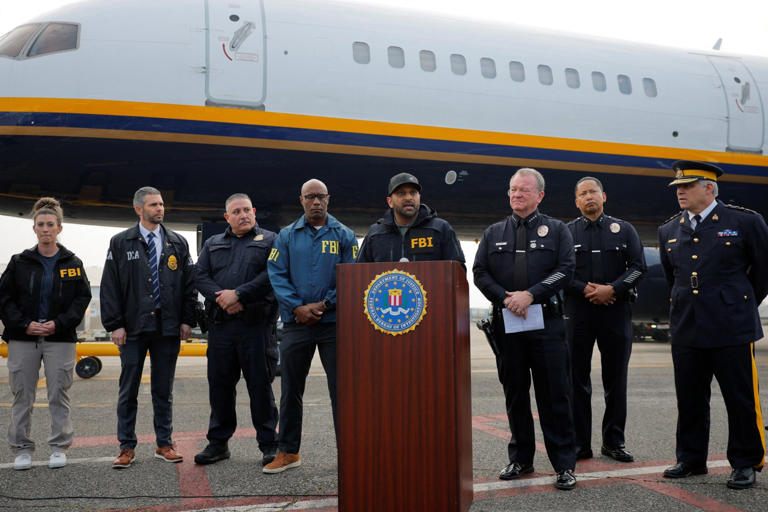
But on Friday, FBI Director Kash Patel publicly described the bureau’s participation on X.
Mexican President Claudia Sheinbaum moved quickly to contain the fallout on Tuesday. She pushed back on Patel’s account, insisting there was no U.S. involvement in the operation and emphasizing that U.S. agents in Mexico face clear legal limits.
“I’m not going to get into a debate with the FBI director, nor do I want there to be a conflict,” Sheinbaum said at her daily news conference on Tuesday. “What they, the U.S. authorities, told the Mexican authorities is that it was a voluntary surrender.”
Sheinbaum also referenced an Instagram photo that appeared to show Wedding outside the decommissioned U.S. Embassy building, posted Friday with a caption suggesting he was turning himself in. Asked whether the images might have been generated by AI, she said social-media companies had provided no indication that the photo was fake.
Colombo disputed Sheinbaum’s version, saying Wedding did not surrender at the embassy and that U.S. agents were directly involved. “He was arrested, he didn’t surrender,” Colombo said.
“If the U.S. government is unilaterally going into a sovereign country and apprehending somebody, you can understand the concern that sovereign entity might have,” Colombo told reporters outside the courthouse on Tuesday.
Wedding’s surrender “was a direct result of pressure applied by Mexican and U.S. law enforcement working in close coordination and cooperation,” said Ronald Johnson, the U.S. ambassador to Mexico.
The conflicting accounts come at a moment of heightened strain between Washington and Mexico City following the U.S. attack on Venezuela earlier this month. Since then, President Trump has threatened land strikes against Mexican cartels—remarks that have unsettled senior Mexican officials.
Sheinbaum confirmed details of The Wall Street Journal’s reporting on Thursday, but also said, without elaborating, that Mexico does not allow joint operations with the U.S. on Mexican soil.
“We collaborate, they give us information, we give them information, but the operations in our territory are carried out by Mexican forces,” she said after a telephone call with Trump. “We tell President Trump this every time, and they’ve seen that we’re making very good progress.”
Trump later said the conversation had been “very productive,” focused on border security, stopping drug trafficking and trade. “It went extremely well for both countries.”
Meanwhile, some Mexican and U.S. officials say the FBI is identifying additional targets in Mexico and wants to pursue joint operations with Mexican forces against major trafficking figures—another sign, they say, of Trump’s pressure campaign to expand U.S. reach against cartels inside Mexico.
U.S. officials also said Patel was in Mexico City last week, combining a high-profile visit with quieter coordination with Mexican partners during the operation involving Wedding.
Sheinbaum has already made several concessions to Trump aimed at avoiding punitive tariffs and preventing unilateral U.S. military action on Mexican soil. Those steps include strengthening border enforcement, imposing import duties on some Chinese products, and sending three separate planeloads of imprisoned drug lords to the U.S. outside the typical extradition process—an approach some legal experts have called illegal.
Wedding was transported to California in the same Justice Department aircraft that carried Maduro to New York from Guantanamo Bay after his capture, according to flight records and photos showing the aircraft’s tail number.
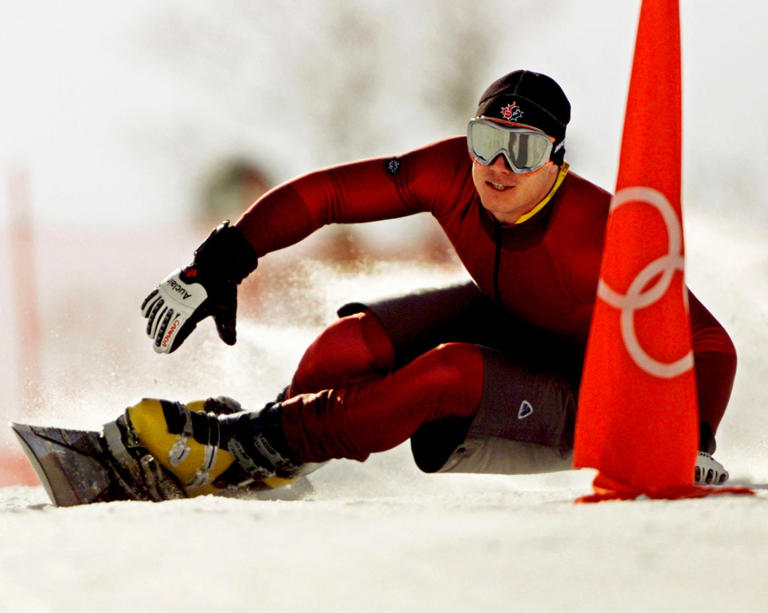
Born in Ontario, Wedding grew up in a middle-class family and represented Team Canada at the 2002 Winter Olympics in Salt Lake City, finishing 24th in the parallel giant slalom.
Canadian authorities have said his shift into criminal activity began with a marijuana-growing operation. In 2008, he tried to buy cocaine in California from an undercover U.S. law-enforcement agent and was convicted and sentenced to four years in prison. U.S. authorities say he built contacts there that later helped him establish a transnational cocaine-trafficking operation after his release.
Known in Mexican criminal circles as “Thor,” Wedding was placed on the FBI’s Ten Most Wanted Fugitives list with a $15 million reward.
He is believed to have lived in Mexico for years under the protection of Sinaloa Cartel operatives. Wedding has been wanted on cocaine-trafficking and murder charges since 2024, Patel said on X.
Authorities in both countries say Mexican law enforcement began closing in over the past several months. In December, Mexican security forces raided a warehouse filled with professional racing motorcycles allegedly owned by Wedding and estimated to be worth $40 million.
Last year, Andrew Clark—a Canadian national charged with drug trafficking and described by Mexican authorities as one of Wedding’s top lieutenants—was expelled by Mexico to the U.S. along with dozens of imprisoned cartel leaders and lieutenants.
Clark, known in drug gang circles as “the Dictator,” is now cooperating with U.S. prosecutors, according to court documents. Officials believe he provided information about Wedding’s operations and location.


