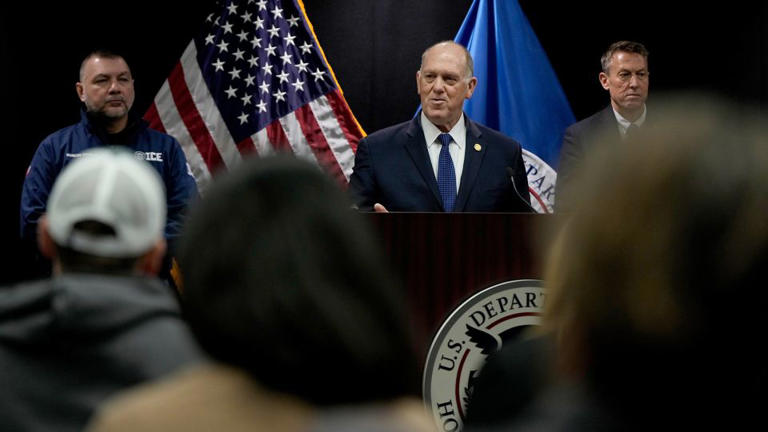

Even after a Thursday-morning press conference from Tom Homan — the new leader of President Donald Trump’s immigration crackdown in Minneapolis — it’s still unclear how much the mission will change in the wake of Alex Pretti’s killing.
What is clear: the administration is suddenly wary of the political fallout surrounding ICE and its enforcement tactics.
A series of developments — not only in Minneapolis, but also in Maine and Washington, DC — point to a shift in posture. Homan is signaling a smaller, more narrowly focused effort in Minneapolis. At the same time, Trump appears to be pulling out of another state where a similar enforcement push had begun. And in Washington, the White House and Republicans look unusually open to legislative concessions on immigration enforcement as they try to avoid a government shutdown.
A lot is still unresolved. Here’s where things stand.
Homan’s press conference
The central question is what changes, if anything, will be visible on the ground in Minneapolis.
Homan’s remarks on Thursday were short on details, but packed with hints that the operation may take a different direction. The most notable line: he said there would be a “drawdown.”
He didn’t say how quickly it would happen or how significant it would be, noting that a plan is still being developed. But he suggested a reduction is coming regardless — and that it could go further depending on what happens next.
“Yes, I said it,” Homan said. “Draw down the number of people here.”
“The drawdown is going to happen, based on these agreements,” he added. “But the drawdown can happen even more if the hateful rhetoric and the impediment and interference will stop.”
Homan also stressed repeatedly that the operations would be “targeted,” focusing on safety and national security risks — language that suggests less interest in broad sweeps or stopping people at random.
The administration has argued for months that its enforcement actions are already “targeted.” But Homan suggested the Minneapolis effort had drifted from that approach, saying it “got away from” being targeted “a little bit.”
He also made comments that sounded like a break from the administration’s earlier no-apologies posture.
“I do not want to hear that everything that has been done here has been perfect,” Homan said. He added that agents who fail to act professionally “will be dealt with,” and that the operation would be “safer” and “by the book.”
Those remarks could be read as a rebuke of the previous Minneapolis operation leader, Gregory Bovino, who said last week that “everything we do every day is legal, ethical, moral, well grounded in law.” They also contrast with White House adviser Stephen Miller’s earlier claim that ICE had “a flawless track record of deporting non-citizens.”
At the same time, Homan tried to frame any shift as refinement — not retreat. He criticized protesters’ rhetoric while acknowledging their right to protest, and emphasized the administration was “not surrendering” its mission.
“I’m staying till the problem’s gone,” he said.
Whether this represents real operational change or just messaging will become obvious quickly — especially with so much scrutiny now focused on what agents do next.
Pulling out in Maine
In another sign of political recalculation, Republican Sen. Susan Collins of Maine said Thursday morning that ICE was abruptly ending its recently expanded enforcement push in her state — which, like Minnesota, has a sizeable Somali population.
Collins had urged ICE to scale back efforts in both Maine and Minnesota.
The Maine deployment had always looked risky for the administration. Collins is pivotal to Republicans’ chances of holding the Senate in this year’s midterm elections, and heightened ICE activity carried the potential for backlash in a state where her political standing matters.
The pullback is striking because the ramp-up was announced only eight days ago — suggesting the White House may have concluded, even if late, that the move was politically costly.
The funding fight in Washington
The most consequential maneuvering may now be happening in Washington, where the White House and Republican leaders appear unusually willing to make concessions to Democrats.
CNN’s Manu Raju and Jeff Zeleny reported late Wednesday that the White House was moving toward Democrats’ demand to remove DHS funding from the larger spending package as a shutdown deadline approaches. That approach would prevent an immediate standoff over DHS funding — and leave negotiations over ICE restrictions to continue in the weeks ahead.
Republican leaders had dismissed the idea earlier this week. But Democrats, whose votes are needed to overcome Senate filibusters, have pressed hard. And even centrist Democrats who previously helped end last year’s shutdown have publicly aligned with leadership, rejecting attempts to negotiate separately.
That doesn’t mean Democrats will get every policy change they want. Senate Minority Leader Chuck Schumer laid out a list of demands Wednesday, including restricting roving patrols and agents’ ability to use force, requiring body cameras, and banning masks.
Still, Democrats appear to hold significant leverage at the moment — and Republicans aren’t projecting the usual defiance.
Democratic Sen. Brian Schatz of Hawaii said Republicans “seem to understand the gravity of the situation societally, and I’m confident we can land it.”
Acknowledging political reality
In many ways, this all looks like the White House reacting to a deteriorating political environment — especially as polling trends against it.
CBS News-YouGov polling has shown the share of Americans who say ICE is “too tough” rising from 53% in October to 56% in November to 61% after an ICE agent shot and killed Renee Good earlier this month.
A Reuters-Ipsos poll on Wednesday showed Trump’s approval on immigration falling to its lowest point across both of his terms, at 39%.
And a Fox News poll Thursday found that nearly as many Americans supported abolishing ICE (36%) as opposed it (42%) — with support for abolition now roughly double what it was when the “abolish ICE” movement gained traction in the late 2010s.
Trump has often pushed ahead even when polling turns negative — especially on issues he views as core to his brand. But this time, something appears different. On immigration enforcement, at least for the moment, the White House and Republicans seem to be edging toward compromise — and flirting with what could look, to their base, like capitulation.