

A new goal is gaining traction among anti-tax activists: ending property taxes for homeowners altogether.
Soaring home values have driven up tax bills in many states. But fully eliminating homeowner property taxes would leave major holes in state and local budgets — often in the billions, and in some states the tens of billions. That raises a central question for lawmakers: can they deliver sweeping tax relief without destabilizing schools and local governments that depend on property tax revenue to fund everyday services?
A growing push across states
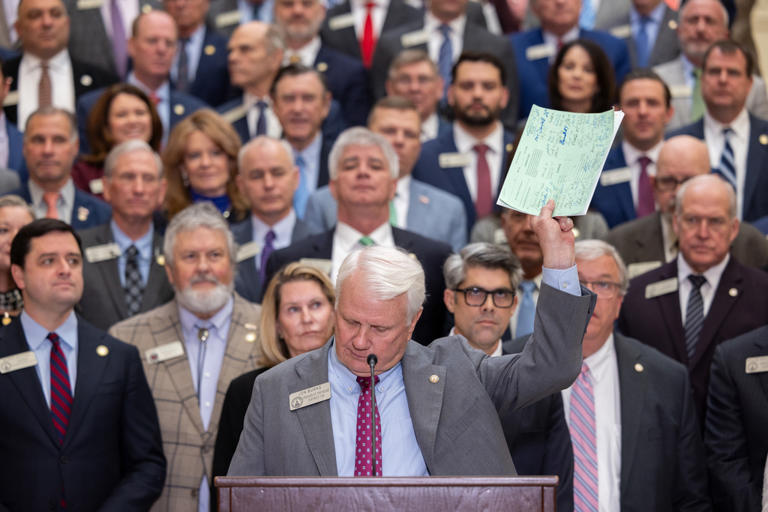
Republican leaders in several states are embracing the idea. In North Dakota, officials say they’re already moving toward eliminating homeowner property taxes, using oil revenue. In Georgia, House Republicans on Wednesday unveiled a detailed plan to phase out homeowner property taxes by 2032. In Florida, Gov. Ron DeSantis has said he wants to end the taxes, while lawmakers consider a proposal to phase out non-school property taxes on primary residences over a decade. And in Texas, Gov. Greg Abbott has said he wants to eliminate school property taxes.
Supporters frame the issue as a matter of ownership — arguing that if the government can seize a home for unpaid taxes, people never truly own their property.
“No one should ever face the loss of their home because they can’t pay rent to the government,” Georgia House Speaker Jon Burns said Wednesday.
An election-year tax revolt
The movement is also spilling into ballot campaigns. Organizers in Oklahoma and Ohio are pursuing initiatives to eliminate property taxes entirely. Similar efforts failed in North Dakota in 2024 and didn’t make the ballot in Nebraska that year, though organizers there are trying again. A proposed initiative in Michigan may also fall short of the ballot.
“We’re very much in this property tax revolt era, which is not unique, it’s not new. We’ve seen these revolts in the past,” said Manish Bhatt, vice president of state tax policy at the Tax Foundation, a Washington, D.C.-based group that is generally skeptical of new taxes.
Earlier waves of backlash helped fuel laws such as California’s Proposition 13, the 1978 measure that limited property tax rates and restricted how quickly local governments could raise assessed valuations for tax purposes.
The affordability pressure
For homeowners like Tim Hodnett, a 65-year-old retiree in Lawrenceville, Georgia, the appeal is straightforward. His annual property tax bill rose from $2,000 to $3,000 between 2018 and 2024. Because he paid off his mortgage years ago, the tax increases stand out even more — he pays the full bill at once rather than through monthly escrow payments.
Hodnett said he is disabled and living on $30,000 a year. He’s about to get relief because seniors in Gwinnett County are exempt from school property taxes, which make up about two-thirds of his bill. Still, he’d like the rest eliminated too.
“It would be nice to be exempt from property taxes,” Hodnett said.
The big question: What replaces the money?
The debate ultimately comes down to what happens to the revenue — and who fills the gap.
“I think the complete elimination of the property tax for homeowners is really going to be very difficult in most states and localities around the country, and undesirable in most places,” said Adam Langley of the Lincoln Institute of Land Policy, a Massachusetts nonprofit that studies land use and taxation.
In Florida, Chief Financial Officer Blaise Ingoglia, a Republican, has been traveling the state arguing that local governments are overspending and don’t need the roughly $19 billion they collect in homeowner property taxes — those paid on primary residences. Local governments dispute that claim.
North Dakota’s approach is more direct: it is using investment earnings from its $13.4 billion oil tax savings fund to reduce and eventually erase homeowner property taxes. Last year, the Republican-controlled Legislature expanded the state’s primary residence tax credit from $500 to $1,600 annually. Officials said in December that the credit eliminated property taxes for 50,000 households last year and lowered bills for nearly 100,000 more. The subsidies cost the state $400 million for the 2025 and 2026 tax years.
“It works, and we know we can build on it to provide even more relief and get property taxes to zero for the vast majority of North Dakota homeowners,” Gov. Kelly Armstrong said.
Texas and Georgia face tougher math. Texas has been relying on state surplus funds to reduce property taxes, while Georgia’s proposal would restructure the tax system more broadly.
Georgia’s plan: Shift from property taxes to sales taxes
Burns’ plan would eliminate $5.2 billion in homeowner property taxes — more than a quarter of the $19.9 billion in property taxes collected in Georgia in 2024 — and push cities, counties, and school districts to rely more heavily on existing or new local sales taxes.
Politically, the proposal faces a steep climb. It would require approval from Georgia’s Republican-led Senate and would also need Democratic support to meet the two-thirds requirement for a state constitutional amendment. After that, it would still need voter approval in November.
Even if it passes, questions remain. Most property taxes support schools, while in some communities most sales tax revenue does not. It’s unclear whether local governments would redistribute sales taxes to protect school funding. On top of that, local sales taxes in Georgia are capped at a combined 5%, in addition to the state’s 4% rate — which could leave some communities unable to raise enough replacement revenue.
Under the proposal, Georgia would increase the current $5,000 home value exemption to $150,000 by 2031, then abolish most homeowner property taxes in 2032. It would also cap annual property tax revenue growth at 3% on other types of property.
Local governments would still be allowed to bill homeowners annually for specific services such as garbage pickup, street lighting, stormwater control, and fire protection — though supporters argue these would not be “taxes.” Voters could also approve assessments for school or government improvements. Lawmakers have not yet decided whether unpaid assessments could lead to loss of a home.
Burns also wants to spend about $1 billion to cut property tax bills in 2026, but it’s unclear whether Gov. Brian Kemp will support that plan. A spokesperson declined to comment.
Another path: Capping assessment growth
Georgia has also pursued a more common approach — limiting how much assessed home values can rise for tax purposes. But many school districts and local governments have opted out. Georgia senators are still pushing that strategy, with a Senate committee voting Wednesday to make the limit mandatory.


