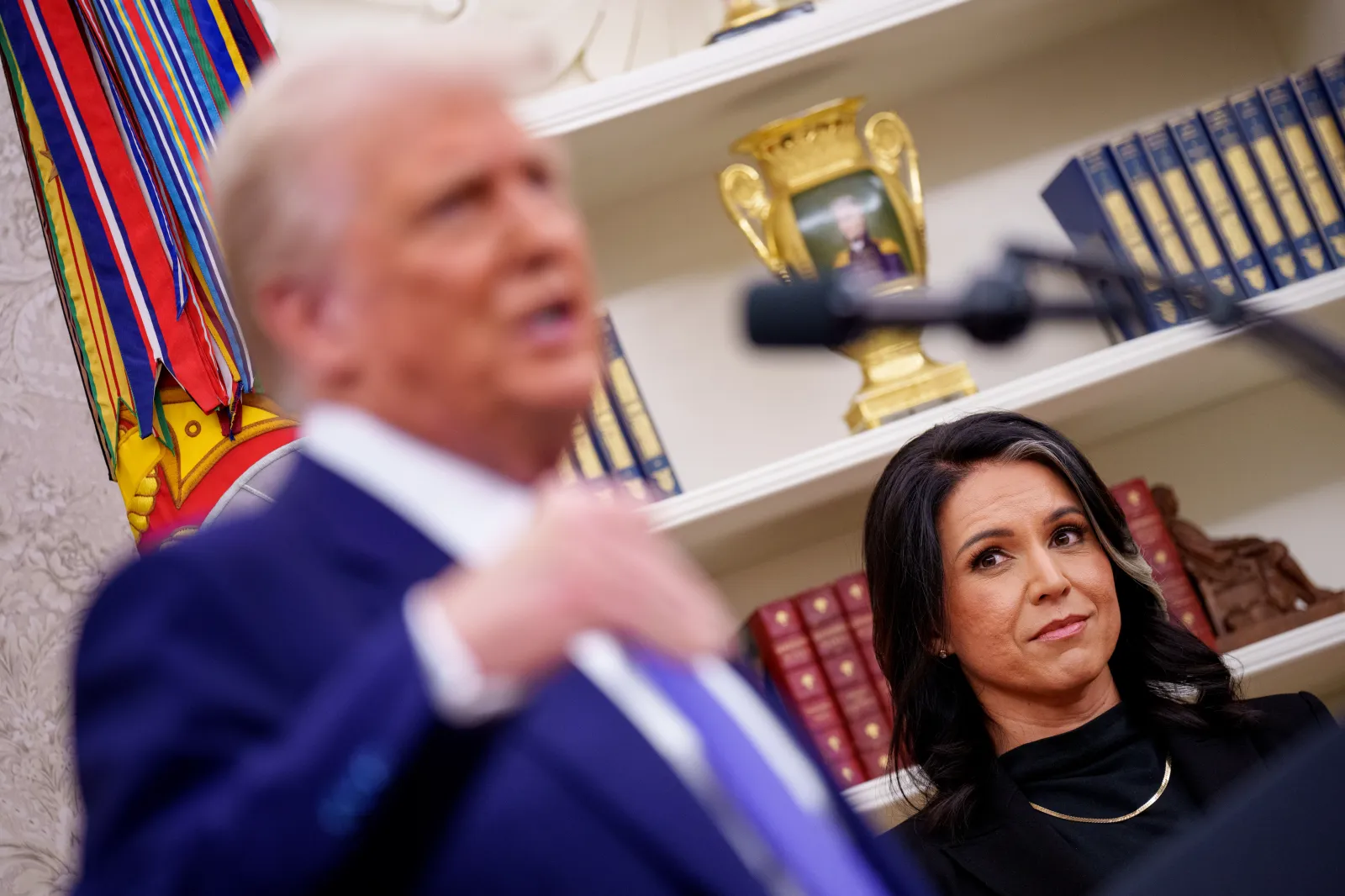

President Donald Trump spoke directly with FBI agents involved in a recent search of a Georgia election facility, The New York Times reported Monday.
According to the Times, the call happened one day after agents searched an elections operations center in Fulton County, removing ballots and other materials tied to the 2020 presidential election. The newspaper said the conversation took place January 29 during a closed-door meeting at the FBI’s Atlanta field office between agents and Director of National Intelligence Tulsi Gabbard.
The Times reported that Gabbard used her cellphone to place a call to Trump, who later returned it and addressed agents on speakerphone. People familiar with the discussion told the paper that Trump praised the agents and asked questions about their work, but did not offer investigative direction. One U.S. official characterized the exchange as brief and motivational.
A U.S. official also told the Times that Trump personally directed Gabbard to travel to Atlanta and that her actions were coordinated with senior FBI leadership.
“President Trump pledged to secure America’s elections, and he has tasked the most talented team of patriots to do just that,” White House spokesman Davis Ingle told the Times. “President Trump has full confidence in his entire team. DNI Gabbard and FBI Director Patel are working together to implement the president’s election integrity priorities, and their work continues to serve him and the entire country well.”
FBI Seizes Fulton County’s 2020 Ballots and Records
Last week, FBI agents arrived at Fulton County’s elections operations center, secured areas around the warehouse-like facility, and loaded election materials into trucks as part of a court-authorized law enforcement action tied to the 2020 vote.
Federal authorities have not publicly explained what triggered the search or what specific allegations are being examined. The FBI confirmed that agents were carrying out a court-authorized action but declined to provide more detail, citing an ongoing matter. Documents that typically lay out the basis for a search of this scale have not been made public, leaving county officials and residents without a clear explanation for why investigators believed a seizure of long-archived election materials was necessary.
Fulton County—Georgia’s most populous county and a Democratic stronghold—has long been central to Trump’s claims about the 2020 election. He has repeatedly alleged, without evidence, that widespread fraud in the county cost him the state, which he narrowly lost to Democrat Joe Biden.
What Agents Sought: Ballots, Tabulator Tapes, Ballot Images, and Voter Rolls
County officials said the paperwork shown to them described a broad search for 2020 election materials, including physical ballots, tabulator tapes produced by vote-scanning equipment, electronic ballot images created during counting and recounting, and voter rolls.
One county commissioner said the FBI removed roughly 700 boxes of materials. Local officials said the size and speed of the operation made it difficult to independently verify, in real time, everything that left the facility. Those concerns quickly became a central issue for county leaders, who said they were being asked to cooperate with an expansive seizure while the public still had no explanation for why the records were needed.
Inside the County Response: Confusion, Limited Access, and Chain-of-Custody Concerns
County officials said they learned of the federal presence as the operation was already unfolding. Leaders described an initial dispute over who, under Georgia law, has legal custody of sealed election records—an issue they said required agents to return with updated documentation before moving forward.
Attorneys reviewed the materials presented by agents and advised compliance, county officials said. Still, some local leaders argued they were kept at a distance as records were removed, leaving them uncertain about exactly what was taken beyond the broad categories outlined in the paperwork.
Those concerns extended beyond access. Local officials said removing original ballots raised immediate chain-of-custody questions: once materials leave local control, they argued, it becomes harder to independently confirm what was taken, whether anything was missed, and what will ultimately be returned. The stakes, they added, are heightened by the intense political pressure Fulton County has faced since 2020.
Questions About the Warrant: Why Now, and What Was Shown to a Judge?
The search has also raised pointed questions about its legal foundation. Federal authorities have not disclosed what evidence was presented to a federal magistrate judge to justify taking ballots and other records more than five years after the election.
The sworn narrative normally used to establish probable cause has not been released publicly, and officials have declined to discuss an ongoing investigation. As a result, it remains unclear what investigators allege occurred, why they believe these materials are evidence of a crime, or why such a broad seizure was necessary.
That absence of detail has helped fuel competing narratives. Critics argue the action risks reopening claims that have repeatedly failed in court and in reviews, while supporters say a judge-approved warrant is part of due process and investigators should be allowed to follow evidence without political interference.
Trump’s Direct Contact With Agents Could Become a Litigation Issue
Trump’s direct contact with FBI investigators could become relevant in future litigation, the Times reported. Even if no investigative instructions were given, defense attorneys in politically sensitive cases often probe communications between political leadership and front-line investigators for any signs of improper influence.
If the investigation leads to criminal charges, such contact could become part of pretrial disputes over whether a case should be narrowed or dismissed. Defense lawyers could also seek testimony from agents about early-stage communications and decision-making.
“The DNI was created to be a high-level intelligence coordinator, not a field operator. By personally participating in a raid and acting as a switchboard for the president, Gabbard has traded her statutory mandate for a partisan performance,” Alexandra Chandler, director of Impact Programs, Free and Fair Elections, Protect Democracy, told Newsweek on Monday.
“This invites damning claims of undue influence and selective prosecution, effectively handing a roadmap to the defense in a future case. When the lines between national intelligence, domestic law enforcement, and the president’s personal grudges are so erased, any resulting prosecution looks less like the rule of law and more like a political hit.”
Senior Officials on Scene: Gabbard and Bailey Draw Scrutiny
Two senior figures were seen at or around the elections hub during the operation: FBI co-deputy director Andrew Bailey and Gabbard.
Gabbard’s presence drew particular attention because the DNI’s traditional role focuses on foreign threats and coordination across intelligence agencies—not on-site involvement in domestic criminal investigative work. Administration officials defended her participation by framing it as connected to election security and the protection of election infrastructure from interference.
Democrats on Capitol Hill questioned the propriety of her appearance and said Congress should be briefed if foreign-interference claims are being used to justify intelligence-community involvement in a domestic election-related action.
What’s Next: Fulton County Signals Court Challenge
Fulton County officials have signaled they are preparing to challenge the federal action in court. One county commissioner said the county plans to file a lawsuit contesting the warrant and seizure and seeking the return of ballots and other sensitive election records.