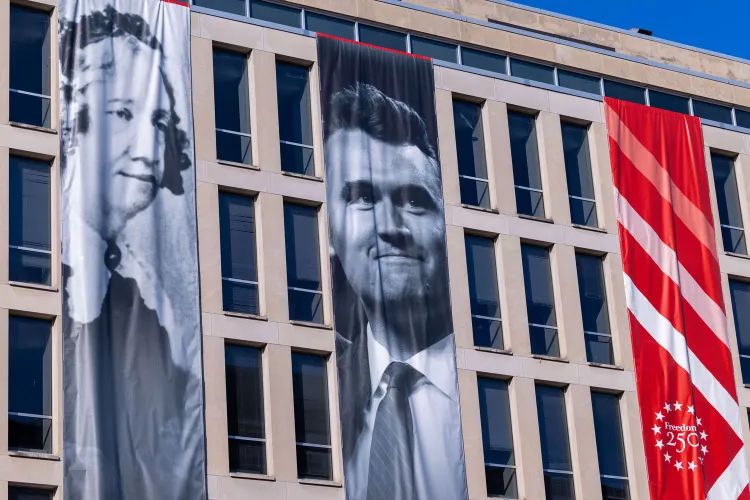

WASHINGTON — The Trump administration’s visual overhaul of the nation’s capital to celebrate the United States’ 250th anniversary has ignited a sharp editorial and political debate. While the “America 250” initiative aims to honor national milestones, the decision to install a massive portrait of the late conservative activist Charlie Kirk on the U.S. Department of Education headquarters is drawing intense scrutiny from educators and historians alike.
The banner, unveiled on March 1, 2026, depicts Kirk alongside five other figures labeled as “heroes in American education.” The selection has raised eyebrows not only because of Kirk’s polarizing legacy but also due to his lifelong advocacy against the very institutions the Department of Education oversees.
:max_bytes(150000):strip_icc():focal(749x0:751x2):format(webp)/charlie-kirk-banner-2-030326-b8630293fc4c4d45bea53c409b7b3ce9.jpg)
A “Hero” Who Called College a “Scam”
The Department of Education’s facade now features a rotation of historical and contemporary figures, including Benjamin Franklin, Martin Luther King Jr., Anne Sullivan, Booker T. Washington, and Catharine Beecher. However, it is the inclusion of Kirk—who was fatally shot in September 2025—that has dominated the national conversation.
Kirk, the founder of Turning Point USA (TPUSA), rose to prominence by labeling higher education an “ideological indoctrination” camp. His 2022 book, The College Scam: How America’s Universities Are Bankrupting and Brainwashing Away the Future of America’s Youth, served as a manifesto for his movement, urging young Americans to bypass traditional four-year degrees.
“I really don’t think grades matter that much in the world,” Kirk famously stated during a campus appearance. “Your character and your integrity… matters a lot more than pandering to some sort of an agenda.”
Critics argue that placing a man who actively discouraged university attendance on the nation’s primary academic headquarters is a deliberate provocation. Administration officials, however, maintain the display honors Kirk’s efforts to “empower states” and challenge the educational status quo.
:max_bytes(150000):strip_icc():focal(999x0:1001x2):format(webp)/charlie-kirk-1-d53ded71d03d4f1db29f92057585d8c4.jpg)
The Assassination of Charlie Kirk and Pending Legal Action
The posthumous tribute comes as the legal proceedings surrounding Kirk’s death continue to move through the courts. Kirk was assassinated on September 10, 2025, during a speaking engagement at Utah Valley University. He was 31.
Authorities later arrested Tyler Robinson, 22, in connection with the shooting. Robinson currently faces a litany of charges, including:
- Aggravated murder
- Felony discharge of a firearm
- Obstruction of justice
Prosecutors have confirmed they intend to pursue the death penalty, citing the targeted nature of the attack and the presence of children during the commission of the crime. The federal recognition of Kirk via the America 250 banners suggests the administration is leaning into his status as a martyr for the conservative movement.
Historical Contradictions: From Beecher to the DOJ
Kirk is not the only figure on the building sparking debate. The inclusion of Catharine Beecher, a 19th-century educator who pioneered teaching as a profession for women, has also drawn criticism for her staunch anti-suffragist views. In her writings, Beecher argued that women entering the political sphere would devalue their roles in the home and classroom.
The Department of Education controversy is part of a broader pattern of “America 250” decorations that have rankled D.C. observers. Earlier this week, a massive banner featuring President Donald Trump’s face was hung from the Department of Justice—the same agency that previously brought multiple federal indictments against him.
A Nation Divided on Its Anniversary
As Washington prepares for a year of celebrations, the aesthetic choices of the administration reflect a deeply divided America. While supporters view the banners as a bold reclamation of American identity, detractors see them as an attempt to rewrite the purpose of federal institutions.
The “America 250” events are scheduled to continue through the end of 2026. Legal analysts and historians expect the debate over these public displays to intensify as more federal buildings are outfitted with commemorative materials.