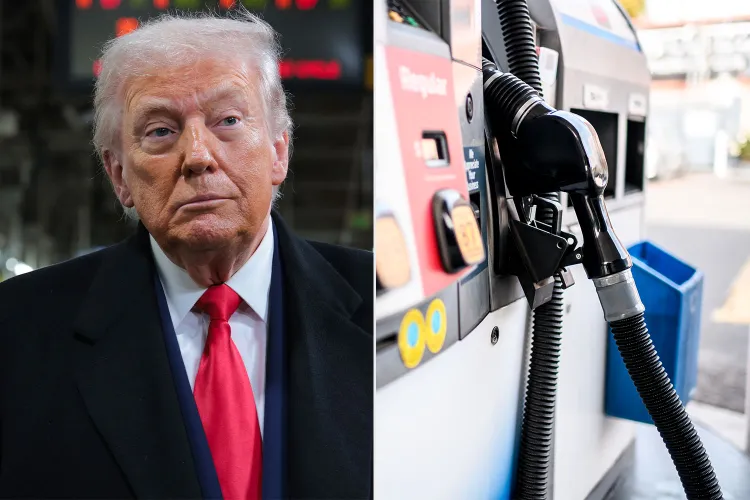

President Donald Trump has signaled the imminent unveiling of a federal strategy to mitigate surging global energy costs, as the ongoing U.S.-Israeli military campaign in Iran continues to destabilize international oil markets and choke critical shipping lanes.
In an interview with The New York Post on Monday, March 9, the 79-year-old president claimed to possess a “plan” that would drastically slash fuel prices, which have skyrocketed since hostilities commenced on February 28.
“I have a plan for everything, okay?” Trump told the outlet. “I have a plan for everything. You’ll be very happy.”
While the President did not provide specific policy details during the interview, the administration has since moved to coordinate an unprecedented release from the Strategic Petroleum Reserve (SPR). On Wednesday, the White House confirmed the U.S. would release 172 million barrels as part of a broader 400-million-barrel emergency action by International Energy Agency (IEA) member states.
The Cost of Conflict: From $2.30 to $100 Crude
The energy crisis is a direct consequence of the joint U.S.-Israeli strikes launched two weeks ago, which resulted in the death of Iranian Supreme Leader Ali Khamenei and prompted Tehran to effectively shutter the Strait of Hormuz.
The impact on the American consumer has been immediate and severe:
- Gasoline Surges: Prior to the conflict, Trump highlighted a national gasoline average of roughly $2.30 per gallon. As of March 12, AAA reports the national average has climbed past $3.60, with some regions exceeding $5.00.
- Crude Volatility: Brent crude, which traded at $67 per barrel in late February, breached the $100 threshold on March 8. It reached a peak of $126 before settling in the $92–$97 range following news of the SPR release.
- Supply Chokehold: The Strait of Hormuz, which handles approximately 20% of the world’s daily oil and gas supply, remains a high-risk zone. Iranian retaliatory strikes on shipping have reduced traffic by an estimated 70%, according to maritime tracking data.
A “Good Investment”: The Push for Energy Dominance
The administration’s “plan” appears to be part of a broader, more aggressive geopolitical strategy to secure American energy hegemony. Republican Senator Lindsey Graham (R-SC) recently framed the conflicts in Iran and Venezuela as a financial and strategic windfall for the United States.
Speaking to Fox News on Sunday, Graham suggested that the removal of the Iranian regime, coupled with the January 3 capture of Venezuelan President Nicolás Maduro in Operation Absolute Resolve, would allow the U.S. to broker a “partnership” controlling nearly a third of the world’s oil.
“Venezuela and Iran have 31% of the world’s oil reserves,” Graham stated. “We’re going to have a partnership with 31% of the known reserves. This is China’s nightmare. This is a good investment.”
Critics, however, argue that the “plan” may be more of a stop-gap than a permanent solution. Analysts from the IEA warned this week that while the coordinated release of reserves provides a temporary “salve,” the long-term price trajectory depends entirely on the duration of the war and the security of the Persian Gulf.
Journalistic Fact-Check: Can the Plan Succeed?
While President Trump maintains that his energy policies will make Americans “very happy,” several economic headwinds remain:
- Production Lags: Although U.S. production has increased by 600,000 barrels a day since 2025, domestic infrastructure is currently operating at near-maximum capacity, limiting the ability to offset the total loss of Iranian and Gulf exports.
- Utility Bills: Beyond the pump, Americans are facing a projected 15% increase in spring utility bills due to the disruption of Liquefied Natural Gas (LNG) exports, which have been diverted or halted by the naval blockade in the Middle East.
As the war enters its third week, the White House is expected to issue a formal executive order regarding “Ratepayer Protection” and further energy deregulations.