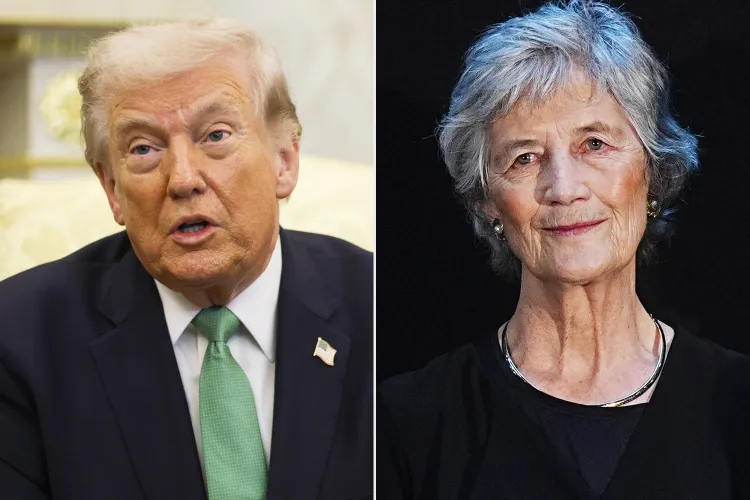

President Donald Trump faces renewed scrutiny regarding his cognitive clarity and diplomatic precision following a series of high-profile verbal lapses this week. During consecutive press briefings on Monday and Tuesday, the 79-year-old commander-in-chief misgendered the female heads of state of Venezuela and Ireland, appearing to default to the assumption that their offices are held by men.
The incidents occurred during a critical week for U.S. foreign policy and have intensified a national conversation regarding the age and mental acuity of the oldest person ever elected to the presidency.
Successive Gaffes in Diplomatic Protocol
The first instance took place Monday, March 16, during a luncheon with the Kennedy Center Board of Trustees. While discussing the geopolitical status of Venezuela—following the U.S. military’s capture of former leader Nicolás Maduro two months ago—Trump praised the nation’s current leadership.
The United States formally recognizes Delcy Rodríguez as the acting president of Venezuela. However, Trump repeatedly utilized masculine pronouns when referencing the head of state.
“The relationship with Venezuela has been fantastic,” Trump stated. “The president has done a really good job. We get along with him really well.”
The pattern repeated on Tuesday, March 17, during a St. Patrick’s Day celebration at the White House. When questioned by a reporter regarding criticisms leveled by Irish President Catherine Connolly, who has described the administration’s military posture toward Iran as an “attack on international law,” Trump again misidentified the leader’s gender.
“Who said that?” Trump asked. Upon being told it was the Irish president, he responded, “Look, he’s lucky I exist. That’s all I can say.”
:max_bytes(150000):strip_icc():focal(746x254:748x256):format(webp)/Catherine-Connolly-Delcy-Rodriguez-031726-c88b830c0699482abf838b9e021227fd.jpg)
Privacy Concerns and Medical Disclosures
The Monday briefing was further marked by a significant breach of protocol regarding the health of Rep. Neal Dunn (R-FL). In a moment that appeared to catch House Speaker Mike Johnson off guard, the President prompted the Speaker to disclose details of Dunn’s private medical history before live cameras.
“What was the diagnosis?” Trump asked. After Johnson noted it was a “terminal diagnosis,” the President told the room that Dunn “would be dead by June” without the intervention of the White House Medical Unit.
Speaker Johnson was heard interjecting, “OK, that wasn’t public,” as the President continued the narrative. The White House has not yet issued a formal statement regarding the disclosure of the congressman’s private health information.
A Pattern of Geographic and Personal Confusion
These latest incidents follow a string of verbal missteps that have defined the early months of 2026. In January, while attending the World Economic Forum in Davos, Switzerland, the President repeatedly referred to Greenland—a territory he has expressed interest in acquiring—as “Iceland.” Despite the geographic and scale differences between the two NATO members, the President used the wrong name four times during his address. At the time, White House spokesperson Taylor Rogers dismissed concerns, characterizing the scrutiny as a “liberal media meltdown” while emphasizing the President’s focus on national security interests.
The Political Stakes of Presidential Longevity
As the President approaches his 80th birthday, each verbal slip is being viewed through a highly polarized lens. Supporters argue these are minor rhetorical “gaffes” common in high-pressure environments, while critics and medical ethicists suggest the frequency of geographic, gender, and privacy-related lapses requires greater transparency regarding the President’s health.
The White House has been reached for comment on the specific instances involving President Connolly and President Rodríguez, but has not provided a response as of press time.