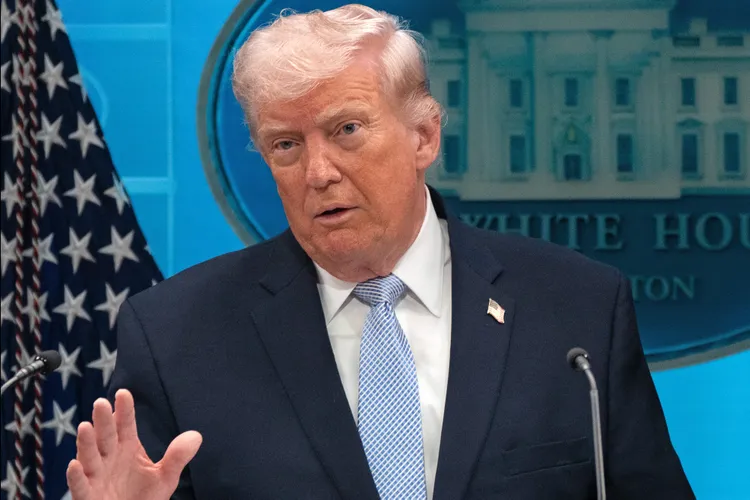

President Donald Trump asserted Tuesday that he would have secured a “very quick” victory in the Vietnam War had he been commander-in-chief, even as his own administration faces a looming deadline to prevent the resumption of hostilities with Iran.
During a 30-minute interview on CNBC’s Squawk Box, Trump compared the current two-month-old Iran conflict to the 19-year American involvement in Vietnam. “I would have won Vietnam very quickly. I would have, if I were president,” Trump said, listing the durations of past U.S. wars to frame his current military strategy.
Ceasefire on the Brink
The President’s comments come at a volatile moment. A temporary ceasefire with Iran is set to expire Wednesday evening. Trump signaled a high probability of renewed military action, stating he expects U.S. forces to resume airstrikes if a permanent deal is not reached.
“I expect to be bombing because I think that’s a better attitude to go in with,” Trump told CNBC. “The military is raring to go.”
High-level negotiations are scheduled to begin Wednesday in Islamabad, Pakistan. The U.S. delegation includes Vice President JD Vance, roving peace envoy Steve Witkoff, and Jared Kushner. Notably, Tehran requested Vance’s presence as a condition for the talks, following previous sessions with Witkoff and Kushner that were followed by surprise U.S. air campaigns.
The Contrast of History
Trump’s confidence regarding Vietnam invites scrutiny of his own record during that era. While over 58,000 American service members were killed in the conflict, the 79-year-old President avoided the mandatory draft.
After receiving four student deferments, Trump obtained a medical disqualification in 1968. A Queens-based podiatrist, Dr. Larry Braunstein—who rented office space from Trump’s father—diagnosed the future president with bone spurs in his heels.
In 2019, former Trump attorney Michael Cohen testified to Congress that the President failed to provide any medical documentation to support the diagnosis when questioned during the 2016 campaign. Cohen alleged the deferment was a favor arranged by the elder Trump.
Naval Standoff and Economic Pressure
The current conflict remains centered on a strategic standoff in the Strait of Hormuz. Despite the temporary ceasefire, the U.S. continues a strict naval blockade of Iranian ports. Trump has demanded that Tehran relinquish military control of the waterway, a crucial artery for global oil traffic, while maintaining that the U.S. has little patience for extended diplomacy.
“I don’t want to [extend the ceasefire],” Trump said. “We don’t have that much time.”
The Iranian delegation in Islamabad is expected to be led by Mohammad Bagher Ghalibaf, the speaker of the Iranian parliament. The outcome of these talks will determine whether the U.S. returns to an active bombing campaign by tomorrow night.