
Iranian Foreign Minister Abbas Araghchi is in China this week to attend the Shanghai Cooperation Organization (SCO) Summit, where he will meet with Chinese and Russian counterparts in a bid to strengthen Tehran’s geopolitical alliances. The visit follows Iran’s recent conflict with Israel and comes amid heightened tensions with the United States.
The summit marks a key moment in Iran’s deepening alignment with Beijing and Moscow—two powers increasingly at odds with Washington over influence in the Middle East.
Newsweek has reached out to the U.S. State Department for comment.
Why It Matters
Araghchi’s visit underscores Iran’s expanding relationship with China, which has continued purchasing Iranian oil despite sanctions and has reportedly transferred missile components and air-defense systems to Tehran.
This growing partnership provides Iran with vital economic lifelines and military technology, weakening the impact of U.S.-led sanctions. For Washington, it signals a rising challenge to its influence in a region critical to global energy markets and security frameworks.
China, meanwhile, gains a stronger foothold in the Middle East while reinforcing its broader strategy to counter U.S. hegemony through economic and defense cooperation with sanctioned or isolated states.
What To Know
- Araghchi is expected to meet with Chinese Foreign Minister Wang Yi and Russian Foreign Minister Sergey Lavrov on the sidelines of the summit.
- Tehran plans to use the platform to advocate for greater regional security coordination under the SCO framework and to reaffirm support from Beijing.
- Following a June 24 ceasefire with Israel, multiple reports suggest Iran received Chinese-made surface-to-air missile systems, reportedly paid for through oil shipments.
- While China has denied arms sales to “nations engaged in warfare,” Beijing maintains that weapons like the J-10 fighter jet are available to “friendly countries”—a category Iran is actively courting amid delays in Russian arms deliveries.
SCO as a Strategic Platform
The Shanghai Cooperation Organization, formed in 2001, includes China, Russia, Iran, India, Pakistan, and several Central Asian nations. The bloc serves as a vehicle for China and Russia to expand influence across Eurasia and provide alternatives to Western-led institutions.
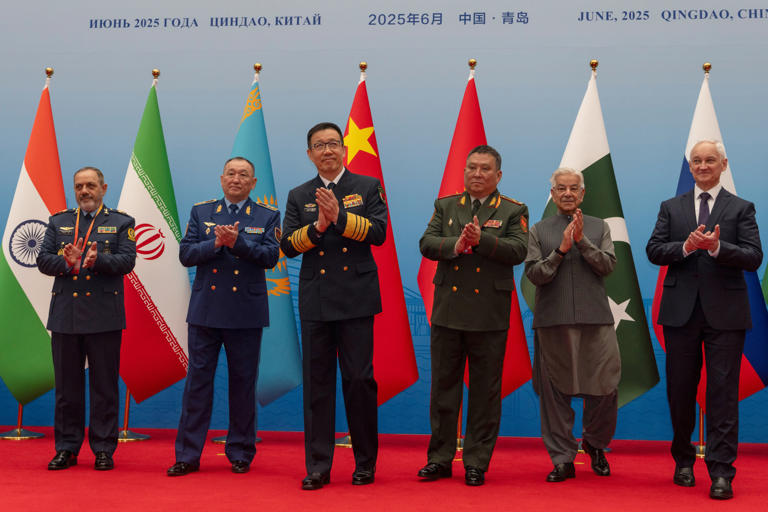
For Iran, the SCO offers economic and diplomatic breathing room, allowing Tehran to bypass U.S.-dominated systems. China’s hosting of SCO defense ministers last month further reflects Beijing’s growing role as the bloc’s central organizer.
Photo Caption: Chinese Defense Minister Dong Jun, Iranian Defense Minister Aziz Nasirzadeh, and Russia’s Andrei Belousov appeared together at the June 26 SCO defense summit in Qingdao, highlighting their alignment on security cooperation. (AP Photo / Ng Han Guan)
What People Are Saying
- Iran’s Foreign Ministry spokesperson:
“During this trip, in addition to participating in the foreign ministers’ meeting and presenting our country’s positions, the Foreign Minister will hold bilateral talks with Chinese and other attending foreign ministers.” - Bradley Bowman, senior director at the Foundation for Defense of Democracies:
“For Beijing, strategic ambiguity is a feature, not a flaw … China is quietly enabling Iran’s missile ambitions while publicly downplaying its role.”
What’s Next
Iran is poised to broaden its strategic partnership with China, advancing both economic cooperation and military-technical ties. This alignment is expected to further challenge U.S. influence in the Middle East.
While Washington ramps up sanctions enforcement and strengthens ties with Gulf and Israeli partners, the shifting power balance highlights the growing complexity of regional diplomacy—and China’s evolving role as a counterweight to U.S. dominance.