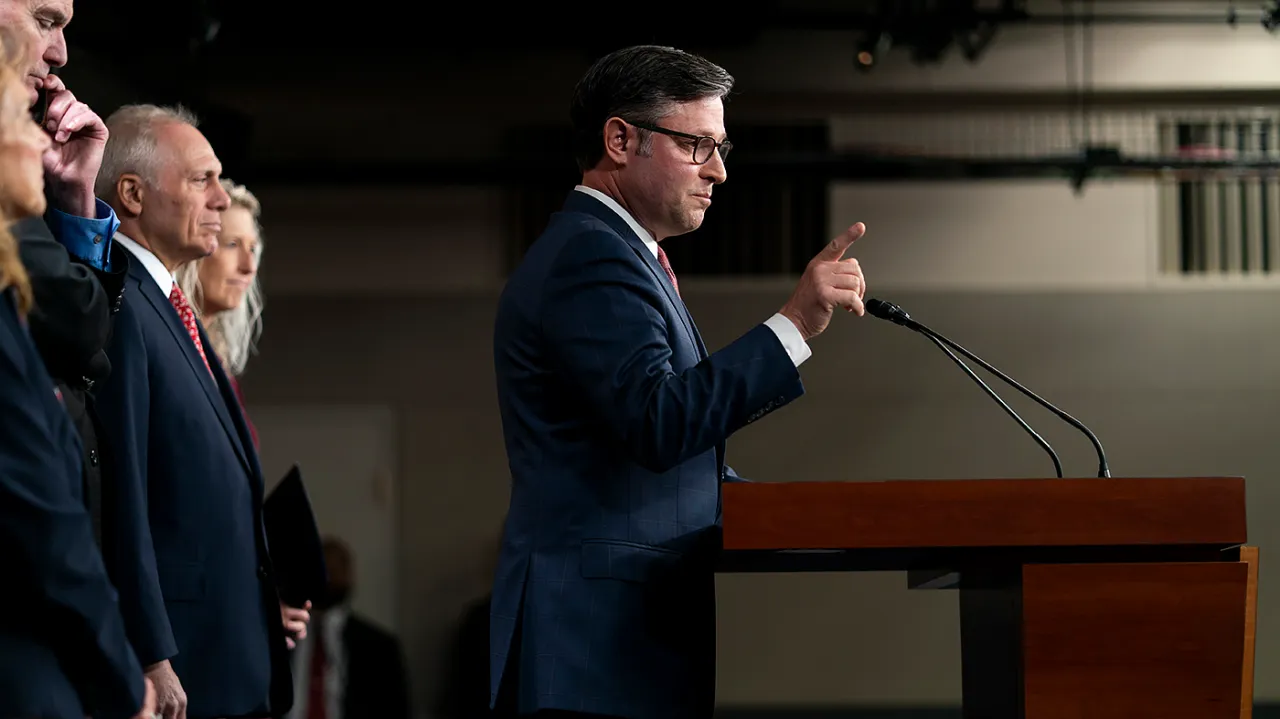

A brewing rebellion within Speaker Mike Johnson’s (R-La.) inner circle on the House Rules Committee has thrown the House into disarray, as GOP leaders grapple with how to handle growing demands—both internal and from Democrats—to release Jeffrey Epstein-related documents.
Members of the Rules Committee, often referred to as the “Speaker’s Committee” for its role in controlling floor debate, stalled progress on several bills this week over fears Democrats would force politically difficult votes tied to Epstein file disclosures.
At the heart of the standoff is a bipartisan resolution—backed by Reps. Thomas Massie (R-Ky.) and Ro Khanna (D-Calif.)—that would compel the release of Epstein-related documents. GOP leaders have tried to counter it with a nonbinding resolution crafted by Republicans, but concerns remain that the alternative may not garner enough support to pass in the narrowly divided House.
Due to the impasse, House Republican leadership canceled Thursday’s votes and sent lawmakers home early for the August recess, unable to move forward on anything beyond uncontroversial bills.
This latest challenge is especially thorny for Johnson—not because of hardliners in the Freedom Caucus, but because of trusted allies on the Rules Committee now reluctant to take politically risky votes. Rep. Erin Houchin (R-Ind.) privately raised concerns this week about being forced to vote on the Democratic amendment and pushed for a separate GOP-backed resolution instead.
Hardline conservatives like Reps. Ralph Norman (R-S.C.) and Chip Roy (R-Texas) also support more transparency on Epstein, but insiders say it’s more moderate Republicans who are stalling the committee’s work.
Defending the holdup, Johnson accused Democrats of turning the Epstein files into a political weapon.
“We’re not going to let them use this as a political battering ram,” Johnson said Tuesday. “We’re not going to allow them to engage in that charade anymore.”
Still, the standoff has provided Democrats with an opening to keep GOP divisions—and the Epstein issue—in the headlines. The Rules Committee, which traditionally avoids prolonged internal disputes, has now become the epicenter of a broader party clash.
GOP strategist Brendan Buck, a former adviser to Speakers Paul Ryan and John Boehner, criticized the GOP holdouts on social media: “Respectfully, Rs on the Rules Committee need to toughen up… I promise you won’t lose your seat over a few procedural committee votes.”
Johnson, who has authority to appoint and remove Republicans from the Rules Committee, signaled he has no intention of doing so.
“They serve at the Speaker’s request… We’ll see,” he said when asked whether he might replace any of the holdouts.
The political balancing act has grown increasingly complex. Johnson faces pressure from GOP lawmakers eager to vote for more Epstein disclosures, grassroots MAGA activists demanding transparency, and former President Trump—who has urged Republicans to move on from the issue. Still, Trump recently directed Attorney General Pam Bondi to seek the release of grand jury transcripts tied to Epstein, signaling his own effort to respond to public outcry.
Despite a nonbinding resolution being advanced by the Rules Committee last week, Johnson said he would not bring it to the floor before the August recess—frustrating allies like Rep. Norman, who posted on X: “The American people deserve action, not excuses. Let’s vote on it before August recess and get it DONE!!”
But with several Republicans backing the Massie-Khanna bipartisan measure—which carries more legal weight—the GOP alternative may not pass at all. Massie and Khanna are preparing to file a discharge petition in September to force the resolution to the floor. Eleven Republicans have already signed on, and the sponsors believe they’ll have enough support when Congress returns.
Johnson, clearly irritated, criticized Massie for his break with leadership. “I don’t understand Thomas Massie’s motivation. I really don’t… Bless his heart,” Johnson said.
Meanwhile, the legislative logjam is affecting unrelated priorities. Rep. Stephanie Bice (R-Okla.), whose immigration bill was delayed due to the Epstein fallout, expressed frustration: “We cannot let this drag on.”
Rep. Gregory Murphy (R-N.C.) echoed her concerns. “This is so myopic. We should be working on trade, health care—all the things that matter—instead of dragging out information that could damage innocent lives,” he said.
For now, Speaker Johnson is betting the August break will cool tensions. But the Epstein debate shows no sign of disappearing—and may return even more forcefully when lawmakers reconvene in the fall.