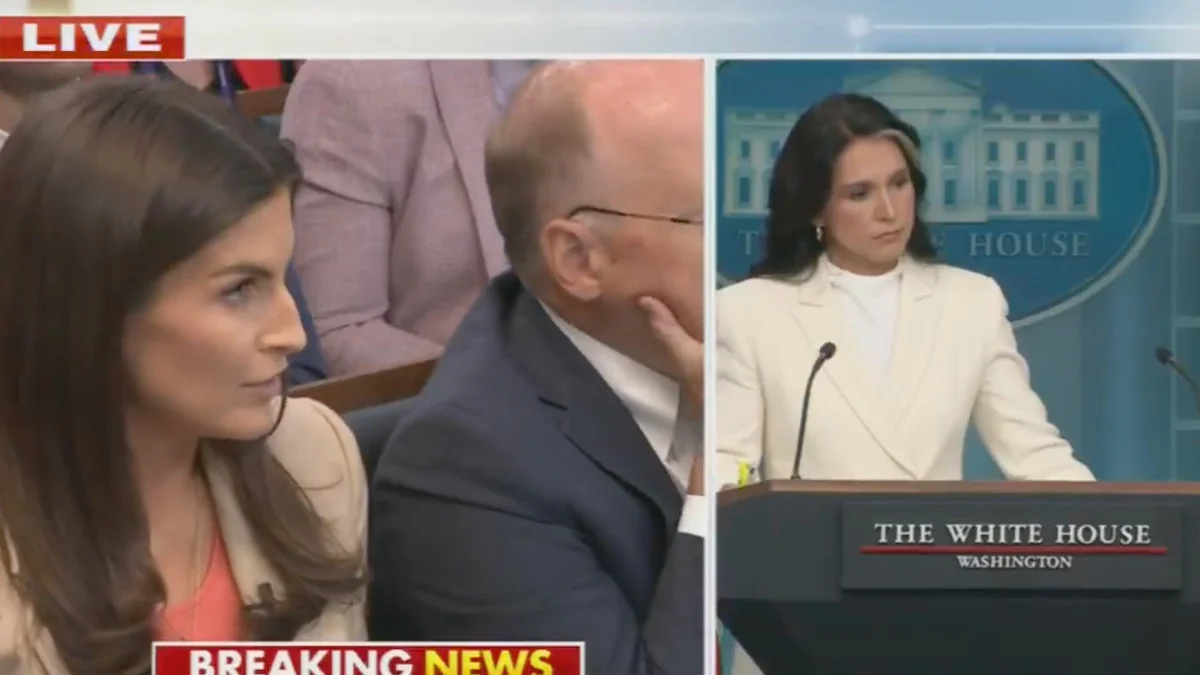

CNN anchor Kaitlan Collins got into a fiery exchange with Director of National Intelligence Tulsi Gabbard and White House Press Secretary Karoline Leavitt on Tuesday, pressing whether Gabbard’s recent intelligence disclosures were aimed at regaining favor with President Trump.
The tense back-and-forth unfolded in the White House press room just days after Gabbard accused former President Barack Obama and other top officials of “manufacturing intelligence” to support claims that Russia interfered in the 2016 election.
Collins challenged Gabbard’s motives directly, citing a 2017 bipartisan Senate Intelligence Committee report that confirmed Russian meddling in the election. “You referenced previous assessments, including the 2017 report that was backed by every Republican on the Senate Intelligence Committee—including then-Acting Chair Marco Rubio, now Secretary of State,” Collins began. “That report found no collusion but did confirm irrefutable Russian interference.”
She then asked bluntly, “What do you say to those who believe you’re only releasing these documents now to repair your standing with the president, after he dismissed your previous assessments?”
Gabbard responded by taking issue with Collins’ framing. “I want to clarify something,” she said. “The Senate Intelligence Committee is not the same as the Office of the Director of National Intelligence. They serve different functions. And the intelligence we’ve released is rock solid.”
Gabbard then handed the floor to Press Secretary Leavitt, prompting Collins to double down.
“The president has publicly contradicted her on Iran,” Collins interjected. “He told me on camera, aboard Air Force One, that she didn’t know what she was talking about.”
Leavitt pushed back sharply, insisting she had a clearer view of the president’s opinions due to her proximity to him. “I’m with the president every single day,” she said. “He has full confidence in Director Gabbard. He always has—and so does the rest of the cabinet. We are united in delivering on his agenda.”
The moment highlighted ongoing tensions between the White House and major news outlets over national security narratives—and showed how Gabbard’s controversial claims continue to stir political friction.