
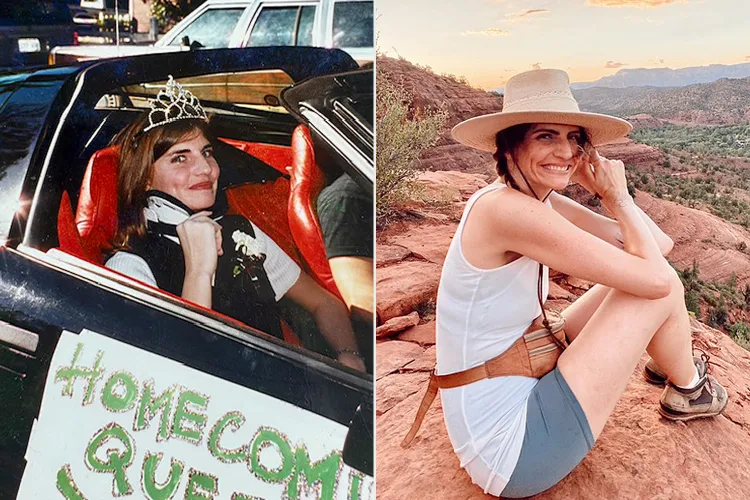

Ruthie Lindsey was just a high school senior when her life took a devastating turn. The 17-year-old from Saint Francisville, Louisiana, had recently been crowned her school’s homecoming queen when, on November 2, 1996, she was struck by an ambulance.
The accident left her with three broken ribs, a collapsed left lung, a ruptured spleen, and fractures to the top two vertebrae in her neck, C1 and C2. “Apparently, I had a 5 percent chance to live and a 1 percent chance to walk,” Lindsey, now 45, tells PEOPLE. “I was very lucky to be alive.”
Doctors performed a spinal fusion using bone from her left hip and stabilized her neck with wires.
Nearly a decade later, as a newlywed, Lindsey began experiencing sudden, intense pain. “I was standing in front of a Starbucks one day, and this crazy shooting pain went up my head like I’d been electrocuted; it felt like lightning,” she recalls. “It was terrifying. I felt like I was going to either vomit or pass out.”
:max_bytes(150000):strip_icc():focal(499x0:501x2):format(webp)/Ruthie-Lindsey-080125-Courtesy-of-Ruthie-Lindsey-2-c5c09764c9784c5d97c735934b33148d.jpg)
Over the next five years, the pain became more frequent. Despite numerous MRIs, doctors could not determine the cause. “This pain was so intense, but I think it was also kind of a trauma response,” she says. “I had never done any work around what had happened in my childhood or with this wreck.”
Days spent in bed became routine. “I got to stop showing up to a life that I didn’t really like that much, to be honest,” Lindsey says. “I got to take all these narcotics and watch shows and eat my feelings, and I was miserable.” She describes that time as a “dark, dark, scary, debilitating period.”
In spring 2009, a doctor finally found the source: an X-ray revealed that the wire from her spinal fusion had broken and pierced her brain stem, requiring urgent surgery. Just two weeks later, her father died, plunging her into despair. “I was like, ‘If there’s a God, he must hate me.’”
:max_bytes(150000):strip_icc():focal(749x0:751x2):format(webp)/Ruthie-Lindsey-080125-Courtesy-of-Ruthie-Lindsey-f820662ab11e49f085628757a3ffcd68.jpg)
Insurance wouldn’t cover the surgery, but her father’s legacy inspired her community to rally. In April 2010, Lindsey underwent surgery at the Mayo Clinic, where doctors removed the wire from her brain stem and fused C1, C2, and C3 with titanium screws.
“I put all my hope into this surgery being the thing to save me, to take all the pain away, and for me to be okay,” she says. But complications left her with severe nerve damage. “I would’ve said I lived at a 10 on the pain scale before the surgery. But suddenly I was in the most pain I’d ever experienced in my life.”
The setback triggered a deeper depression. Lindsey spent two more years bedridden, relying on high-level narcotics like fentanyl, morphine, and hydrocodone. Her marriage ended, and her mother took her back home to Louisiana.
The shame was crushing for the former cheerleading captain and homecoming queen. “I had always been the most popular girl. And all of a sudden, the only reason I’m coming back home is because I’m having a nervous breakdown,” she says.
:max_bytes(150000):strip_icc():focal(499x0:501x2):format(webp)/Ruthie-Lindsey-080125-Ashley-LeMieux-3bf8f15b04604def835e91964cec5ad7.jpg)
Yet this breakdown became the catalyst for change. Lindsey began exploring inner work and understanding the mind-body connection and trauma. She gradually weaned herself off pain medications and, upon returning to Nashville, learned to listen to her body and interpret her pain.
“Living with this has been really traumatic and exhausting and overwhelming and takes so much energy. And I think my body’s always speaking to me and calling me in to remember it,” she says.
In April 2021, her memoir, There I Am: The Journey From Hopelessness to Healing, was published by Simon & Schuster.
Now a transformational coach in Nashville, Lindsey offers one-on-one guidance for those living with chronic pain. “I actually teach how pain is always inviting us in to do such deep inner work; it wants us to look at more of the emotional pain that we haven’t been willing to look at,” she says. She also leads an annual workshop called “The Invitation of Pain.”
:max_bytes(150000):strip_icc():focal(429x526:431x528):format(webp)/Ruthie-Lindsey-080425-Nathan-Freitas-1-0882ed7dbef04ee8af62302e15bed84b.jpg)
“I get to help people meet their pain with as much self-compassion and kindness and gentleness,” Lindsey explains. She wants those who suffer to know they are not alone and to develop a new relationship with their bodies—seeing them not as broken, but as whole.
Her personal experience allows her to guide clients authentically. “It’s been, holy hell, it’s been really exhausting having this level of pain for 20-something years,” she reflects, underscoring both the challenge and the resilience her journey has fostered.


