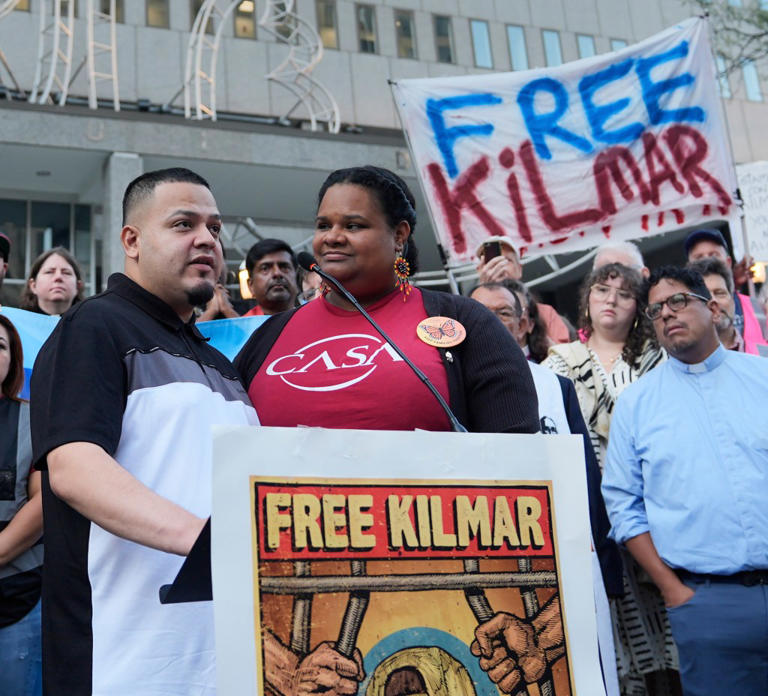

The Trump administration absorbed four major courtroom losses this week, with judges in federal and state courts rejecting or pausing initiatives tied to immigration enforcement, deportation authority, voting policy, and National Guard deployments.
Taken together, the rulings show a judiciary increasingly focused on whether the administration is following required procedures, correctly applying statutes, and staying within the bounds of executive power.
Here’s a detailed look at each decision.
1. Flagship Deportation Case Hits a Procedural Wall
One of the administration’s highest-profile deportation efforts—its push to remove Salvadoran national Kilmar Abrego Garcia—ran into trouble after a basic legal gap surfaced: his 2019 immigration case does not appear to contain a formal removal order.
In that earlier proceeding, Immigration Judge David Jones granted Abrego withholding of removal after finding credible evidence that Barrio 18 gang members had threatened him and his family in San Salvador. The decision described a sustained pattern of extortion and intimidation against Abrego and his siblings, concluding he would face a serious risk of persecution if sent back to El Salvador.
But while the ruling protected him from return to El Salvador, it did not issue a formal removal order to any country. That omission is now central to the administration’s current deportation strategy.
At a Nov. 20 hearing in the U.S. District Court for the District of Maryland, Judge Paula Xinis pressed government lawyers repeatedly on the missing order, emphasizing that deportation and detention require a valid legal foundation. “There is no order of removal in the docket, in the record… You can’t fake it ’til you make it,” she said.
Abrego’s attorney, Andrew Rossman, argued that without a final order, deportation would violate due process. He warned the court that removing someone in these circumstances would be plainly unlawful.
Meanwhile, the administration has attempted to deport Abrego to multiple third countries—including Uganda, Eswatini, Ghana, and most recently Liberia—after he offered to leave voluntarily for Costa Rica. ICE officials struggled to explain why Costa Rica was dropped or why the destination changed repeatedly.
The absence of a removal order now casts serious doubt on whether the government can lawfully deport him at all. It also intensifies scrutiny of a case already linked to separate criminal proceedings in Tennessee, where prosecutors are pursuing human-smuggling charges and plan to introduce broad “other-acts” evidence.
For the administration, the Maryland hearings represent a sharp blow: a years-old procedural failure is threatening to collapse one of its most public-facing enforcement efforts.
Supporters rally as Syrian President Ahmed al-Sharaa arrives to greet them outside of the White House, Monday, Nov. 10, 2025.

2. Court Orders Revival of SIJS Deferred-Action Protections
In New York, the administration lost another significant immigration fight after U.S. District Judge Eric Komitee ordered USCIS to resume processing deferred-action protections for Special Immigrant Juvenile Status (SIJS) recipients—vulnerable young immigrants who qualify under a separate federal pathway.
USCIS had ended the SIJS deferred-action program in June 2025, eliminating automatic consideration for work authorization and blocking renewals. Judge Komitee froze that rollback, granting a stay and partial injunctive relief.
The ruling requires USCIS to restart deferred-action determinations and, for certain applicants, to process employment authorization. With more than 150,000 SIJS recipients stuck in a backlog waiting for visas, the decision has immediate nationwide impact.
Absent deferred action, many of these young people could lose their work permits and face deportation despite their protected status. The ruling is one of the strongest judicial checks on the administration’s immigration agenda in recent months.
3. Federal Judge Stops TPS Termination for Syrians
A separate decision in the Southern District of New York halted the administration’s attempt to end Temporary Protected Status (TPS) for roughly 6,100 Syrians.
Seven Syrian nationals and advocacy groups challenged the termination, arguing it was arbitrary, poorly justified, and driven by improper considerations. The court agreed that the plaintiffs were likely to succeed and found that ending TPS now would expose beneficiaries to serious risk.
As a result, TPS protections and work authorization for Syrians remain in effect while the lawsuit proceeds. The administration could appeal, but the ruling adds to a growing list of judicial interventions limiting efforts to reduce humanitarian relief programs.
4. Tennessee Judge Blocks Memphis National Guard Deployment
The week’s final setback came in Tennessee, where a state judge blocked the deployment of the Tennessee National Guard to Memphis.
The troops had been activated under a presidential memorandum creating the “Memphis Safe Task Force,” intended to strengthen federal and local law-enforcement operations. Davidson County Chancellor Patricia Head Moskal issued an injunction, finding the activation likely violated state constitutional limits.
Local officials and state lawmakers argued that the governor could not authorize deployment without legislative approval and that crime conditions in Memphis did not meet the legal standard for a “grave emergency.” Moskal sided with them, barring Gov. Bill Lee and Major General Warner Ross II from continuing the activation.
Her ruling echoes concerns raised in federal cases over similar Guard deployments in Oregon and Illinois, where courts have questioned whether the administration exceeded authority under 10 U.S.C. § 12406.
Across all four cases, the message from the courts was consistent: the administration’s ambitions may be broad, but judges are demanding strict adherence to legal process, statutory text, and limits on executive reach.