
It’s a karaoke staple and a dive-bar anthem, but Lynyrd Skynyrd’s 1974 hit “Sweet Home Alabama” also contains a line that has long puzzled listeners — and it points to a strange, dark corner of Southern political history.
Just over a minute and a half into the song, lead vocalist Ronnie Van Zant sings, “In Birmingham, they love the governor, boo, boo, boo.” The “governor” referenced is widely understood to be George Wallace, the segregationist Alabama Democrat who served four nonconsecutive terms.
Wallace first took office in January 1963 and quickly became a national symbol of resistance to desegregation. In his inaugural address, he delivered the notorious pledge: “segregation now, segregation tomorrow, segregation forever.”
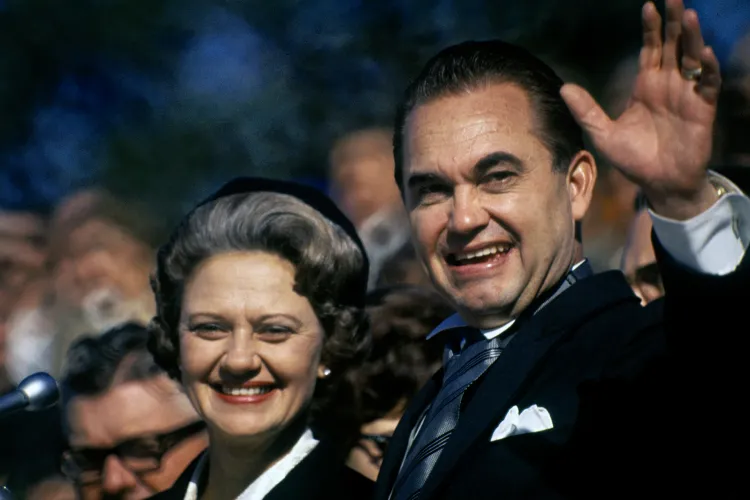
By 1966, Alabama law prevented Wallace from running for a second consecutive term. Rather than step away from power, he devised a workaround: he persuaded his wife, Lurleen Wallace, to run for governor as a stand-in while he continued to influence decisions behind the scenes.
:max_bytes(150000):strip_icc():focal(749x0:751x2):format(webp)/wallace-Governor-of-Alabama-1963-012926-b1022a64f1ed4c92bedff8aa7c311645.jpg)
Those close to the family later described Lurleen as someone who preferred private life to politics. Still, she entered the race branded explicitly as “Mrs. George C. Wallace,” won the Democratic nomination against a crowded field, and then campaigned in the general election under the slogan “Two Governors, One Cause.” The message was blunt: Wallace would remain the real force in state government.
The strategy worked. Lurleen won in a landslide, carrying nearly every county in Alabama and defeating Republican James D. Martin with 63.4% of the vote.
But as the campaign unfolded, Lurleen’s health was collapsing. Not long before the election, she learned she had uterine cancer — and then learned something even more devastating: her husband had known about signs of the disease for years. After her final childbirth in 1961, doctors found cancerous tissue. Following common medical practice at the time, the information was given to her husband rather than to her. Wallace insisted she not be told and did not pursue treatment.
:max_bytes(150000):strip_icc():focal(749x0:751x2):format(webp)/Mr-Mrs-George-C-Wallace-Governor-of-Alabama-1966-012926-03bdc63786d84bdb9b26bdebb7c58ba9.jpg)
When Lurleen finally understood what was happening, the disease was advanced. She took office in January 1967, while Wallace — holding no official role — operated from an office nearby. In her inaugural speech, she effectively described herself as the instrument through which her husband would continue to govern.
Even as she traveled to Houston for treatment, her public role remained largely ceremonial. One of the biggest initiatives associated with her time in office came after she toured Alabama’s mental health facilities and pushed for increased funding in response to what she saw.
Lurleen died on May 7, 1968, as Wallace campaigned for president. On the trail, he often minimized her illness, at times implying she had beaten cancer. After her death, he sent their underage children to live with others and returned quickly to campaigning. He lost the presidential race that year, but within a few years he was back in the governor’s office — this time with a new wife, Cornelia.
:max_bytes(150000):strip_icc():focal(749x0:751x2):format(webp)/Rock-group-Lynyrd-Skynyrd-1976-012926-9b57b806f23d4df2aa5a75c6a028a8eb.jpg)
The Wallace reference in “Sweet Home Alabama” has fueled decades of debate about what the band meant — especially given the group’s association with Confederate imagery during performances. Some band members later suggested the flags were encouraged as part of a marketable “good ol’ boy” persona, while others argued the song itself signaled disapproval of Wallace.
Guitarist Gary Rossington, a co-writer of the track, pointed to the backing “boo, boo, boo” as the tell. In his view, the line wasn’t praising Wallace — it was a rejection of him.
Still, parts of the song’s backstory may never be fully settled. Van Zant, guitarist Steve Gaines, and backup singer Cassie Gaines died in a plane crash on Oct. 20, 1977, near Gillsburg, Mississippi. Rossington later acknowledged that with key voices gone, the song is likely to remain open to competing interpretations.