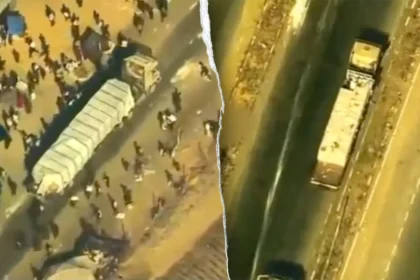

President Trump and Defense Secretary Pete Hegseth are navigating a narrow and “perilous” set of military maneuvers to reopen the Strait of Hormuz, as Iranian asymmetric tactics threaten to paralyze 20% of the global oil trade and drive energy prices to record highs.
Following a Friday evening strike on Kharg Island—Iran’s primary oil export hub—the administration is signaling a shift toward more aggressive containment. While the President stated he has directed the military to avoid destroying Iran’s core oil infrastructure for now, the strike served as a kinetic warning. However, the tactical reality on the water remains grim: the U.S. faces a choice between a slow, dangerous mine-clearing operation or a risky amphibious escalation to seize Iranian territory.
The “Asymmetric” Nightmare: Mines and Drones
The strategic challenge lies in the disparity between U.S. high-tech assets and Iran’s low-cost, high-impact weaponry. Iran possesses an arsenal of over 5,000 naval mines, ranging from World War II-era contact explosives to sophisticated “bottom influence” mines that can remain dormant until a specific number of ships pass over them.
“It’s hard, it’s messy, you’ve got to sort one mine at a time,” said Steven Wills, a navalist for the Center for Maritime Strategy.
Furthermore, the U.S. Navy is currently engaged in a lopsided economic war, using multi-million dollar missiles to intercept Shahed-136 drones that cost as little as $50,000. Erik Bethel, a U.S. Naval Academy graduate and partner at Mare Liberum, warned that even a billion-dollar flotilla is vulnerable to a single “kamikaze” drone boat or aerial strike.
Tactical Options on the Table
Pentagon officials and private analysts have identified three primary courses of action, each carrying significant political and physical risks:
- Island Occupation: Forces could land on Iranian-controlled islands within the Strait to neutralize shore-based missile and drone launchers. While this avoids a full-scale invasion of the mainland, it would be a “complicated expeditionary operation” likely to result in U.S. casualties.
- Naval Escort Missions: The Navy could begin ferrying tankers through the waterway, though Joint Chiefs Chairman Gen. Dan Caine noted that the military must prioritize countering mine-laying capabilities before these “tactically complex” missions can begin.
- Seizure of Kharg Island: By occupying the facility that handles 90% of Iran’s oil shipments, the U.S. could leverage the regime’s own economy to force a reopening of the Strait.
A Diminishing Threat?
Despite the tension, some veteran commanders believe Iran’s “teeth” have been dulled by recent strikes. Retired Vice Adm. Kevin Donegan, former commander of the U.S. Navy’s Fifth Fleet, noted that Iran’s ability to coordinate a planned minefield has dwindled alongside its naval losses.
“The ability to throw mines here and there out of a simple boat is not a hard task,” Donegan said. “But… it is unlikely for Iranian ships to ‘march out’ into the Strait now to place mines without them getting destroyed.”
The Political End Game
For President Trump, the crisis is as much about domestic optics as it is about global security. With 13 U.S. service members already killed in the ongoing conflict, any further escalation carries heavy political weight. Yet, a negotiated settlement that leaves the Iranian regime and its nuclear material intact would contradict the administration’s stated goals for “total victory.”
When asked by Fox News when the conflict would conclude, Trump remained characteristically cryptic: “When I feel it. When I feel it in my bones.”
For now, the world’s energy markets remain on edge as the Pentagon moves 2,500 Marines and three warships from the Indo-Pacific toward the Persian Gulf, waiting for the President’s next move.