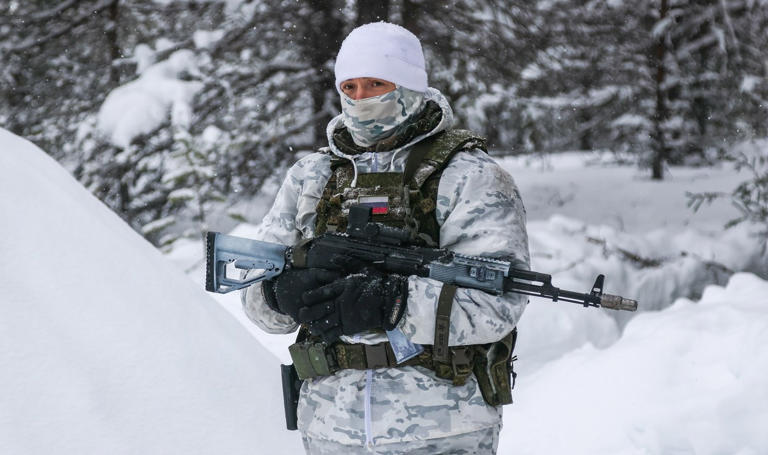

Russia’s growing power in the Arctic is a “grave concern” to NATO, according to Iceland’s foreign minister, as Moscow pushes forward with military expansion and economic projects in one of the world’s harshest but most strategic regions.
“The Arctic remains central to Russia’s strategic calculus, and its activities in the region go well beyond defensive measures,” Þorgerður Katrín Gunnarsdóttir told Newsweek. “Russia’s military posture in the Arctic is of grave concern.”
Newsweek has reached out to Russia’s defense ministry for comment.
For years, Russia has been reopening Soviet-era military bases in the Arctic while also building new ones. Moscow has invested heavily in its Northern Fleet, based in the Murmansk region, which borders NATO members Finland and Norway.
Many of Russia’s key military sites, including those housing nuclear-armed submarines, are located near the Arctic cities of Murmansk and Severomorsk. Despite the strain of more than three years of war in Ukraine, Russia’s Arctic capabilities remain strong.
Climate change is also reshaping the region, melting ice and opening up new routes for trade and military traffic. This shortens shipping paths from Asia to the Atlantic, raising both opportunities and tensions.
“This has implications for both NATO and Russia, as the operational environment becomes more dynamic and contested,” Gunnarsdóttir said.
Russia controls over half of the Arctic’s coastline. Analysts and NATO officials say Moscow sees climate change as both a chance to extract valuable resources and a potential threat to its security.
“As an Arctic nation, this new reality must be appropriately considered and addressed,” Gunnarsdóttir said. “NATO has responded decisively to these developments.”
NATO has increased its Arctic presence in recent years, investing heavily in anti-submarine warfare (ASW). However, Russia’s submarines are still very difficult to track, and experts admit NATO has not fully caught up. Russia also has far more icebreakers than any other country, giving it an advantage in extreme Arctic conditions.
Cooperation on Hold
Seven other nations, including the U.S., Canada, and Norway, all NATO members, also hold Arctic territory. NATO’s reach in the region grew after Finland and Sweden joined the alliance following Russia’s 2022 invasion of Ukraine.
All eight Arctic nations, including Russia, are members of the Arctic Council. The council focuses on issues like climate change and pollution rather than military matters.
But cooperation has suffered since the war in Ukraine. Political collaboration among the Arctic states was suspended in 2022, although limited scientific exchanges and online meetings continue, according to the council.
Denmark took over leadership of the council in May. Russia had been in charge when it launched its full-scale invasion of Ukraine in 2022, and Moscow has said it wants normal council operations to resume.
“We cannot hide the fact that we don’t have a normal modus operandi,” said Torsten Kjølby Nielsen, the Kingdom of Denmark’s Senior Arctic Official.
Nielsen said Denmark’s Arctic representatives remain in direct contact with Moscow but offered few details. Scientists across the Arctic report that data sharing has been disrupted, limiting research and cooperation.
“The efficiency isn’t what it should be,” said Ambassador Kenneth Høegh, chair of the Senior Arctic Officials. “What happens in Canada has an influence in Greenland, [and] what happens in Russia—Siberia—has an influence in Alaska. We need data from the whole region.”
Russia, NATO and China
The Arctic is drawing not just scientists but also militaries, governments, and businesses. Russia sees the region as key to its economic future, with vast reserves of oil, natural gas, and fish stocks.
Russian state media reported in 2022 that the Arctic continental shelf contains more than 85 trillion cubic meters of natural gas and as much as 17 billion metric tons of oil. Other estimates put the oil figure at 13 billion metric tons.
The Northern Sea Route, which runs along Russia’s Arctic coast, is also central to Moscow’s strategy. It shortens shipping times between Asia and Europe and helps Russia move hydrocarbons to global markets. Climate change is making the route more accessible.
China has also shown growing interest in the region. Although Russia was cautious at first, Beijing has become one of the main users of the Northern Sea Route. China was accepted as an observer to the Arctic Council in 2013 and has called itself a “near Arctic” state.
In recent years, China and Russia have drawn closer. Before Russia invaded Ukraine, President Vladimir Putin and Chinese leader Xi Jinping declared a “no limits” strategic partnership.
In mid-2024, the U.S. said it saw “growing cooperation” between Russia and China in the Arctic, with Beijing funding Russian energy projects and even taking part in joint military exercises off the coast of Alaska. In July 2024, NORAD said it intercepted two Chinese bombers and two Russian aircraft near Alaska.
Beijing has called itself an “important stakeholder in Arctic affairs.”
“China’s growing interest in the Arctic adds another layer of complexity,” Gunnarsdóttir said. “While not an Arctic state, China is expanding its presence through scientific, economic and strategic initiatives. All this is a cause for concern and underscores the need for vigilance and unity among NATO allies.”
On the security front, Iceland has pushed for closer Arctic cooperation among the seven NATO allies.
The waters around Iceland, the U.K., and Greenland form the “GIUK gap,” a key naval passage that Russia’s submarines must cross to reach the Atlantic. NATO officials say this makes the region vital to global security.
“The Arctic is not a remote or isolated region—it is a central arena in global security,” Gunnarsdóttir said.