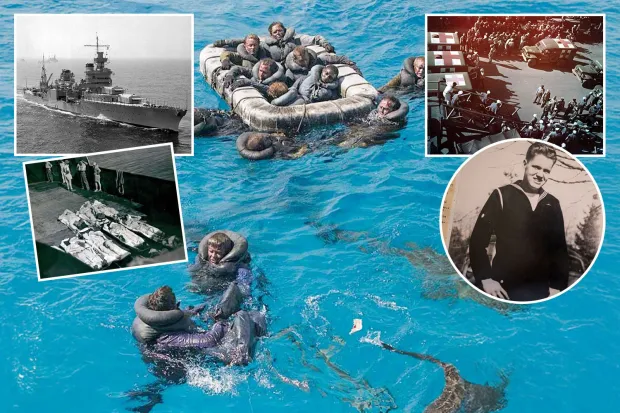

The heavy cruiser USS Indianapolis was racing across the Pacific in the final weeks of World War II, carrying vital components of the first atomic bomb. The mission was completed. The ship’s crew expected to head home. Instead, a quiet night at sea turned into one of the most terrifying maritime disasters in U.S. history — and the deadliest shark attack ever recorded.
Just after midnight on July 30, 1945, a Japanese submarine struck without warning. The first torpedo tore into the cruiser’s starboard bow, igniting aviation fuel in a towering blast. Moments later, a second torpedo detonated near the ship’s powder magazines. Still moving fast, the Indianapolis shuddered, cracked apart, and sank in roughly 12 minutes.
Of the 1,196 men aboard, about 900 made it into the water alive. What followed was a four-day nightmare in open ocean.
Adrift in heat, thirst, and blood
At dawn, survivors gathered into scattered groups. Few had rafts. Many had no life jackets. Under a blazing sun, dehydration set in quickly. Saltwater burns, exhaustion, and despair spread through the ranks. As hours turned into days, hallucinations became common, and some men in delirium endangered others.
Then the sharks arrived.
Oceanic whitetips — large, aggressive predators known to investigate anything struggling at the surface — were first drawn by the explosions and the dead. Soon they turned to the living. Survivors later described sudden strikes from below, a sailor vanishing in seconds, and the constant sense of being hunted. Men tried to push bodies away to divert attention and set up crude “shark watches,” splashing and striking the water when fins circled too close. Sometimes it worked. Often it didn’t.

Still, most deaths were caused not by sharks but by exposure: dehydration, salt poisoning, injuries from the sinking, and sheer fatigue. Life jackets slowly waterlogged and sagged, leaving men barely able to keep their faces above water.
A rescue that almost never came
The Indianapolis managed to transmit distress signals as it went down, but no one responded. The ship’s route was secret, and its failure to arrive wasn’t immediately noticed. Even when U.S. intelligence intercepted a Japanese claim about sinking a major American vessel, it was dismissed as misinformation.
So the survivors drifted with no idea that no rescue had been sent.

On the fourth day, a Navy patrol plane happened to spot men in the water. The pilot radioed the shock of what he saw, and help finally surged toward the area. A seaplane dropped life rafts, and its commander made the risky decision to land in rough seas after witnessing shark attacks, pulling the weakest survivors aboard. Later that night, the destroyer USS Cecil J. Doyle arrived, sweeping the darkness with a powerful searchlight to guide more rescuers to the scene.
By the time the operation ended, only 316 of the roughly 900 men who had entered the water were still alive.
Aftermath: blame, loss, and a tomb beneath the sea
In the months after the disaster, the Navy court-martialed Captain Charles B. McVay III, accusing him of failing to zigzag to avoid submarines. In a bitter irony, the commander of the Japanese sub testified that zigzagging likely wouldn’t have saved the ship — but McVay was convicted anyway.
He endured decades of public blame and hate mail from grieving families. In 1968, he died by suicide. His name wasn’t officially cleared by the Navy until 2001.

The wreck of the USS Indianapolis was found in 2017 more than three miles beneath the Pacific Ocean. It remains untouched, a grave for the hundreds who never came home.
The tragedy later became a chilling cultural touchstone — most famously echoed in Jaws, where Quint’s monologue about the Indianapolis captured a real horror that survivors lived through: days in the sea, surrounded by death, and watched from below by hungry fins.