
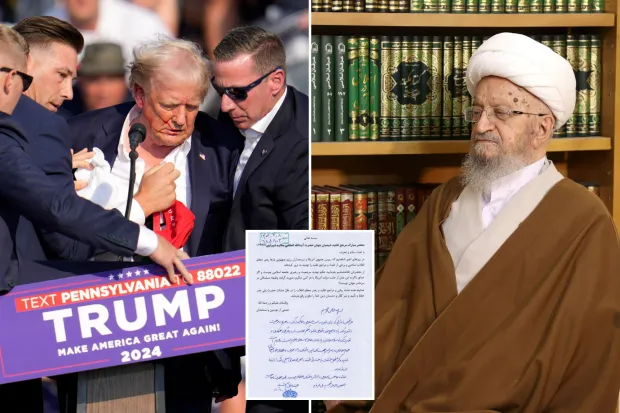

Iran’s hardline leadership has sparked global outrage after senior clerics issued fatwas calling for the execution of former U.S. President Donald Trump, labeling him an “enemy of God” and urging Muslims to make him “regret his actions.”
Top officials and security experts have warned the threats could incite homegrown terrorism and fuel extremist activity in the West.

The incendiary fatwa—an Islamic legal decree—was delivered by Grand Ayatollah Naser Makarem Shirazi in response to Trump’s recent comments about Iranian Supreme Leader Ayatollah Ali Khamenei. Under Sharia law, those accused of “moharebeh”—or waging war against God—can face gruesome punishments, including torture, crucifixion, and dismemberment.
“Barbaric and Dangerous”
In an exclusive statement to The U.S. Sun, Governor Jeb Bush, Ambassador Mark D. Wallace, and UK MP Tom Tugendhat, who all lead the nonprofit United Against Nuclear Iran (UANI), condemned the threats, urging urgent international sanctions and legal action.
“The Iranian regime’s medieval and barbaric threats against the U.S. president and others cannot be ignored – and must not go unanswered,” they said.
They called on the U.S. and its allies to:
- Sanction key Iranian religious figures including Ayatollah Khamenei and his son, Makarem Shirazi, and other senior clerics as Specially Designated Global Terrorists.
- Pursue criminal indictments and request INTERPOL Red Notices against those issuing violent threats.
- Launch a national security review into Iranian officials and their families residing in the West.
Chilling Fatwa and Fundraiser
The fatwa accuses both Trump and Israeli Prime Minister Benjamin Netanyahu of “threatening religious authority”, and explicitly sanctions their deaths. One senior cleric, Najmuddin Tabasi, said:
“The same hand that fired a shot past [Trump’s] ear can put a bullet through his throat.”
Shockingly, extremist cleric Abdolmajid Kharahaani has even launched a fundraiser to hire assassins to target Trump and Netanyahu.
These developments come in the wake of a 12-day military confrontation where U.S. and Israeli forces reportedly crippled parts of Iran’s nuclear infrastructure.
A Series of Threats and Plots
The threats arrive amid a growing list of alleged assassination attempts against Trump:
- July 2024: A gunman fired eight shots at Trump during a rally in Pennsylvania. A supporter was killed and two others injured.
- September 2024: A man armed with a rifle was caught stalking Trump at his Florida golf course.
- October 2024: The FBI uncovered a plot involving an Iranian official ordering a hit on Trump within seven days.
- November 2024: Two New York men were arrested in connection with an Iranian-backed plan to assassinate Trump and other American targets.
“Reward in the Afterlife”
In his ruling, Shirazi instructed Muslims not to cooperate with or support either Trump or Netanyahu. He declared that any Muslim who dies while attacking the two leaders will be rewarded by Allah.
The decree was issued after Shirazi was asked how Muslims should respond to perceived threats against Iran’s religious leadership. Shirazi’s edict mirrors the infamous 1989 fatwa issued against author Salman Rushdie, which led to decades of death threats and a 2022 stabbing attack that left him blind in one eye.
Warnings of a Broader Crackdown
The fatwas appear to also serve a dual domestic purpose, as Tehran ramps up crackdowns on its own population. Hundreds of people have been arrested in recent weeks, many accused of collaborating with Israel.
Executions have spiked. At the funeral of top military commanders killed in Israeli airstrikes, state-organized crowds chanted “Death to America.”
Human rights campaigners warn the Iranian regime, shaken by internal dissent and foreign pressure, is intensifying repression to prevent any potential uprising.
“These calls are incitements to terrorism,” UANI leaders warned. “They are a direct threat not only to President Trump but to U.S. nationals everywhere.”
What Is a Fatwa?
A fatwa is a formal legal or religious ruling issued by senior Islamic scholars—often used to justify action or guide followers. In Shia Islam, such rulings are often binding in countries like Iran, where clerics wield political authority.
The 1989 fatwa against Salman Rushdie—issued for his novel The Satanic Verses—resulted in a $3 million bounty and decades of hiding. It was widely condemned and is often cited as an example of religious extremism weaponized by state power.
As tensions mount and global leaders call for immediate action, the situation has reignited fears that Iran’s religious leadership is once again exporting violence, both against political enemies abroad and its own people at home.


