
On a cold Saturday morning, just over a week before New York City’s mayoral election in November, I stood in a Queens park to speak at a fundraiser for Asiyah Women’s Centre, the oldest and largest shelter supporting American Muslim women who are survivors of domestic violence. Vendors sold everything from chai to embroidered Palestinian handicrafts. A DJ filled the air with music, and artists painted children’s faces in Halloween colors.
I headed for the food stall with the most protein on offer. I lift and squat more than my bodyweight and keep a close eye on my daily intake. “Our kebab is one of Zohran’s favourites,” the man at the King of Kebab stand said proudly and without prompting, as he piled meat onto my plate.
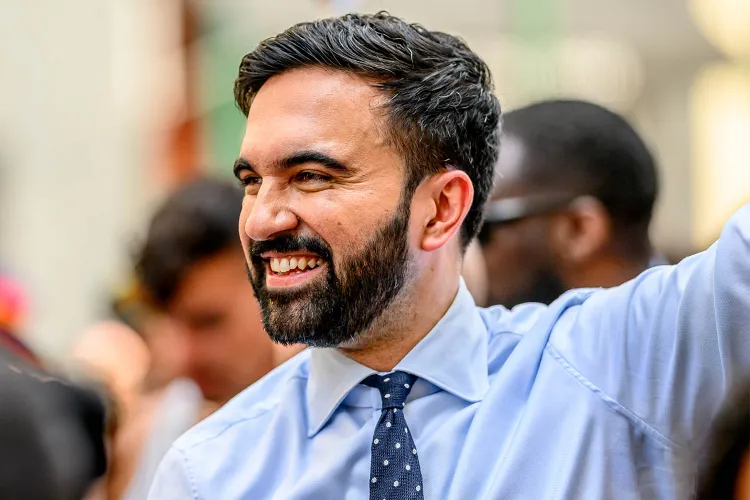
I hadn’t asked him about the mayoral race, but I knew exactly who he meant. Like Cher, Madonna, Beyoncé, and Björk, our mayor-elect is simply Zohran to many of us. Not because we can’t pronounce his last name—I’m looking at you, Andrew Cuomo, and anyone else who insists on mangling “Mamdani.” In New York City, and everywhere else I’ve been, 2025 was the year everyone learned his name. And after he is sworn in today on the steps of City Hall—followed by a party for 40,000 people in Lower Manhattan—2026 will be the year of Zohran.
I’ve been a New Yorker for 23 years. In that time, I’ve traveled the world giving lectures, and I’ve never once been asked what I think of Michael (Bloomberg), Bill (de Blasio), or Eric (Adams)—the mayors who served during my time here. None of them captured the arduous and necessary complexity of identity that so many New Yorkers feel in a city home to more than a million Muslims. Since announcing his candidacy at the end of 2024, Zohran has seemed to represent something deeply familiar—something my life has repeatedly brushed up against during my years here.
I’ve spent 19 of my 23 years in New York living in Harlem, in a rent-stabilised apartment in a brownstone owned by a Black woman from the neighborhood. Mamdani campaigned as an ally to tenants like me, pledging to freeze rents for 2 million people in rent-stabilised apartments as part of his broader focus on affordability. A few weeks before Election Day, my landlady and I ran into each other outside her apartment. “I hope you’re voting for Zohran,” she said.
When I took my citizenship oath in New York in 2011, we were told that people from 140 countries were gathered in the hall, all about to become US citizens. Few cities command the global imagination like New York. And few Muslims have reached Mamdani’s level of first-name recognition—or his ability to complicate narrow ideas of what it means to be Muslim. I’m an unapologetic cannabis consumer, and I cheered during the mayoral debates when candidates were asked whether they’d ever bought marijuana, which is legal in New York. “I’ve purchased marijuana at a legal cannabis shop,” Mamdani said, flashing a big, cheesy grin. Fuck, yeah, Zohran.
I moved from Egypt to Seattle in 2000, then to New York City a year after September 11. Soon after arriving, I found community among Muslims who began calling ourselves progressive Muslims. Most of them, unlike me, were born and raised in the US. Those who didn’t wear hijabs often spoke about how the attacks forced an unfamiliar visibility upon Muslims, who make up less than 2% of the US population. That visibility weighed differently on recent immigrant families than on Black Muslims, whose roots here stretch back to enslavement. “I came out as Muslim after 9/11,” one friend told me, explaining that neighbors and colleagues had assumed he was Latinx. Over the years, I’ve lost count of how many times I’ve said “No hablo español” because people assume I’m Dominican or Puerto Rican.
Mamdani lives in Queens—the same borough where the Asiyah Women’s Centre fundraiser took place. “The capital of linguistic diversity, not just for the five boroughs but for the human species, is Queens,” Rebecca Solnit and Joshua Jelly-Schapiro wrote in Nonstop Metropolis: A New York City Atlas. As many as 800 languages are spoken in New York City, and nowhere has more than Queens, according to the Endangered Language Alliance.
Donald Trump is also from Queens. So is Republican New York City councilwoman Vickie Paladino, who called for the “expulsion of Muslims” after the Bondi Beach massacre. With plans underway in 2026 to intensify efforts to strip naturalised citizens of their US citizenship, the politics of fear and exclusion have felt relentless. In that context, Zohran’s victory feels like a gasp of fresh air.
Mamdani inspires people in the US and beyond because—borrowing and misquoting Robert Frost—he represents the more compelling of two roads diverging in Queens and across the country. He sharpens, and rejuvenates, the choice to embrace social justice and reject hate and nationalism at a moment when older politicians are succeeding through bigotry and chauvinism. He will be the youngest mayor since 1892, the city’s first Muslim mayor, and its first mayor born on the African continent. It feels right that New York is the city that welcomed him first.
The year after I moved to New York, my brother and his wife had a daughter—my family’s first US citizen. Ten years after my move, I was arrested for spray-painting over a racist, Islamophobic, pro-Israel advertisement in the subway. I did it because I didn’t want my niece, her three siblings, or any other American Muslim children to be bullied or forced to choose— as racists insist—between being American and being Muslim.
And now, here in New York City, I can point to Zohran.