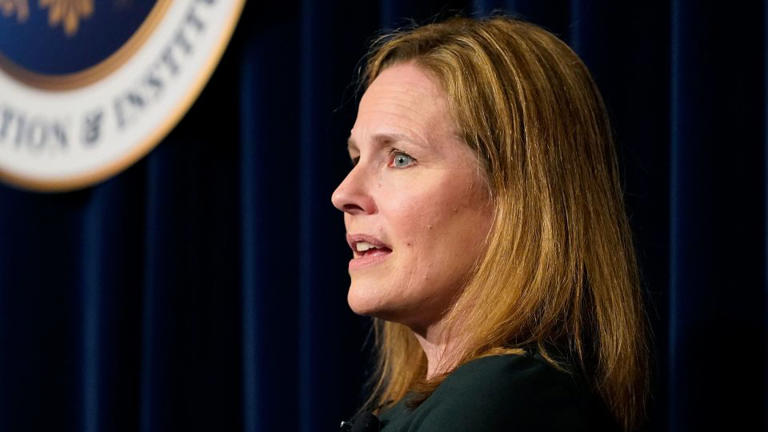

Supreme Court Justice Amy Coney Barrett, in her new memoir, defends her vote to overturn decades of national abortion rights, saying that Roe v. Wade went against the will of the American people and “came at a cost.”
“(T)he Court’s role is to respect the choices that the people have agreed upon, not to tell them what they should agree to,” Barrett writes in Listening to the Law, set to be published on September 9.
CNN obtained access to Barrett’s memoir. In it, she also addresses religious bias and explains how she makes decisions, revealing that her chambers once celebrated with champagne when other justices agreed with a “particularly tricky” opinion of hers.
Barrett, President Donald Trump’s third appointee to the Supreme Court, has become an important justice on the nine-member bench. She often helps shape oral arguments and can provide key votes in major cases.
Her 2020 appointment, filling the vacancy left by the death of liberal Justice Ruth Bader Ginsburg, helped set the stage for the 5-4 decision ending Roe v. Wade.
Barrett, 53, said she wrote the book to give people an easy-to-understand look at how the court works. She warns from the start that she will not reveal details of private case deliberations or use the names of her seven children and other family members to protect their privacy.
She also doesn’t reveal the case that led to the champagne celebration. Given normal book timelines, it’s unlikely she was referring to her recent opinion supporting the Trump administration in its challenge to lower court judges who blocked a birthright citizenship policy.
She reportedly received a $2 million advance for the book, published by the conservative Sentinel imprint of Penguin Random House. Barrett declined CNN’s requests for an interview.
Any work by Barrett is likely to be read by those trying to understand an institution that could influence how fully Trump reshapes America. So far, the conservative supermajority, which Barrett’s appointment strengthened, has rarely blocked his agenda.
Barrett only briefly mentions Trump, writing that the court has always been influenced by its times.
“While the intensity of the challenges faced by the Court ebbs and flows, the challenges themselves will never disappear,” Barrett writes. “Throughout, the job of every justice is to do his or her best by the law.”
Reflections on the Dobbs case
The book’s most detailed parts cover the 2022 case Dobbs v. Jackson Women’s Health Organization, in which a 5-4 majority overturned constitutional abortion rights.
Barrett, who joined the majority opinion by Justice Samuel Alito, says in the book that the court shouldn’t have recognized abortion as a constitutional right in the first place. Two other justices wrote separate statements, but Barrett declined at the time.
She agrees with Alito that Roe v. Wade was an “exercise of raw judicial power.” Barrett argues that the usual respect for precedent didn’t apply because Roe was wrongly decided.
She writes that abortion wasn’t historically considered a fundamental right in the U.S., unlike other constitutional rights: “Abortion not only lacked long-standing protection in American law – it had long been forbidden.”
Barrett also cites Justice Ruth Bader Ginsburg, her predecessor, who said nearly 20 years after Roe that the case may have “halted a political process that was moving in a reform direction,” “prolonged divisiveness,” and “deferred stable settlement of the issue.”
Barrett disagrees with the three liberal justices who dissented in Dobbs and claimed that for 50 years, the court’s abortion-rights decisions protected women’s liberty and equality. She argues that abortion involves a “complicated moral debate” that makes it different from other fundamental rights like marriage, sex, procreation, and contraception.
Barrett recalls that after the Dobbs ruling in June 2022, while on a family vacation, a brother-in-law brought her a copy of the decision, joking that he was following her advice to “read the opinion.” She notes that Dobbs “did not top the list of things I wanted to talk about on vacation,” but she still hugged him.
How the justices operate
The Supreme Court can be confusing with its unwritten rules and complex opinions. Barrett herself can be decisive but also mysterious, as shown in an August case that let the Trump administration halt nearly $800 million in research grants at the National Institutes of Health.
Barrett says she was once frustrated by opinions before joining the court:
“Before I joined the Court, I was sometimes frustrated by an opinion’s cryptic language or its failure to resolve fairly obvious points,” she writes. “Now I better appreciate that glossing over issues is often deliberate.”
She explains that if justices agree on a case’s outcome but differ on some side points, the opinion may be narrowed. Still, she can be frustrated by this: “Skirting issues is sometimes the price of finding common ground – though it’s frustrating to delete points I’d like to make.”
Five justices are needed for a majority. Barrett writes that when she writes an opinion, she works to keep the majority and even gain extra votes.
She describes how her law clerks track which justices will join her opinion:
“The best days are when ‘join’ memos come in quickly and without requests for changes,” Barrett says. “Once, when other justices quickly joined a particularly tricky opinion of mine, my chambers celebrated with an impromptu bottle of champagne. More often, there are requests for edits – some simple and others requiring significant work. The latter requests are not an occasion for champagne, because after the effort of producing the opinion, reworking it is painful.”
Barrett also discusses emergency cases, which the court handles quickly, including recent requests from the Trump administration. She notes that the conservative majority often favors the administration in these cases but admits that the judicial system works better with full briefs, oral arguments, and careful deliberation.
Religion and Feinstein’s “dogma” question
Before the Supreme Court, Barrett was a Notre Dame law professor and a judge on the 7th U.S. Circuit Court of Appeals.
During her 2017 confirmation hearing for the appellate court, Democratic Sen. Dianne Feinstein questioned how Barrett’s Catholic faith might affect her judgments, saying, “the conclusion one draws is that the dogma lives loudly within you. And that’s of concern when you come to big issues that large numbers of people have fought for, for years in this country.”
Barrett writes that people of faith are not the only ones with strong beliefs. Nonreligious judges also face conflicts between personal beliefs and the law.
She also refers to her vote to reinstate the death penalty for Dzhokhar Tsarnaev, convicted in the 2013 Boston Marathon bombing, despite personally opposing capital punishment.
“For me, death penalty cases drive home the collision between the law and my personal beliefs. … Swearing to apply the law faithfully means deciding each case based on my best judgment about what the law is. If I decide a case based on my judgment about what the law should be, I’m cheating.”