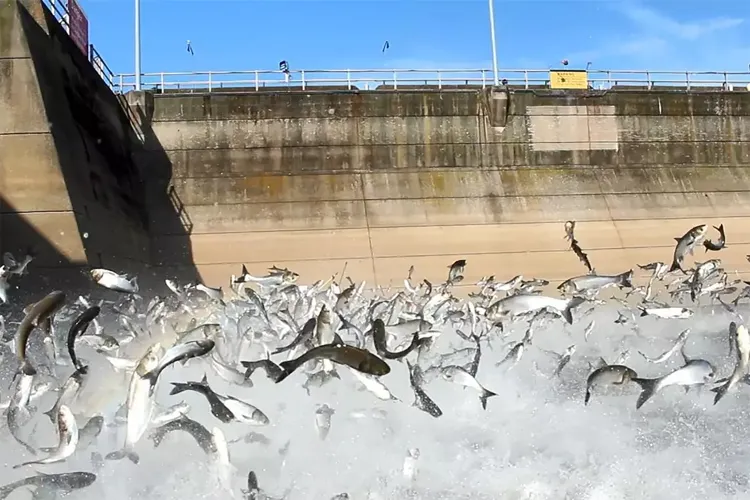

Kansas wildlife officials are answering a question that’s trailed the state’s invasive carp crackdown for years: what happens to the fish once they’re pulled from the Kansas River.
A spokesperson for the Kansas Department of Wildlife and Parks (KDWP) said the carp removed during management efforts are placed back into the river system as part of what the agency described as a “nutrient recycling process.” The fish are returned so they can decompose naturally, allowing the nutrients stored in their bodies to reenter the ecosystem.
“This allows the fish to decompose naturally and ensures the nutrients stored in the fish’s body are returned to the river ecosystem,” the spokesperson said, calling the approach an “environmentally sound” way to complete the process after large-scale removals.
The explanation comes after years of intensive carp removal along the Kansas River. KDWP biologists have removed about 109,000 pounds of invasive carp since organized efforts began in 2022. The campaign’s most productive year came in 2025, when officials removed 36,863 pounds — the highest annual total so far.
:max_bytes(150000):strip_icc():focal(749x0:751x2):format(webp)/silver-carp-jumping-barkley-012626-6cbc462172424713a0b3e88c1a77c9dd.jpg)
The work focuses on three invasive species found in Kansas waters: silver, bighead and black carp. First brought to the U.S. from Asia in the 1970s for aquaculture, the fish later escaped into waterways and spread across the Midwest. They reproduce quickly, feed heavily on plankton and can outcompete native fish for food.
KDWP invasive carp biologist Liam Odell said the sustained removals appear to be making a difference. He noted that biologists are seeing declines in carp populations in areas where efforts have been concentrated, along with signs that native species are returning.
Kansas’ program is part of a broader, multi-state push to control invasive carp throughout the Mississippi River basin. The U.S. Fish and Wildlife Service says management programs across the basin now remove more than 20 million pounds of invasive carp from U.S. waters each year.
In August 2025, the agency announced nearly $19 million in funding to support carp removal, monitoring and prevention efforts across 18 states, including Kansas.
:max_bytes(150000):strip_icc():focal(449x0:451x2):format(webp)/invasive-carp-removal1-012626-0dad963d5582487494ed244669020ea9.jpg)
In Kansas, biologists use a combination of electrofishing, gill nets and specialized gear — including an electrified dozer trawl built specifically for carp removal. In 2025, the effort expanded 15 miles downstream. Meanwhile, the Bowersock Dam in Lawrence, Kan., continues to act as a barrier to prevent the fish from moving farther upstream.
KDWP officials say removals will continue year-round and could expand as research and funding allow, stressing that keeping invasive carp under control remains essential to protecting native ecosystems — even after the fish are out of the nets.