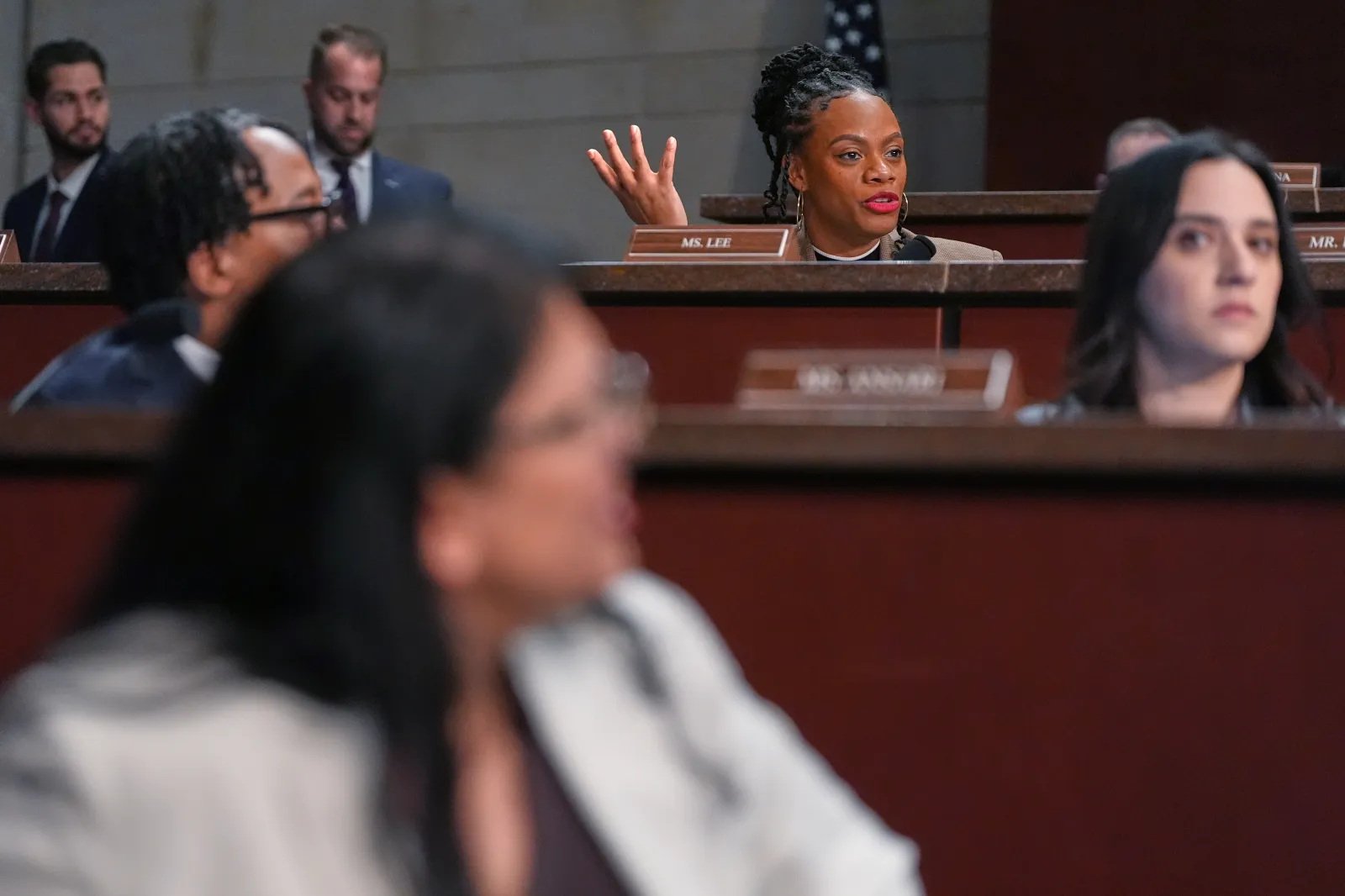

A Republican-led House committee on Wednesday voted to advance resolutions recommending contempt of Congress citations against former President Bill Clinton and former Secretary of State Hillary Clinton, escalating a confrontation tied to the committee’s investigation into Jeffrey Epstein. If the full House takes up and approves the measures, it would mark a rare — and politically explosive — attempt to use one of Congress’s most aggressive enforcement tools against a former president.
In bipartisan votes, the House Oversight Committee approved the contempt recommendations and sent them to the full House for possible consideration. Republicans largely backed the resolutions, while Democrats split — with several progressive members supporting the effort as a matter of transparency, even though it targets a former Democratic president and first lady.
The committee voted 34–8 to advance the recommendation against Bill Clinton, with two members voting present. A separate contempt recommendation against Hillary Clinton passed 28–15, with one member voting present. Nine Democrats joined Republicans in supporting the contempt measure against Bill Clinton, while three Democrats voted with Republicans to advance the recommendation against Hillary Clinton.
Newsweek reached out to Bill Clinton’s office via email on Wednesday night for comment.
Democrats Voting in Favor of the Contempt Resolutions
Bill Clinton contempt resolution (9 Democrats):
- Rep. Maxwell Frost of Florida
- Rep. Raja Krishnamoorthi of Illinois
- Rep. Summer Lee of Pennsylvania
- Rep. Stephen Lynch of Massachusetts
- Rep. Ayanna Pressley of Massachusetts
- Rep. Emily Randall of Washington
- Rep. Lateefah Simon of California
- Rep. Melanie Stansbury of New Mexico
- Rep. Rashida Tlaib of Michigan
Hillary Clinton contempt resolution (3 Democrats):
- Rep. Summer Lee of Pennsylvania
- Rep. Melanie Stansbury of New Mexico
- Rep. Rashida Tlaib of Michigan
Contempt of Congress and the Epstein Investigation
The votes followed the Clintons’ refusal to comply with subpoenas seeking testimony connected to Epstein, the wealthy financier who sexually abused dozens of teenage girls over many years. Epstein died by suicide in a New York jail in 2019 while awaiting trial on federal sex trafficking charges.
If the full House approves the contempt citations, they would be referred to the Justice Department, potentially opening the door to criminal prosecution. Convictions for contempt of Congress can carry penalties including fines and jail time, though such cases are uncommon and often legally complicated.
Committee Chairman Representative James Comer of Kentucky said the Clintons have responded to subpoenas with “defiance,” not cooperation.
“Subpoenas are not mere suggestions,” Comer said at the start of the hearing. “They carry the force of law and require compliance.”
Lawmakers from both parties say the investigation is aimed at understanding how Epstein avoided accountability for so long — and whether influential figures helped protect him. Public court records and flight logs have documented Epstein’s connections to prominent individuals, including Bill Clinton and President Donald Trump, though neither has been accused of wrongdoing.
The Clintons argue the subpoenas are invalid, saying they lack a legitimate legislative purpose.
Partisan Flashpoints — and a Wider Fight Over Scrutiny
While Bill Clinton, Trump and many others linked to Epstein have not been accused of wrongdoing, the investigation has intensified disputes over who should face the sharpest scrutiny. A spokesman for the Clintons, Angel Ureña, said on social media Wednesday that the couple is trying to assist the probe, but emphasized that “both Clintons have been out of office for over a decade” and that neither had anything to do with Epstein for more than 20 years.
Their attorneys also argue Congress has limited authority to compel testimony from a former president, pointing to historical precedent.
Comer said the committee moved toward contempt after months of what he described as stonewalling.
“Every witness gets the same treatment,” Comer said. “No one is above the law.”
Signs of Negotiation Amid Uncertainty
Even as tensions rose publicly, committee officials said there were behind-the-scenes efforts to avoid a full contempt showdown. According to officials, longtime Clinton attorney David Kendall proposed that the Clintons testify around Christmas, including on Christmas Eve.
The committee rejected the proposal. Comer also turned down an offer for a private interview with Bill Clinton in New York conducted by Comer, the committee’s top Democrat, Representative Robert Garcia of California, and staff.
Comer has insisted any testimony must be in the form of a transcribed deposition.
“You have to have a transcript in an investigation,” he said. “So no transcript, no deal.”
Even if the resolutions move forward, their future in the full House is uncertain. Passage would require a simple majority — something Republicans have struggled to secure at times amid internal divisions.
Clintons Push Back on Subpoenas
In a letter released last week, the Clintons criticized Comer for pushing their testimony while the Justice Department has missed a congressionally mandated deadline to release its full cache of Epstein-related files.
The Clintons say they were unaware of Epstein’s crimes and have offered written statements describing what they characterize as limited interactions with him.
“We have tried to give you the little information we have,” they wrote. “We’ve done so because Mr. Epstein’s crimes were horrific.”
They also argue their testimony would not meaningfully advance legislation and that Congress is improperly inserting itself into an ongoing federal investigation.
How Contempt Has Been Used Historically
Contempt of Congress is an extraordinary tool, historically deployed in major investigations — including the 1940s House inquiries into alleged Communist influence in Hollywood and the Watergate investigation involving President Richard Nixon.
More recently, former Trump advisers Steve Bannon and Peter Navarro were convicted of contempt after refusing to comply with subpoenas from the House committee investigating the January 6, 2021, attack on the U.S. Capitol. Both served prison sentences.
That committee also subpoenaed Trump but later withdrew the request after his attorneys argued that longstanding precedent protects former presidents from being compelled to testify before Congress.
No former president has ever been successfully forced to appear before Congress, though some have testified voluntarily.
Democrats Split Over Clinton Focus
Democrats on the Oversight Committee largely avoided mounting a full-throated defense of the Clintons, instead stressing the importance of a thorough Epstein investigation.
“No president or former president is above the law,” Garcia said.
Several Democrats criticized Comer for focusing on the Clintons while the Justice Department remains behind schedule in releasing Epstein files. They also noted that Comer has accepted written statements from several former attorneys general and questioned why similar accommodations could not be offered to Bill Clinton.
“It’s interesting that it’s this subpoena only that Republicans have been obsessed about,” Garcia said.
The committee has also subpoenaed Ghislaine Maxwell, Epstein’s longtime associate who is serving a lengthy prison sentence for sex trafficking. Comer said the committee plans to interview Maxwell next month. Attorney General Pam Bondi is scheduled to testify before the House Judiciary Committee in February.
The investigation has increasingly blurred partisan lines, fueled by bipartisan frustration over delays in releasing unredacted case files. That pressure led to a joint subpoena ordering the Justice Department and Epstein’s estate to turn over records, with Republicans later pushing to include the Clintons among the witnesses.
Stansbury said on the House floor: “I am deeply troubled that the individuals who are the subject of today’s hearing did not appear on their scheduled date. No one is above the law. But I do know that they have been corresponding with you regularly to try to resolve this issue. But I don’t believe that’s what this hearing his actually about. Because if it was about actually about justice and the truth, we would have Pam Bondi here. We would be hearing from the survivors themselves.”