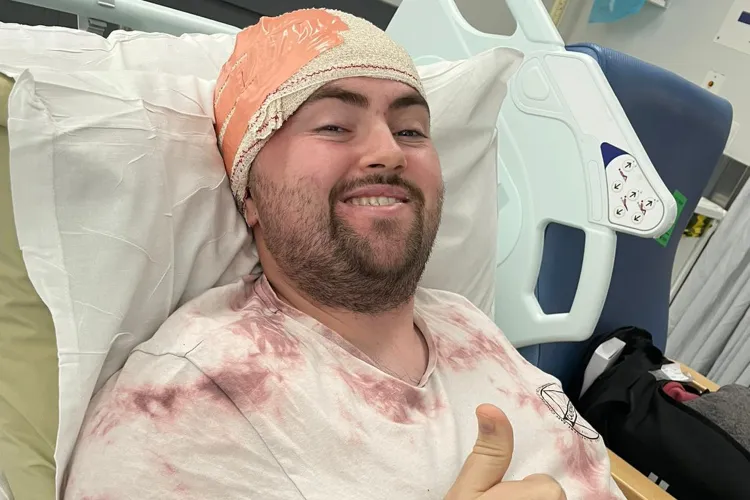

A 31-year-old man from England who believed he had injured himself while weight training was stunned to discover his symptoms were actually caused by brain cancer.
Sean Sweeney, from South Yorkshire, was diagnosed with a high-grade brain tumor in July 2022, according to U.K. charity Brain Tumour Research.
Months earlier, Sweeney began experiencing frequent headaches, neck pain, and tingling down the right side of his body. Assuming he’d hurt himself at the gym, he booked several physiotherapy appointments. However, he was eventually discharged after clinicians were unable to identify the cause of his pain.
“That was worrying,” Sweeney recalled. “I remember feeling frustrated and unsettled, thinking, ‘I don’t feel right,’ but not being able to explain why. I was struggling to concentrate, and the symptoms just kept lingering.”
In July, his condition suddenly escalated when he suffered a seizure in the early hours of the morning. He was woken by his partner of 12 years, Lucy, and rushed to Doncaster Royal Infirmary. After a CT scan, a junior doctor told him a lesion had been found on his brain.
:max_bytes(150000):strip_icc():focal(749x0:751x2):format(webp)/sean-sweeney-010726-3-6cd6107dc92243a081db8dd173d939fe.jpg)
“I felt completely numb,” Sweeney said. “I didn’t cry or panic — my thoughts went straight to Lucy and my family.”
Doctors initially believed the tumor might be low-grade. Before surgery, Sweeney and Lucy decided to get married. However, following a nine-hour craniotomy in November 2022, he was diagnosed with a grade 3 astrocytoma — a more aggressive form of brain cancer. He was later told his life expectancy could be around 10 years.
During surgery, Sweeney also suffered an acute stroke.
“Because I was awake, I remember the moment things changed,” he said. “I could hear the psychologist telling the surgeon that my speech was becoming slurred. The next day, physiotherapists noticed problems with my walking, and one side of my face had dropped.”
Although the experience was frightening, Sweeney said rehabilitation helped him make a strong recovery. “Today, you wouldn’t know I’d had a stroke at all,” he said.
:max_bytes(150000):strip_icc():focal(749x0:751x2):format(webp)/sean-sweeney-010726-2-37bb470ff3ff42d5ad6427394dc9a586.jpg)
In January 2023, he began five weeks of radiotherapy, followed by 12 rounds of chemotherapy, which he completed in February 2024.
“Telling my mum, Kathleen, was incredibly difficult,” Sweeney said. “She was shocked and thought the surgery meant I was cured. It took time and many hard conversations for her to understand that there is no cure for my tumour.”
Now focused on rebuilding his life, Sweeney continues to manage the long-term effects of his diagnosis. Two years on, he has returned to work, taken up cycling again, and is fundraising for Brain Tumour Research alongside his family.
Sharing his story, Sweeney hopes to offer encouragement to others facing a similar diagnosis. “If there’s one message I’d give,” he said, “it’s to stay positive and try not to dwell on what’s out of your control. It’s not easy, but I truly believe a positive mindset can help you keep moving forward.”