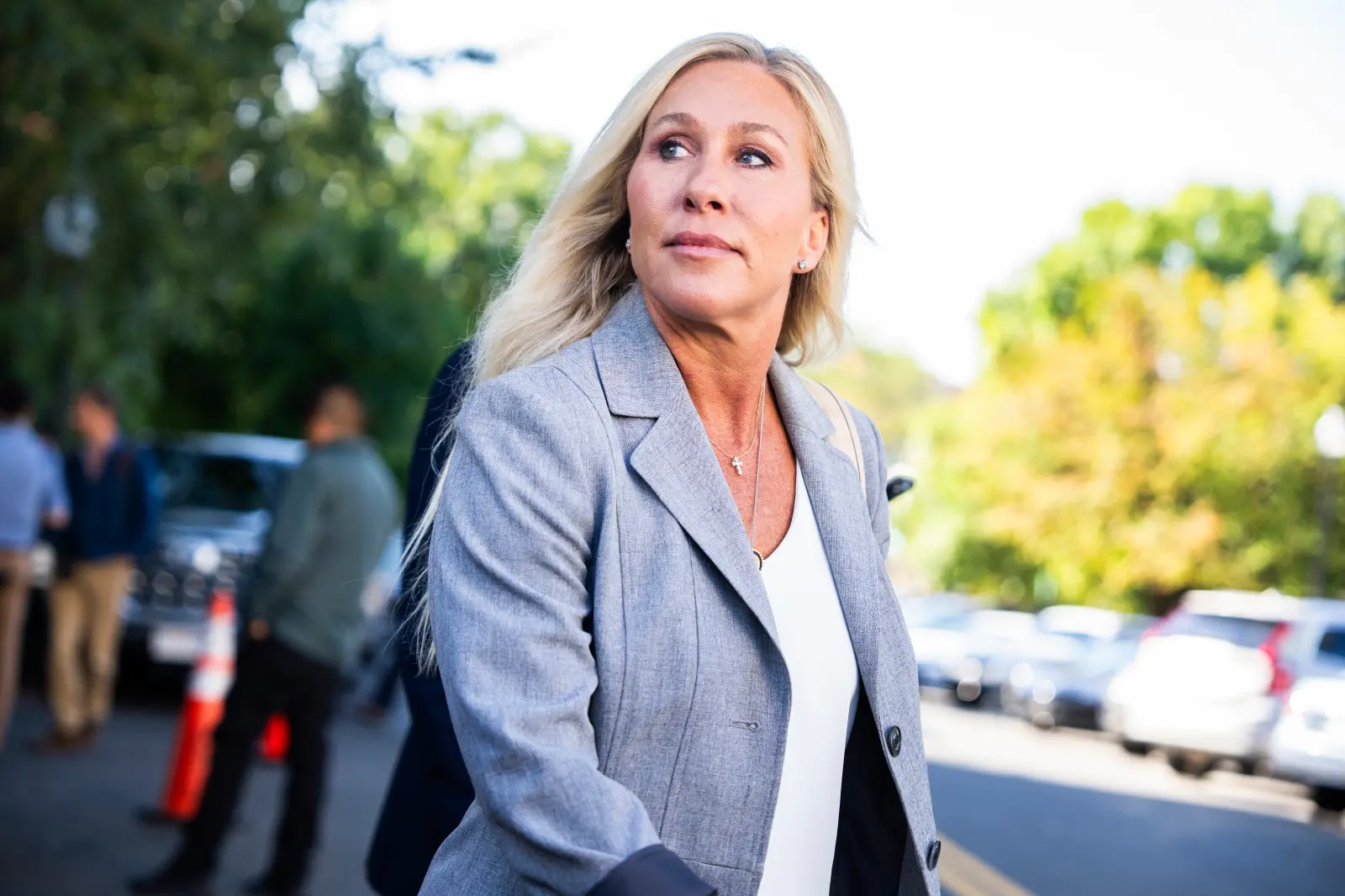

Representative Marjorie Taylor Greene’s chances of becoming the Republican nominee in the 2028 presidential election have nearly doubled in the past week, according to prediction platform Polymarket.
On November 10, the Georgia congresswoman was trading at about a 2.3 percent chance of being the GOP candidate. This week, her implied odds have climbed to around 4 percent, placing her ahead of figures such as Florida Governor Ron DeSantis and Donald Trump Jr. on the platform. Newsweek has contacted Greene’s press office via email for comment.
Why It Matters
Greene overtaking several high-profile Republicans is notable because she has previously dismissed speculation that she intends to run for president in 2028.
In recent months, her political positioning has shifted in ways that have sometimes put her at odds with the Trump administration on issues including foreign policy, the president’s One Big Beautiful Bill, the release of the Jeffrey Epstein files, and the recent government shutdown.
These moves may have influenced bettors’ perceptions of her future prospects, though it is difficult to pinpoint exactly what is driving the recent surge in activity around her on the market.
What To Know
Polymarket, a New York–headquartered cryptocurrency-based prediction market, allows users to wager on the likelihood of various outcomes, including who will secure the 2028 Republican presidential nomination. The pricing reflects what participants think the probability of an outcome is, rather than whether they personally favor that outcome.
Vice President JD Vance has consistently led the Polymarket contract for the 2028 GOP nomination, with traders giving him roughly a 56 percent chance of running and emerging as the Republican candidate. He also remains the leading contender by a wide margin in national polling.
As of Monday morning, Secretary of State Marco Rubio was in second place on Polymarket at 8 percent. Greene was tied for third with President Donald Trump at 4 percent, followed by Tucker Carlson at 3 percent, while DeSantis and Trump Jr. each stood at 2 percent.
On Sunday, Greene’s contract saw a sudden jump: her implied probability climbed from 2.7 percent on November 15—just behind Trump—to 3.9 percent on November 16, nudging her about 0.6 percentage points ahead of him. Until then, her odds had hovered at 2.7 percent on the platform for several months.
Hans Noel, a professor of government at Georgetown University, said that while Greene’s rise is interesting, the numbers should be kept in perspective.
While Greene’s chances have almost doubled on the platform over the course of a week, Noel noted that prediction markets this far out from the nomination can be “affected by a lot of things, especially this far out from the nomination.” At this stage, he said, pricing is driven largely by “name recognition and other chatter more than what will actually happen in two and a half years,” adding that a shift from 2 to 4 percent is still “pretty small.”
Noel also stressed that many market participants are trading on price movements, not simply on who they think will win. Investors in these markets “aren’t necessarily betting on the outcome, but on how each stock will rise and fall.”
“Buying now may just be based on the belief that the price will go up in the coming years, and then the buyers can sell when it reaches 10 or 15,” he explained, arguing that much of the current movement is about “predicting the future market, not the ultimate outcome.”
Regarding Greene’s recent bump, Noel suggested that “before today, fewer people thought Greene was even going to run for president. Now more people think she might declare, which probably gives her a bump.” He also pointed out that she has been in the news frequently, especially “in the context of who or what might challenge Donald Trump’s hold on the Republican Party.”
What People Are Saying
Earlier this month, Greene told NewsNation that she is not focused on a presidential bid in 2028, saying: “The only thing that I’m focused on is being a representative for my district.”
Noel believes her current trajectory says more about her growing profile than about the eventual nominee.
“I don’t think it shows much of anything about who will be the nominee, but it does show that Greene is creating a brand for herself that challenges the current direction of the party, and that people are noticing,” he said. “But it’s a long way from that to winning. Her chances of being a possible candidate for the nomination are modest. She might decide that running is a good move. I think it’s far less likely that she wins the nomination and becomes the Republican candidate.”
He added that the attention on Greene’s prediction market performance underscores how observers are already thinking about the post-Trump era of the Republican Party. “A lot depends on the direction that the party goes,” he said. “She is clearly trying to differentiate herself from Trump while also claiming many of the populist goals that made Trump popular in the first place. So that’s one direction, and she’s likely to be involved in shaping that direction.”
Miles Coleman, associate editor of Sabato’s Crystal Ball, the University of Virginia Center for Politics’ nonpartisan newsletter on American campaigns and elections, said Greene’s recent moves could be viewed both as principled and strategic.
“On one hand, Greene may just sincerely care about getting the Epstein files out, if for no other reason than to expose wrong-doers and give his victims a sense of closure,” Coleman said. “On the other hand, it would be easy to interpret this as a more calculated move. You can begin to see how she’d be creating a ‘lane’ for herself in a post-Trump primary, as she’s shown independence on this, as well as on some foreign policy stances that the administration has had.”
He added that some of her recent rhetoric, including her concerns about voter polarization, “seems so post partisan,” and speculated that such themes could appeal to swing voters if she ever reached a general election.
“All that said, it’s usually easier to run for an office if one already holds office,” Coleman continued. “In other words, if she were to run in 2028, Greene may want to at least have the platform that her House seat brings. If Trump gets involved against her in the 2026 primary, it could make for an early test of her own ‘brand.’ In past cycles, notably 2022, Trump made a point to go after Republicans that were perceived as ‘crossing’ him.”
What Happens Next?
No major Republican figure has formally declared a 2028 presidential run, and with years to go before the next election, Polymarket’s pricing is likely to keep shifting as new developments unfold.
For now, Greene’s rising odds indicate that more traders see her as a plausible contender—or at least as a figure whose political stock could continue to rise—even if the road from online markets to a party nomination remains long and uncertain.