
Linda Doane always considered herself healthy — until a sudden health crisis at age 41 revealed something far more serious.
The mother of five recalls first experiencing trouble breathing, which led to a lengthy hospital stay, seven lung taps, and extensive testing. Doctors eventually diagnosed her with stage 4 non-Hodgkin’s lymphoma.
The journey that followed lasted more than a decade. “I’ve had eight different IV chemotherapies and three oral chemotherapies. I’ve lost my hair three times. Methotrexate was injected into my spinal fluid, and the cancer spread to my brain,” she says. “There were countless pokes and procedures. I know what it means to go through hard things.”
:max_bytes(150000):strip_icc():focal(665x0:667x2):format(webp)/Woman-with-cancer-111325-3-e44c77b1edfd4bd8bff11166f8db0887.jpg)
Throughout treatment, Doane stayed committed to exercising and keeping a routine. But when she lost her hair for the third time, she began avoiding public workouts. Her sister and brother-in-law introduced her to their Tonal workout machine — something that soon became central to her recovery.
In August 2021, she underwent her second CAR T-cell therapy, a cutting-edge approach using the patient’s own immune cells. It penetrated her brain barrier, and from that point until May 2025, she remained consistent with her workouts two to four times each week. By 2022, she received life-changing news: she was in remission.
But in May 2025, everything changed again.
What began as a mild cough turned into urgent care visits and a pneumonia diagnosis. Within days, she was rushed via ambulance to the hospital, and by the third day, her family was told to come say goodbye.
:max_bytes(150000):strip_icc():focal(665x0:667x2):format(webp)/Woman-with-cancer-111325-4-540ef831c6e14e9fb82e57dec98822c0.jpg)
Her husband took photos of her medical readings and ran them through an AI software tool, which recommended ECMO (extracorporeal membrane oxygenation) — a form of life support that temporarily replaces heart and lung function. The hospital didn’t have ECMO available, so she was flown to their sister facility — a high-risk decision that saved her life.
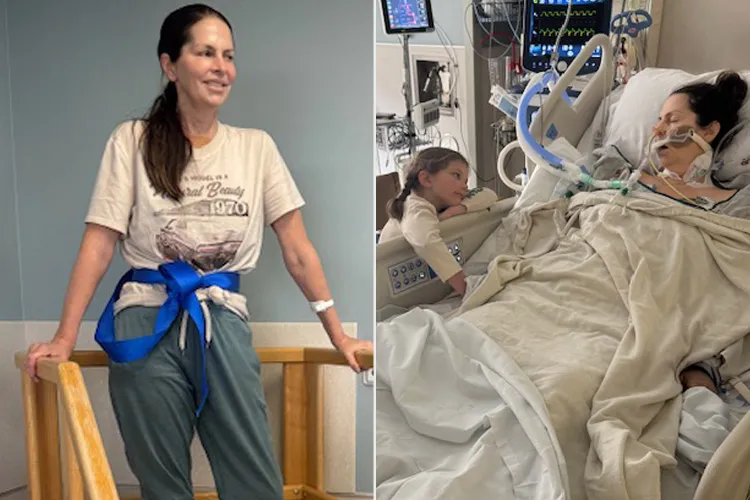
“I woke up tied to the bed, on a ventilator, and it was the hardest thing I’ve ever experienced,” she recalls. She spent two weeks on ECMO, and afterward remained on a ventilator and feeding tube — unable to move for 42 days.
Doctors later put her struggle into perspective: “Out of more than 1,100 beds in this hospital, you were the sickest person here,” one told her.
Once stable enough, she transitioned to different breathing support and intensive physical therapy. Years of conditioning helped her push forward. Though she lost immense muscle and strength, she was determined: “The more I do for myself, the faster I will recover,” she told her husband.
Within two weeks she transitioned from walker to cane — and two months later, she was back on her Tonal machine.
She later returned to the hospital with a gift basket to thank the teams who saved her. Many could not believe she had survived, let alone regained such strength so quickly — as roughly half of ECMO patients do not make it.
:max_bytes(150000):strip_icc():focal(999x0:1001x2):format(webp)/Woman-with-cancer-111325-1-8f8b797910a8411189451e15172e42b6.jpg)
Today, nearly six months after that crisis, her medical care now involves periodic scans and bloodwork to ensure the cancer hasn’t returned.
Doane says the experience reshaped her understanding of preparation and resilience.
:max_bytes(150000):strip_icc():focal(665x0:667x2):format(webp)/Woman-with-cancer-111325-2-3d8fe06b495f4229add0ba63c9c439df.jpg)
“We never know what challenges we will face,” she explains. “If there’s anything we can do physically, spiritually or emotionally to prepare, we should. Tonal prepared me for the hardest, most traumatic experience of my life.”
Her message is rooted in gratitude and hope:
“Do the pre-work. Then whatever comes, we can face it. Life is a blessing — and there’s so much joy to be found every day. Being alive is a blessing.”