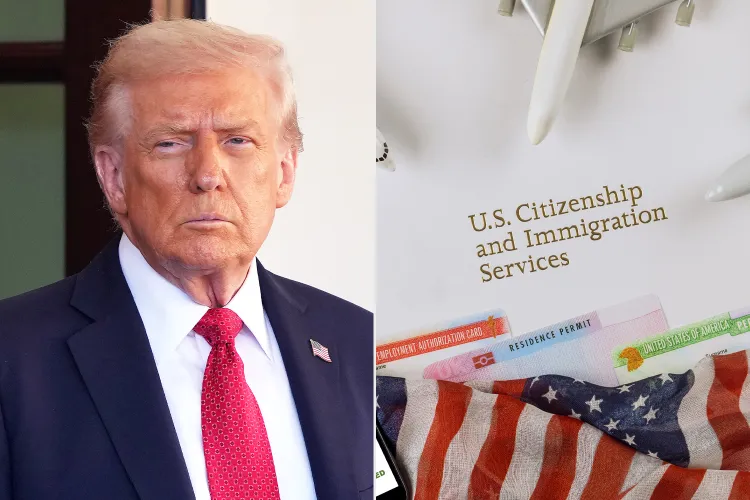

The U.S. citizenship test has become tougher following changes introduced by President Donald Trump’s administration, doubling both the number of questions and the passing requirement for applicants.
According to a news release from the U.S. Citizenship and Immigration Services (USCIS) on Oct. 20, the 2020 Naturalization Civics Test has been updated to “ensure proper assimilation of lawful immigrants into the United States and promote a unified American identity and attachment to the Constitution, laws and founding principles of the United States.”
USCIS stated that the revision aims to provide a clearer sense of what prospective citizens must know about “U.S. history and the principles and form of government in the United States,” as required under section 312 of the Immigration and Nationality Act (INA).
:max_bytes(150000):strip_icc():focal(818x360:820x362):format(webp)/American-Flag-071824-6c715ead0f164e5b92f6fb93ad808173.jpg)
Major Changes to the Test
The updated civics portion now includes 20 questions instead of 10, and applicants must correctly answer at least 12 to pass — double the previous threshold of six.
Examiners must also end the interview immediately once the applicant either answers 12 correctly or gives nine incorrect responses.
The new test version applies to those who filed their citizenship application on or after Oct. 20, while individuals who applied earlier will continue taking the 2008 version. Applicants aged 65 and older who have lived in the U.S. as lawful permanent residents for at least 20 years are still eligible for a simplified 10-question version, drawn from a pool of 20 specially selected questions.
Expanded Question Bank
The number of possible civics questions has increased to 128 (from 100 previously). These cover topics such as:
- Who makes federal laws
- What the Constitution does
- Who lived in America before European settlers arrived
- Naming three of the 13 original states
- Identifying two national U.S. holidays
- Stating two of the three rights listed in the Declaration of Independence
Applicants must also demonstrate proficiency in reading, writing, and speaking English as part of the citizenship process.
:max_bytes(150000):strip_icc():focal(749x0:751x2):format(webp)/us-citizenship-paperwork-102425-c01b6d9d932b4b90a26919f1475b10f7.jpg)
Supporters and Critics Weigh In
Joseph Edlow, director of USCIS, said in September that the older test was “just too easy” to pass.
“We need to make it a little bit more challenging,” he explained. “We’ve got to make sure that people are actually understanding what it means to be a U.S. citizen, what it means to get that benefit.”
However, many advocacy and education groups have criticized the changes. Organizations including Clinic Legal Immigration Network Inc. (CLINIC) and the Citizenship Test Working Group (CTWG) — along with over 120 other national, state, and local groups — argued in a joint letter that the new version disproportionately burdens test takers with “low literacy, limited financial resources, lack of access to preparation materials, and older applicants who may find the increased complexity difficult to navigate.”