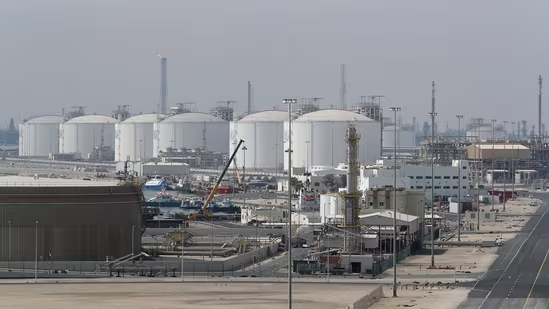

Global energy markets entered a period of extreme volatility Thursday as Iranian forces launched a series of coordinated strikes against critical energy infrastructure in the Persian Gulf. The attacks, which targeted a primary liquefied natural gas (LNG) terminal in Qatar and refineries in Kuwait, have pushed Brent crude toward $114 per barrel and ignited fears of a prolonged global inflationary spiral.
Escalation in the Gulf: Critical Infrastructure Hit
The Iranian offensive marks a significant expansion of regional hostilities, appearing to be a direct retaliation for recent Israeli strikes on Iranian gas fields.
- Qatar’s Ras Laffan Terminal: A drone swarm disabled the Ras Laffan shipping terminal, the world’s premier gateway for LNG. Qatar accounts for approximately 20% of the global LNG supply; the facility’s shutdown effectively freezes a fifth of the world’s seaborne gas trade.
- Kuwaiti Refineries: Two major oil refineries in Kuwait were confirmed hit, further tightening the global supply of refined petroleum products.
- Strait of Hormuz: The strategic waterway remains largely closed to tanker traffic. With the Ras Laffan closure, energy analysts warn that Middle Eastern gas now has “nowhere to go,” creating a localized glut and a global shortage.
Market Reaction: Oil and Gas Prices Surge
The immediate impact on commodity pricing was swift and severe. Investors are now pricing in a “long-term disruption” premium as the safety of Gulf infrastructure is no longer guaranteed.
| Benchmark | Current Price / Change | Context |
| Brent Crude | ~$114.00 / Barrel | Up from $73 prior to the conflict. |
| U.S. WTI Crude | $96.45 (↑ 1.1%) | Steady climb amid domestic supply concerns. |
| European TTF Gas | ↑ 24% | Acute pressure on EU energy security. |
| Henry Hub (U.S. Gas) | ↑ 3.3% | Rising domestic costs for heating and industry. |
Wall Street and Global Equities Retreat
The energy shock has acted as a “macro wrecking ball,” according to market analysts. On Wednesday, the S&P 500 fell 1.4%, while the Dow Jones Industrial Average dropped 1.6%.
The downturn is exacerbated by a U.S. wholesale inflation report showing a jump to 3.4%—a figure recorded before the current energy spike. Federal Reserve Chair Jerome Powell signaled a pause in interest rate cuts, citing the unpredictability of oil prices and the ongoing impact of President Trump’s tariff policies.
Asian Markets Under Pressure
Energy-dependent economies in Asia bore the brunt of Thursday’s trading:
- Tokyo’s Nikkei 225 plummeted 3.4% after the Bank of Japan held interest rates at 0.75%, explicitly citing Middle East volatility as a primary risk.
- Seoul’s Kospi and Hong Kong’s Hang Seng dropped 2.7% and 2.0% respectively.
- India’s Sensex fell 2.3%, reflecting the nation’s high sensitivity to crude oil import costs.
Investigative Outlook: The Inflationary Wave
The primary concern for economists is no longer just the immediate price at the pump, but the secondary “wave” of inflation. High energy costs act as a tax on manufacturing and logistics. If the Strait of Hormuz remains impassable and Qatari LNG remains offline, the global economy faces a “debilitating” contraction risk.
The U.S. Dollar continues to strengthen against major currencies, fueled by rising Treasury yields. While a strong dollar provides some cushion for American consumers, it increases the debt-servicing burden for emerging markets, further destabilizing the global financial landscape.