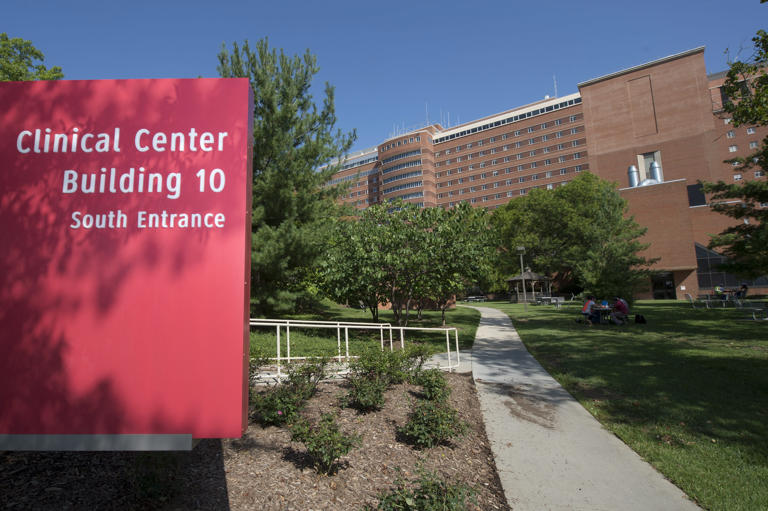

A woman was detained by federal immigration authorities while trying to get medical care at the National Institutes of Health (NIH) hospital, according to an internal document and an NIH official familiar with the situation.
The woman, who was already a patient, was stopped at a security checkpoint at the NIH Clinical Center in Bethesda, Maryland, because her state driver’s license did not meet new federal security rules. When officials checked, they found she had an order for removal and called U.S. Immigration and Customs Enforcement (ICE).
She was supposed to receive care through the National Institute of Arthritis and Musculoskeletal and Skin Diseases. The NIH official spoke on the condition of anonymity because they were not authorized to talk to the media.
A spokesman for the Department of Health and Human Services, which oversees NIH, confirmed the detention.
“We are grateful to NIH security for stopping an illegal immigrant trying to enter the NIH campus Thursday,” said Andrew Nixon, the spokesman. “NIH clinical trials are for people here legally, including citizens or those with proper visas. We appreciate our law enforcement partners for acting quickly to protect patients and staff at NIH.”
The Department of Homeland Security did not immediately comment.
The documents and official did not say the woman’s name or the date of her detention. It is not clear what her immigration history is. Judges usually issue removal orders after evidence shows a noncitizen should be deported.
Maryland allows undocumented immigrants to get driver’s licenses, though it is unclear if the woman had one. Most federal buildings require a Real ID or another approved ID, like a passport. Real IDs are meant to prevent fake licenses.
Hospitals are usually considered “sensitive locations” where immigration enforcement is limited. Experts say that detentions at hospitals can scare people away from getting medical care, especially undocumented immigrants.
President Donald Trump has instructed ICE to increase detentions and deportations of immigrants. Early in his second term, his administration removed protections that limited ICE actions near hospitals, schools, and churches.
Matthew Lopas, director of state advocacy at the National Immigration Law Center, said cases like this raise big concerns.
“Hospitals and clinics should be places of healing, not fear. This kind of enforcement hurts not only undocumented patients but public health overall,” he said. His organization has published a guide to help hospitals protect patients’ rights when immigration authorities visit.
ICE visits to hospitals are still uncommon. Last month, a nurses’ union and immigrant advocates raised concerns when ICE agents spent several days at a hospital in Glendale, California, trying to detain a woman who had been hospitalized. DHS said she had a prior deportation order.
Democratic lawmakers have introduced a bill to mostly stop immigration enforcement within 1,000 feet of hospitals, schools, and churches. But the bill faces an uphill battle because Republicans control Congress.
“We need to make sure everyone can get essential services without fear of ICE,” said Rep. Jesús “Chuy” García (D-Illinois), responding to the NIH detention.