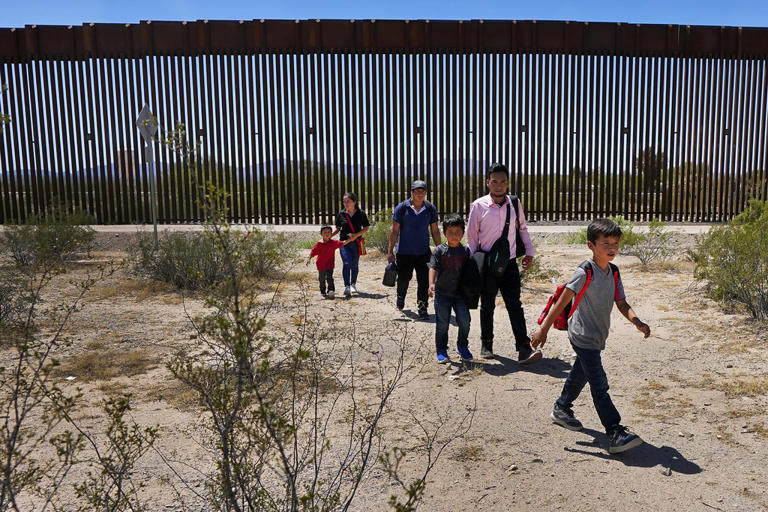

The number of people living in the United States illegally climbed to a record 14 million in 2023, according to new findings from the Pew Research Center. While the increase represents a major jump from prior years, it still falls short of the higher estimates often cited by President Donald Trump and other immigration critics.
Pew’s estimate rose from 11.8 million in 2022 and exceeded the previous high of 12.2 million in 2007. Much of the rise was driven by about 6 million individuals who held temporary legal protections that have since been scaled back under Trump’s administration.
Pew, which has tracked unauthorized immigration since 1990, noted that preliminary data suggests the population continued to grow in 2024—albeit more slowly after then-President Joe Biden imposed strict limits on asylum in June of that year. Under Trump, the total has declined slightly but remains above 14 million.
The overall immigrant population in the U.S., regardless of legal status, hit a record 53 million in January 2025—about 15.8% of the country’s population. That number has since fallen, marking the first decline in decades, according to Pew.
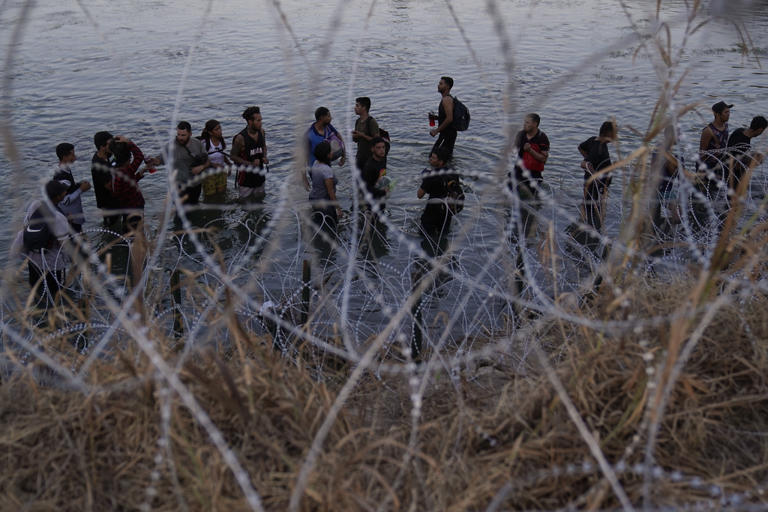
The report also found that nearly all recent growth came from countries other than Mexico. Significant increases were recorded from Guatemala, El Salvador, Honduras, and India, while totals from Venezuela, Cuba, Colombia, Nicaragua, Ecuador, Ukraine, and Peru more than doubled within two years.
Trump, speaking before Congress in March, claimed that 21 million people had “poured into the United States” over the past four years—a figure far higher than Pew’s estimate and official border arrest statistics. The Federation for American Immigration Reform put its own March estimate at 18.6 million.
Similarly, the Center for Immigration Studies reported 14.2 million unauthorized immigrants last month, down from a January peak of 15.8 million. Homeland Security Secretary Kristi Noem hailed the six-month drop of 1.6 million as “massive.”
Yet Noem’s own agency reported a smaller figure. The Department of Homeland Security’s Office of Homeland Security Statistics estimated 11 million in 2022. Meanwhile, the Center for Migration Studies put its 2022 estimate at 12.2 million, narrowly surpassing its previous high from 2008.
Pew’s findings draw on U.S. Census Bureau data and DHS records, highlighting both increased border crossings by asylum-seekers and Biden-era policies that expanded temporary legal protections. These included the CBP One border appointment app and special entry permits for Cubans, Haitians, Nicaraguans, and Venezuelans.
Trump has since rescinded those measures and moved to roll back Biden’s expansion of Temporary Protected Status for migrants already in the U.S.
Mexicans remain the largest single group of people in the country illegally, with numbers rising slightly to 4.3 million in 2023. However, the vast majority of growth—9.7 million individuals—came from other countries, up from 6.4 million in 2021.
California, Texas, Florida, New York, New Jersey, and Illinois hold the largest unauthorized populations, though Texas is rapidly closing the gap with California. Despite recent increases, several states—including Arizona, California, Nevada, New Mexico, New York, and Oregon—had smaller totals in 2023 than at the 2007 peak.
Pew also estimated that 9.7 million people without legal status were in the U.S. workforce in 2023, making up about 5.6% of all workers. Nevada, Florida, New Jersey, and Texas recorded the highest shares of undocumented labor participation.