
The National Transportation Safety Board has identified the probable cause of the midair collision between an Army Black Hawk helicopter and an American Airlines regional jet near Washington, D.C., last January — a crash that killed 67 people and became the deadliest U.S. aviation disaster since late 2001.
During a hearing on Tuesday, Jan. 27, NTSB officials said the crash was likely driven by the use of a helicopter corridor that runs alongside Ronald Reagan Washington National Airport, combined with the helicopter crew’s attempt to maneuver around Flight 5342 using “visual separation.”
Investigators said that approach failed because the Black Hawk crew likely had the wrong aircraft in view. In other words, the helicopter appears to have been tracking a different plane while believing it was avoiding Flight 5342.
What investigators say went wrong
NTSB officials cited several additional factors that, together, increased risk and reduced the chances of the conflict being corrected in time:
- A lack of routine, formal review of helicopter routes around Reagan National, despite the airport’s heavy traffic and known complexity.
- Air traffic control workload and reduced situational awareness at the time of the incident, with controllers operating under significant strain.
- No clear processes for controllers to actively counter risk in that moment, contributing to the absence of stronger, more urgent traffic warnings to the helicopter and the airliner.
- High arrival volume at the airport, described as an “unsustainable arrival rate,” which further increased tower workload.
- Gaps in safety follow-through, including failures by the Army and the Federal Aviation Administration to track or implement needed reforms.
- Limited collision-avoidance and alerting capabilities on both aircraft.
The crash and the victims
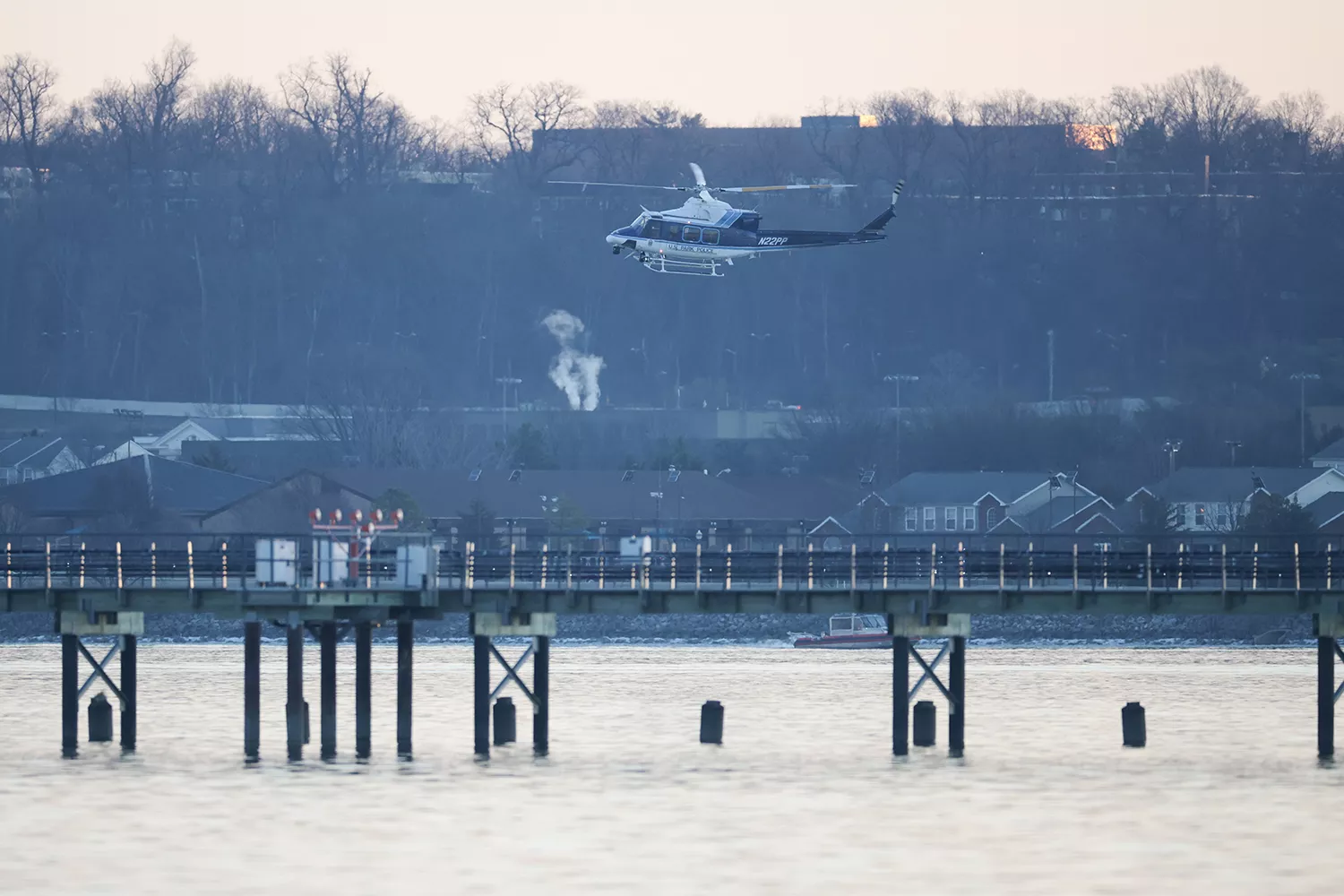
The collision occurred on the night of Jan. 29, 2025, as Flight 5342 approached Reagan National to land and struck the Black Hawk over the Potomac River.
The regional jet had 60 passengers and four crew members onboard and had departed from Wichita, Kansas. Among the passengers were several young figure skaters returning from a training camp.
The helicopter carried three soldiers: Chief Warrant Officer 2 Andrew Eaves, Staff Sgt. Ryan O’Hara, and Army Capt. Rebecca Lobach, the pilot. Officials said the flight was part of a night evaluation for Lobach, with Eaves acting as her instructor.
No one survived.
“This route shouldn’t have been there”
NTSB Chair Jennifer Homendy highlighted the helicopter corridor at the center of the investigation — helicopter route 4, which curves along the Potomac River near the airport.
Established in the 1980s, the route has long been viewed as a pressure point in the congested airspace around Reagan National, where helicopters and commercial aircraft can end up operating in close proximity.
“This helicopter route shouldn’t have been there in the first place,” Homendy said, calling it a flawed airspace design. NTSB officials said previous efforts to relocate or eliminate the route were rejected by the FAA.
Altitude confusion may have put the helicopter closer than the crew realized
Homendy and other officials also pointed to problems affecting the helicopter’s altitude awareness. Investigators said the Black Hawk crew may have believed they were at about 200 feet, while the aircraft was actually closer to 300 feet or higher at times — bringing it nearer to the arriving jet than the crew recognized.
Officials said the helicopter’s attempt to visually separate may also have been complicated by night conditions, potential confusion using night-vision goggles amid bright city lighting, and a lack of more specific guidance from air traffic control.
What air traffic control said — and what the helicopter may not have heard
NTSB officials said the control tower repeatedly warned the helicopter about traffic associated with arrivals to Runway 33. The helicopter crew responded that they had the airliner in sight and would maneuver around it. Investigators believe that assumption was incorrect and that Flight 5342 did not receive a comparable warning about the helicopter.
In earlier interviews referenced during the investigation, the primary controller involved described repeatedly confirming that the helicopter had the airplane in sight and issuing instructions to maintain visual separation. The controller said they told the helicopter to “pass behind” the traffic — but investigators noted that the helicopter cockpit transcript indicates the “pass behind” instruction may not have been heard due to a brief microphone audio interruption.
Prior data showed thousands of close encounters
The NTSB previously released a preliminary report on March 11, noting a history of close calls in the area. Between October 2021 and December 2024, investigators said there were 15,214 known instances in which planes and helicopters came within 400 feet of each other near the airport. In 85 cases, the separation dropped below 200 feet.
The FAA has since taken steps aimed at reducing risk in the area’s crowded airspace.
Separate legal case: government acknowledged failures
Outside the NTSB probe, government attorneys recently acknowledged failures leading up to the crash in a court filing tied to a civil lawsuit from a victim’s family.
“The United States admits that the [helicopter] pilots failed to maintain vigilance so as to ‘see and avoid’ the [passenger plane] and their failure to do so was a cause-in-fact and a proximate cause of the accident,” the Justice Department wrote.
In a statement to CNN at the time, an Army spokesperson said the Army “understands and respects the need for families to receive more information” and acknowledged that many are still seeking answers and reassurance that steps are being taken to prevent another tragedy.