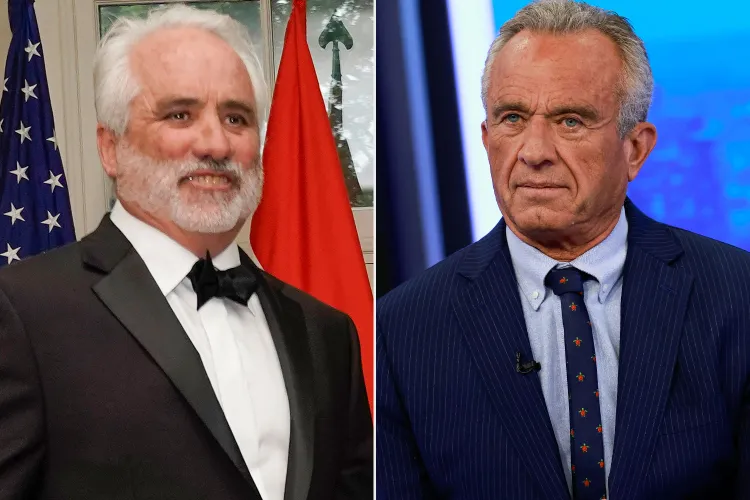

Robert F. Kennedy would have celebrated his 100th birthday this week. Marking the milestone, his son Maxwell Taylor Kennedy has written an op-ed for the Boston Globe reflecting on his father’s life and values — and sharply criticizing his brother, Robert F. Kennedy Jr., for what he calls a betrayal of that legacy while serving in President Donald Trump’s administration.
“Were he alive, he would certainly be taking stock of the country he loved and served,” Maxwell wrote. “Of course, there is no way to know precisely what he would have thought. But I do know what he cared about most deeply: the injustice of poverty in the richest nation in the world and our duty as citizens to make sure that no child goes to bed hungry.”
Maxwell, the ninth of the 11 children RFK and Ethel Kennedy shared, said his father would have been “appalled” by what he described as the Trump administration’s treatment of the nation’s poorest families. “It’s a betrayal of all that my father worked for,” he wrote, adding that those aiding that betrayal have “lowered themselves — not least my brother, Robert F. Kennedy Jr., Trump’s secretary of health and human services, who knows my father’s legacy as well as anyone.”
:max_bytes(150000):strip_icc():focal(737x534:739x536):format(webp)/ethel-kennedy-life-in-photos-101024-5-05f0b38c80d64e5cac5ec10255c0410b.jpg)
In the op-ed, Maxwell acknowledged that RFK did not experience hunger growing up in one of America’s most powerful families. But as RFK and his brother John F. Kennedy moved through national political campaigns, they encountered poverty on a scale that jolted them — and pushed them toward action.
Maxwell pointed to his uncle’s early pilot effort for food stamps, later expanded under President Lyndon B. Johnson after JFK’s assassination. But he emphasized that RFK became a key driver of several anti-hunger programs that remain central to the social safety net today.
After RFK was elected New York senator in 1964, Maxwell wrote, he was deeply moved by the testimony of Marian Wright, a young Black attorney who had risen out of poverty in Mississippi to graduate from Yale Law School. RFK soon traveled with Wright and three other senators to Jackson, Mississippi, to witness hunger and deprivation firsthand — a trip Maxwell said transformed his father.
“My father listened, face to face, to the people who bore this country’s hidden hunger,” he wrote. “He knew that empathy was at the root of wisdom in politics, that you cannot govern a people you refuse to meet.” Maxwell added that RFK’s influence came not from spectacle but from showing up, listening, and treating struggling families as neighbors rather than statistics.
Maxwell said that while Vietnam helped propel RFK’s 1968 presidential run, it was poverty that most consistently shaped his conscience. And though RFK was assassinated before he could pursue the presidency, Maxwell argued that his work helped set in motion lasting reforms.
He credited Senator George McGovern with carrying forward RFK’s anti-hunger push after his death, leading to expansions of SNAP, WIC, and the National School Lunch Program. Maxwell also noted that President Richard Nixon supported a nationwide expansion of food stamps and that legislation signed by President Jimmy Carter removed a requirement that beneficiaries pay into the program.
:max_bytes(150000):strip_icc():focal(691x219:693x221):format(webp)/Robert-F-Kennedy-2d933c7fd6f24e409a33f1313b93eb5a.jpg)
Maxwell warned that these programs have recently been hit hard. He pointed to the government shutdown as an early blow, freezing benefits for many families. But he said the most damaging shift came with Trump’s “Big Beautiful Bill,” signed into law in July, which tightened eligibility for assistance and, in Maxwell’s view, leaves millions at risk of losing crucial support.
“Today hunger remains an acute problem in America and those programs my father fought for are being dismembered or dismantled,” he wrote. He described the current approach as “almost Dickensian cruelty,” arguing that aid for the poor is being stripped away while wealth flows upward.
He saved his harshest words for RFK Jr.’s role in the administration. Maxwell argued that preventing hunger is a basic responsibility of any public health leader, and faulted his brother for standing with Trump while SNAP and related programs are curtailed. “You cannot Make America Healthy while denying food to our most vulnerable citizens,” he wrote.
Maxwell closed by recalling his father’s moral challenge: if a nation cannot prevent its citizens from starving, “we must ask ourselves what kind of country we really are.” He said that question feels just as urgent today.
The op-ed adds to a growing list of Kennedy relatives who have publicly criticized RFK Jr.’s place in the Trump administration. Maxwell noted that earlier this year his cousin Caroline Kennedy urged senators to reject RFK Jr.’s nomination, calling him a “predator.” And in September, his nephew Joe Kennedy III called for RFK Jr. to resign after he defended firing the Advisory Committee on Immunization Practices, which advises on vaccine use.