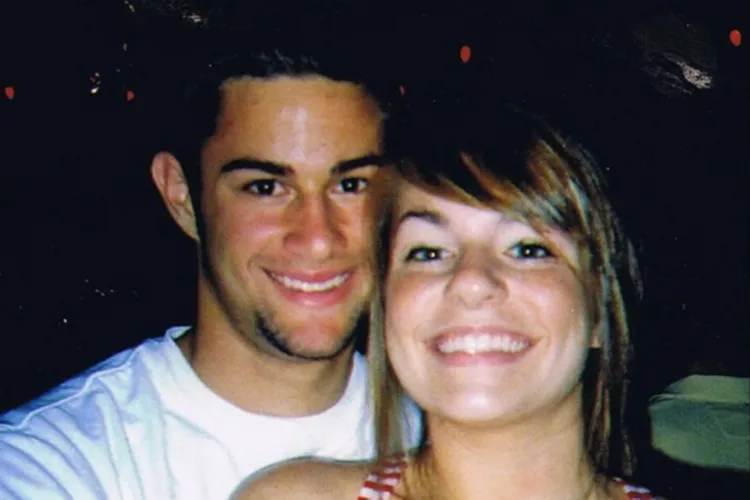

Growing up in New Orleans, Bryan and Allison Condon spent much of their childhood at Memorial Medical Center.
Whenever hurricanes threatened the city, the two friends and their families would often head to the hospital, where their mothers worked as nurses, and wait out the storms.
“It was normal for us because it always felt safe,” says Bryan, 37. “They had generators, food, power, a place to park, and even allowed pets. But during this particular hurricane, things didn’t go that way at all.”
That hurricane was Katrina, which devastated New Orleans in August 2005, when Bryan and Allison were just 17.
The two spent several days trapped at the hospital during flooding and widespread power outages. Six months later, they reconnected — and eventually fell in love. By 2012, they were married.
Two decades after Katrina, Bryan says the memories resurface every hurricane season. The disaster killed more than 1,300 people and caused tens of billions in damage, but for him, there was one lasting personal outcome.
“Without that, we probably wouldn’t be where we are today,” Bryan reflects. “It led me to marry Allie, build a family, and live the life we have now.”
:max_bytes(150000):strip_icc():focal(999x0:1001x2):format(webp)/Allison-Martin-Condon-1-65262c38c60640788564c5d15409c0fb.jpg)
When Katrina struck on Aug. 29, 2005, the levees broke, forcing the Condons and thousands of others into crisis. Inside Memorial, their mothers cared for patients while Bryan and Allison tried to pass the time by walking the halls, playing games, and watching movies.
But as conditions worsened, they became old enough to recognize the danger. “It got dire,” Allison recalls. “We started helping out where we could. I remember moving animals.”
When the hospital lost both power and generator backup, the atmosphere shifted. “That’s when we realized this wasn’t just another hurricane,” Bryan says. “We didn’t know when we’d be able to leave.”
Communication with the outside world was gone, and chaos grew outside the hospital. “People were swimming up to the hospital, desperate to get in,” Allison remembers. “We had to stay put.”
Allison’s father was at another hospital, and her mother was on duty, leaving her and her younger brother on their own. “[Bryan] stuck by me and made sure we were safe,” she says. “We just formed a little group and looked out for one another.”
Bryan admits he was frightened but tried to stay calm. “I didn’t want them to see me worried,” he says. “So I asked my dad what I could do to help, because at that point you were basically fending for yourself.”
Days later, a helicopter evacuated Bryan and his family. Allison and her family left the next day by boat. Their mothers stayed in touch, so each knew the other was safe.
It was only weeks later that Bryan and Allison began talking on the phone again. Bryan, now living in Mississippi and finishing high school, stayed connected with Allison, who had taken a semester off from college.
“We would just check in on each other,” Bryan recalls. “It wasn’t until the following March that we started hanging out again in person.”
Allison remembers their first dinner out with friends after the storm. “We just started spending time together from there,” she says.
The couple dated for six years before Bryan proposed in New York City’s Central Park in 2012.
Today, Bryan works as a physical therapist and Allison as an interior designer. They live in Kenner, Louisiana, with their two sons — Jackson, 10, and Reid, 6. Both boys are sports fans, and the family often attends Pelicans games. Their mothers are still nurses at Memorial, now called Ochsner Medical.
Looking back, Bryan says the experience forced them to grow up too quickly. “You weren’t just a high school kid anymore. You had to act like an adult, take care of yourself, and face situations you never thought you would.”
For Allison, the storm remains a defining moment. “It brought us together,” she says. “I wouldn’t trade any of it, because without that, I wouldn’t have him. And I wouldn’t have my kids.”