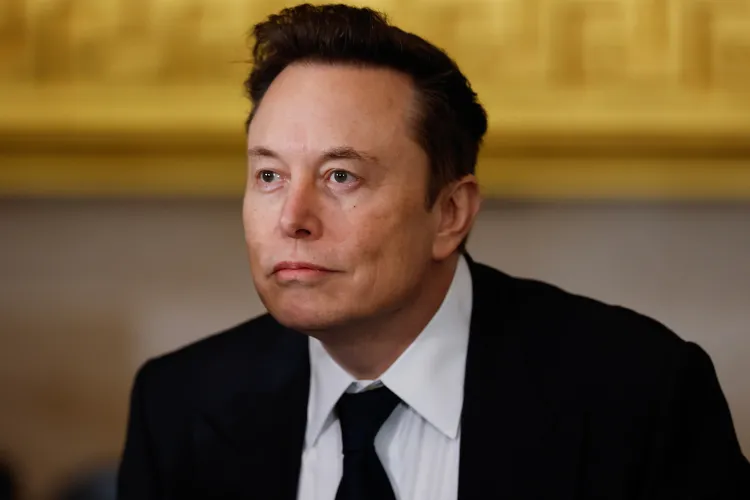

Tesla shares plunged nearly 8% on Monday after CEO Elon Musk announced the launch of a new U.S. political party, sparking renewed concerns about his ability to focus on the electric carmaker amid slumping sales and mounting competitive pressure.
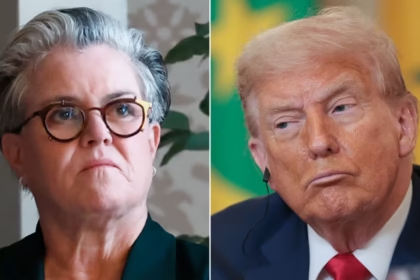
Over the weekend, Musk introduced the “America Party” following a public spat with former ally President Donald Trump over the latest tax and spending bill. Trump slammed Musk’s political foray as “ridiculous” and threatened to revoke billions in federal subsidies for Musk’s companies after their feud exploded on social media in early June.
The timing of Musk’s political move couldn’t be worse for Tesla. The automaker recently reported its second consecutive drop in quarterly deliveries, and its stock has already shed 35% since peaking last December — making it the worst-performing member of the so-called “Magnificent Seven” tech stocks this year.
“If you’re a Tesla investor, the last thing you want is your CEO launching a political party,” said Shawn Campbell of Camelthorn Investments. “We need leadership focused on turning the business around — not stoking political fires.”
Tesla stands to lose more than $80 billion in market capitalization if Monday’s losses hold. Meanwhile, traders shorting Tesla shares are poised to reap around $1.4 billion in paper gains.
Tesla’s Board Faces Mounting Pressure
Musk’s political pivot is also putting Tesla’s board under renewed scrutiny, as questions swirl about its willingness — or ability — to rein in its high-profile CEO.
Board Chair Robyn Denholm previously denied reports that the board was exploring options to replace Musk. But some investors and legal experts are now urging directors to reassess his position in light of his growing outside ventures — including the new political party, and his leadership of five other companies.
“We decided to delay the launch of our Tesla-focused ETF,” said James Fishback, CEO of Azoria Partners. “Elon’s move to create a political party raises serious doubts about whether he can still be a full-time CEO.”
Legal experts note that while Musk’s board can technically remove him without a shareholder vote, doing so is seen as unlikely.
“The board has largely enabled Musk’s increasingly erratic pursuits,” said Ann Lipton, a corporate law professor at the University of Colorado. “It’s hard to imagine they’ll start drawing lines now.”
Musk’s Dominance Looms Large
Despite the turmoil, Musk’s influence over Tesla remains immense. He is the company’s largest shareholder, and much of its public image — and valuation — is closely tied to his personal brand.
But analysts say his deepening political involvement could start to test investor patience, especially as Tesla’s business fundamentals weaken.
“Boards are supposed to act when a CEO’s distractions threaten the company,” said Xu Jiang, a business professor at Duke University’s Fuqua School. “Whether they will act in this case is another matter entirely.”
With Tesla’s future increasingly entangled with Musk’s unpredictable ambitions, shareholders and regulators alike are watching closely — and anxiously.