

America’s fiscal outlook is pushing into new territory. The Committee for a Responsible Federal Budget (CRFB) says the United States has effectively entered the era of trillion-dollar annual interest payments, a milestone first crossed in fiscal year 2025. As the cost of servicing a rapidly growing debt pile rises, interest is poised to claim a larger and more stubborn share of the federal budget for years to come.
In an analysis released Dec. 16, the nonpartisan budget group pointed to the roughly $38 trillion national debt as the primary driver of the surge, noting it has climbed to around 100% of gross domestic product (GDP). Net interest as a budget line item totaled $970 billion for the fiscal year, but the Congressional Budget Office (CBO) indicates actual net interest spending on the public debt topped $1 trillion in FY 2025 for the first time. Looking ahead, CRFB projects the annual tab will continue to climb—rising above $1.5 trillion by 2032 and reaching about $1.8 trillion by 2035.
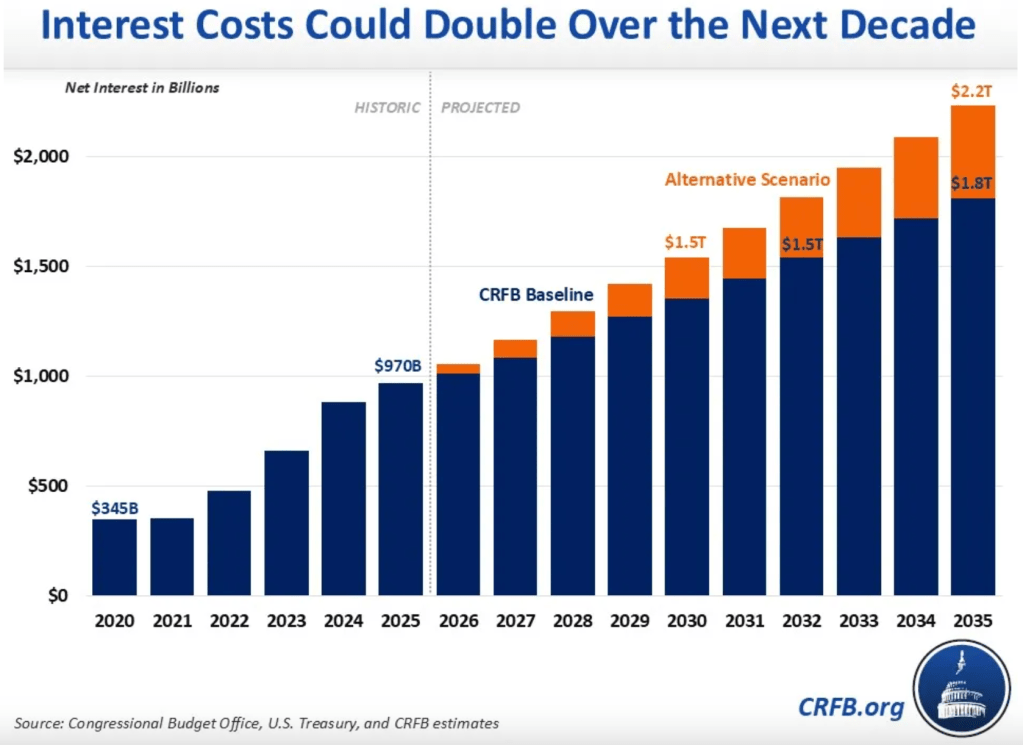
CRFB warns the numbers could get worse under certain policy scenarios. If the Supreme Court strikes down major parts of the Trump administration’s tariffs and provisions in the One Big Beautiful Bill Act are made permanent without offsets, CRFB estimates interest payments could exceed $2.0 trillion in 2034 and hit roughly $2.2 trillion in 2035. The group contrasted today’s reality with just five years ago: in FY 2020, net interest costs were $345 billion. Since then, they have roughly tripled, accelerated by pandemic-era emergency spending and higher borrowing needs—an increase CRFB suggests is becoming less a spike and more a lasting baseline.
The warning lands alongside a similar note from the American Action Forum, which argues this debt trajectory risks placing an “undue burden on future generations.” The think tank says younger Americans are especially likely to bear the consequences through a higher interest-rate environment, weaker economic growth, and slower wage gains.
High-profile economic leaders have echoed variations of that concern. JPMorgan CEO Jamie Dimon and Federal Reserve Chair Jerome Powell have both cautioned about the risks of rising federal debt costs. Bridgewater Associates founder Ray Dalio has described a possible endgame as an economic “heart attack,” where the need to meet debt obligations crowds out other priorities, including investment.
The speed of the debt’s growth has also become part of the alarm. When total debt first exceeded $38 trillion in late October, the Peter G. Peterson Foundation calculated it had taken only two months to rise from $37 trillion—one of the fastest increases outside the pandemic period. Foundation CEO Michael A. Peterson said at the time that this is “no way for a great nation like America to run its finances,” in a statement to Fortune.
CRFB argues that breaking the cycle requires policymakers to “work on a plan to put our national debt on a downward, sustainable path.” Without action to slow the growth of borrowing and interest costs, the government risks a future in which paying for the past steadily consumes more of what it can do next.


