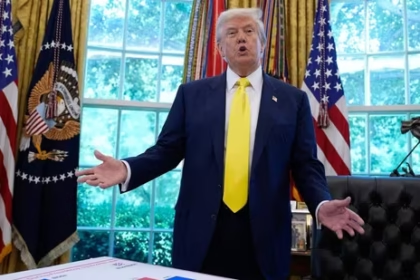
As President Donald Trump has launched tariff fights and singled out individual companies, the opening stretch of his second term has featured a familiar ritual: CEOs from Big Tech and other industries making trips to the White House to offer tributes, deliver gifts, and publicly praise the president.
On Friday, executives from Big Oil had their turn, summoned to discuss whether U.S. companies might pour billions into reviving Venezuela’s long-declining oil sector. But Exxon Mobil CEO Darren Woods didn’t embrace Trump’s push for a quick move. Instead, he calmly signaled that Venezuela remains “uninvestable” unless the country undergoes extensive reforms over a sustained period.
By Sunday, Trump was openly irritated. He described Exxon as being “too cute,” and suggested he may prefer to keep the world’s largest oil company on the sidelines in Venezuela.
Woods—a career Exxon executive who became CEO in 2017 after Rex Tillerson left to join Trump’s first administration—is known as understated but firm. Over time, he has also taken on the role of an unofficial spokesperson for the industry.
He strongly subscribes to the disciplined “Exxon way.” He’s typically polite, but direct: Exxon, he says, focuses on molecules rather than electrons, doesn’t plan to pivot into renewables, and shouldn’t be treated as the primary culprit for climate change.
And he’s not likely to soothe the president at the expense of Exxon shareholders—a tension many corporate leaders are trying to navigate. Energy analysts noted that Exxon’s stock could have taken a bigger hit if the company had committed to spending billions in Venezuela under current economic conditions. Instead, Exxon shares dipped only about 0.5% on Monday despite Trump’s criticism, and the company held a market capitalization of roughly $529 billion.
“There was nobody to say anything, except Darren, and he’s eloquent as heck,” said Jim Wicklund, a veteran oil analyst and managing director at PPHB, an energy investment firm.
In moments like this, it often comes down to leverage.
“This is Trump’s problem. There’s no urgency by the industry at all to go back into Venezuela. And there’s almost no inducement other than guaranteeing profitability, which they can’t do,” Wicklund said. “You can sweeten the terms, but the political risk outweighs that variable by a factor of 10.”— Jordan Blum