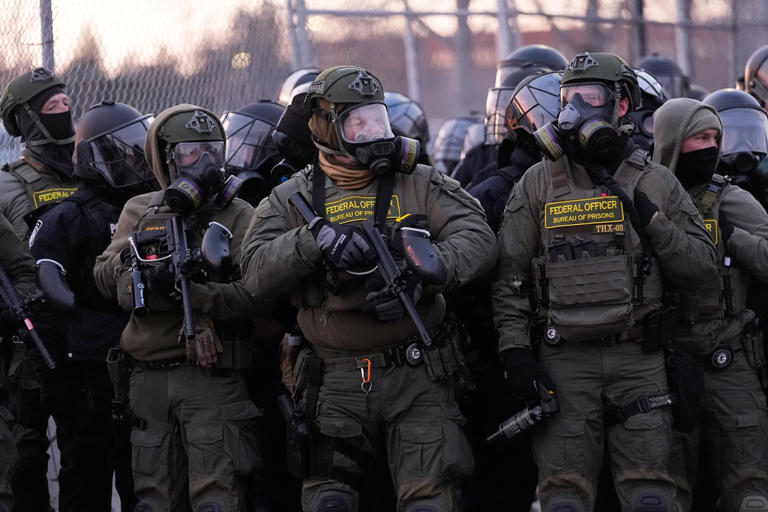

A ballooning Immigration and Customs Enforcement budget. Hiring bonuses of $50,000. A rapid expansion of ICE staffing to 22,000 officers — an enforcement footprint that, in raw size, would outnumber most police departments in the country.
President Donald Trump pledged the largest mass deportation operation in U.S. history. But reaching that scale, critics and budget analysts argue, is being made possible by new funding embedded in the sweeping tax and spending cuts package passed by Republicans in Congress — money that is already fueling intensified enforcement actions in cities such as Minneapolis and beyond.
One budget expert said the GOP’s major legislation is “supercharging ICE” in ways many Americans may not fully grasp — and that the shift is only beginning.
“I just don’t think people have a sense of the scale,” said Bobby Kogan, senior director of federal budget policy at the Center for American Progress and a former adviser to the Biden administration’s Office of Management and Budget. “We’re looking at ICE in a way we’ve never seen before.”
A deportation push that’s becoming a broader national law-enforcement presence
As the Republican president marks the first year of his second term, the enforcement and removal campaign that has anchored his domestic agenda is rapidly evolving into something larger: a nationwide law-enforcement presence backed by tens of billions of dollars in new taxpayer spending.
In Minneapolis, the shooting death of Renee Good drew attention to the reach of the new federal posture, helping ignite sustained protests over the presence of military-styled officers going door to door to find and detain immigrants. In the face of mounting opposition, Trump revived threats to invoke the Insurrection Act to quell demonstrations, and the U.S. Army has 1,500 soldiers ready to deploy.
Even as the administration emphasizes immigration as a signature issue, Trump’s public approval rating on immigration has slipped since he took office, according to an AP-NORC poll.
“Public sentiment is everything,” said Rep. Nydia M. Velázquez, D-N.Y., at a Capitol press conference with lawmakers backing legislation to impeach Homeland Security Secretary Kristi Noem. Americans, she said, are reacting to what they’re seeing. “They didn’t sign on for this,” she said.
Border crossings fall, while enforcement shifts deeper into U.S. cities
Illegal crossings at the U.S.-Mexico border have dropped to historic lows under Trump — a dramatic change from recent years, when the Biden administration allowed millions of people to enter temporarily while their claims were adjudicated.
But as the focus moves away from the border, the newly enlarged army of immigration officers operating in city streets — in Los Angeles, Chicago, and elsewhere — is an aggressive posture that many Americans are unaccustomed to seeing.
Accounts and footage circulating widely show armed, masked officers breaking car windows, pulling people from vehicles, chasing and restraining others, and taking them into custody — scenes replayed repeatedly across television and social media.
And ICE is not acting alone. A long list of supporting agencies — including federal, state, and local police departments and sheriff’s offices — are entering into contract partnerships with the Department of Homeland Security to assist with immigration enforcement operations in communities across the country.
House Speaker Mike Johnson, R-La., warned Democrats this is “no time to be playing games” by stoking opposition to enforcement officers in Minneapolis and elsewhere.
“They need to get out of the way and allow federal law enforcement to do its duty,” Johnson said at the Capitol.
Noem has said officers are acting lawfully, and the department insists it is targeting criminals — what officials describe as the “worst of the worst.”
However, reports indicate non-criminals and U.S. citizens have also been forcibly detained by immigration officers. The Supreme Court last year lifted a ban on using race alone in immigration stops.
Trump last month called Somali immigrants “garbage,” remarks that echoed earlier objections he has voiced about immigrants from certain countries.
The administration has set a target of 100,000 detentions per day — roughly three times typical levels — and 1 million deportations per year.
Massive new funding, with limited avenues to slow it down
With Republicans controlling Congress, efforts by Democrats to impeach Noem or other administration officials are not politically viable. And even if lawmakers wanted to curb immigration operations through a government funding fight, the spending trajectory may be difficult to interrupt.
What Trump called the “big, beautiful bill” is structured to run largely on autopilot through 2029 — the year he is scheduled to finish his term.
The legislation effectively doubled annual Homeland Security funding, adding $170 billion to be used over four years. Of that total, ICE — which typically receives about $10 billion annually — was allocated $30 billion for operations and $45 billion for detention facilities.
“The first thing that comes to mind is spending on this level is typically done on the military,” said Kathleen Bush-Joseph, a policy analyst at the Migration Policy Institute. “Trump is militarizing immigration enforcement.”
Next, Congress will consider the annual Homeland Security funding package unveiled Tuesday, or risk a partial shutdown Jan. 30. A growing bloc of Democratic senators and the Congressional Progressive Caucus say they won’t support additional money without significant changes.
Lawmakers are weighing restrictions on ICE operations, including limiting arrests near hospitals, courthouses, churches, and other sensitive locations — and requiring officers to display proper identification while limiting the use of face masks.
“I think ICE needs to be totally torn down,” said Sen. Ruben Gallego, D-Ariz., on CNN over the weekend.
“People want immigration enforcement that goes after criminals,” he said — not what he called a “goon squad.”
Money is already flowing — but the administration still falls short of its targets
Homeland Security has already begun drawing on the new funding. The department told Congress it has obligated roughly $58 billion so far — including about $37 billion for border wall construction — according to a person familiar with an internal assessment who was not authorized to discuss it publicly.
DHS also says its recruitment campaign surpassed its initial goal, bringing in 12,000 new hires — more than doubling the force to 22,000 officers in a matter of months.
“The good news is that thanks to the Big Beautiful Bill that President Trump signed, we have an additional 12,000 ICE officers and agents on the ground across the country,” Assistant Secretary Tricia McLaughlin said in a December statement.
The department says it has arrested and deported about 600,000 people, and that 1.9 million others have “voluntarily self-deported” since January 2025, when Trump took office.