
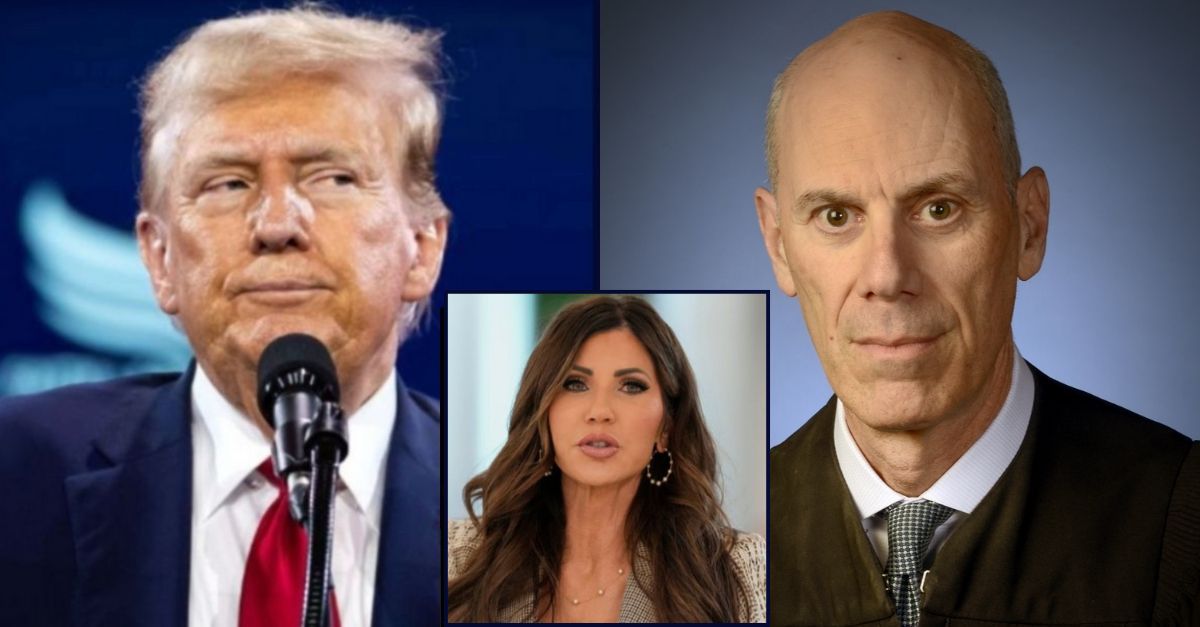

The Trump administration is arguing that it did not violate a court order when it refused to recall flights carrying Venezuelan migrants to a notorious terrorist prison in El Salvador, even though a federal judge had explicitly instructed that the planes turn around. The migrants were deported with little or no due process under President Donald Trump’s unprecedented use of the Alien Enemies Act of 1798 (AEA).
In a five-page court filing submitted Tuesday, the administration defended its actions and, for the first time, revealed that Secretary of Homeland Security Kristi Noem ultimately decided not to follow the verbal directive issued in March by Chief U.S. District Judge James Boasberg. The filing responds to Boasberg’s ongoing inquiry into whether the administration should be held in criminal contempt for failing to comply with his order.
According to the government, Boasberg’s March 15 verbal instruction that the deported migrants “be returned to the United States” was “superseded” less than an hour later by his written order, which only barred the administration “from removing” migrants under the AEA. Because the flights had already exited U.S. airspace by that time, officials concluded that those detainees had already “been removed” and could therefore be handed over to El Salvador’s custody.
The filing states that Deputy Assistant Attorney General Drew Ensign “promptly conveyed” both the verbal and written orders to Deputy Attorney General Todd Blanche and then-Principal Associate Deputy Attorney General Emil Bove, both of whom previously served as Trump’s personal attorneys. Bove has since been confirmed as a federal appellate judge.
Blanche and Bove advised the Department of Justice on how to handle the flights that had already departed, and that advice was relayed to the Department of Homeland Security (DHS) through its acting general counsel, Joseph Mazzara. Mazzara then passed along that guidance, along with his own, to Noem, who “directed that the AEA detainees who had been removed from the United States before the Court’s order could be transferred to the custody of El Salvador.”
The government’s justification for Noem’s decision, as laid out in Tuesday’s filing, is that the judge’s verbal directive did not amount to a binding order.
“That decision was lawful and was consistent with a reasonable interpretation of the Court’s order,” wrote Tiberius Davis, counsel to the assistant attorney general. “Although the substance of the legal advice given to DHS and Secretary Noem is privileged, the Government has repeatedly explained in its briefs — both in this Court and on appeal — why its actions did not violate the Court’s order, much less constitute contempt. Specifically, the Court’s written order did not purport to require the return of detainees who had already been removed, and the earlier oral directive was not a binding injunction, especially after the written order.”
The administration also pointed to a recent appellate court concurrence that described Boasberg’s oral directives during the March 15 hearing as “inconsistent,” “garbled,” and, if read alone, “indefensible.”
“All of that confirms that it was appropriate to construe the written order as having superseded any oral directives, even assuming the latter ‘can ever be binding,’” the filing states.
In April, Boasberg found there was probable cause “to find the Government in criminal contempt.” After the D.C. Circuit recently lifted a monthslong pause on the matter, the judge now appears poised to resume those contempt proceedings.
Potential witnesses at the hearing include Bove, Ensign, and a former Department of Justice attorney who was fired after acknowledging in another high-profile immigration case that migrant Kilmar Abrego Garcia was among several men deported to El Salvador because of an “administrative error.”


