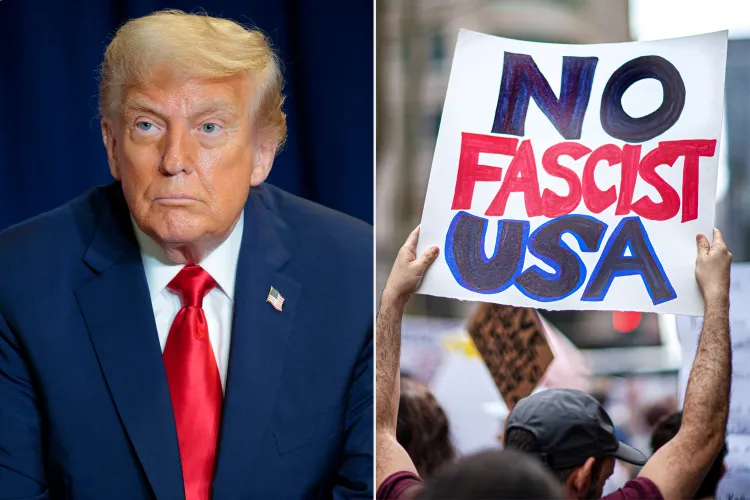

President Donald Trump has labeled “antifa” a “major terrorist organization.”
On Sept. 17, he posted on Truth Social: “I am designating ANTIFA, A SICK, DANGEROUS, RADICAL LEFT DISASTER, AS A MAJOR TERRORIST ORGANIZATION.”
“I will also be strongly recommending that those funding ANTIFA be thoroughly investigated in accordance with the highest legal standards and practices,” he added.
On Sept. 22, Trump formally signed an executive order titled “Designating Antifa as a Domestic Terrorist Organization.”
The order described antifa as “a militarist, anarchist enterprise that explicitly calls for the overthrow of the United States Government, law enforcement authorities, and our system of law.” It claims the group “uses illegal means to organize and execute a campaign of violence and terrorism nationwide to accomplish these goals.”
Trump had previously hinted at a similar move during his first term in 2020, though no official action was taken. He revived the campaign after the assassination of Charlie Kirk, suggesting Kirk’s death was fueled by hatred from political opponents, despite the unclear profile of 22-year-old suspect Tyler Robinson, who has been charged in the case.
:max_bytes(150000):strip_icc():focal(559x249:561x251):format(webp)/Unite-Against-Fascism-092225-76a087cdbb0146239f958dcf0f5bef10.jpg)
Other incidents cited by the right as examples of antifa-related violence include the 2017 shooting of Louisiana Rep. Steve Scalise, the 2020 Black Lives Matter protests, assassination attempts on Trump during his 2024 campaign, the fatal shooting of United Healthcare CEO Brian Thompson in 2024, and the 2025 anti-ICE protests in Los Angeles.
However, experts argue that “antifa” is not an official organization.
What is antifa?
“Antifa” is short for “anti-fascist.” Anti-fascist movements have existed in the U.S. and worldwide for nearly a century, originating as a response to the rise of far-right nationalist movements in Europe during the early 20th century.
Experts say calling antifa an “organization” in 2025 is misleading. Unlike formally recognized terrorist groups, it lacks centralized leadership or headquarters, and is often portrayed by the political right as a shadowy entity coordinating violent acts.
In a Sept. 18 New York Times article, Cynthia Miller-Idriss, an American University professor specializing in domestic extremism, compared antifa more to ideologies like “White supremacy” or “Islamist extremism” rather than structured groups such as the Aryan Brotherhood or Al Qaeda.
“There may be little groups organized around antifa in a neighborhood or community that meet up and share that stance, but it would be very hard to see that as connected in an organizational form that could be tackled,” she said. “There is no expert I’ve ever heard of who has identified antifa as an actual organization.”
Gary LaFree, a University of Maryland criminology professor and former head of the school’s terrorism research center, told PolitiFact that “multiple independent reviews of incidents from the past decade — including analyses of FBI and Department of Homeland Security reporting, the Global Terrorism Database, and congressional testimony — show zero terrorist attacks attributed to Antifa.” He added that terrorist acts are “overwhelmingly carried out by far-right extremists, jihadist-inspired actors, or — less frequently — other movements.”
:max_bytes(150000):strip_icc():focal(1118x299:1120x301):format(webp)/Demonstrators-protesting-the-alt-right-movement-092225-50969775e94f4b25b6f88b60313f7402.jpg)
Why label antifa a terrorist organization?
Democrats worry the order could allow the administration to label Americans perceived as political opponents as antifa terrorists.
Trump’s executive order describes the antifa “campaign” as involving “coordinated efforts to obstruct enforcement of Federal laws through armed standoffs with law enforcement, organized riots, violent assaults on Immigration and Customs Enforcement and other law enforcement officers, and routine doxing of and other threats against political figures and activists.”
It gives the administration authority to target anyone believed to be “recruiting,” “training,” or “radicalizing” young Americans to engage in “violence and suppression of political activity.”
“Individuals associated with and acting on behalf of Antifa further coordinate with other organizations and entities for the purpose of spreading, fomenting, and advancing political violence and suppressing lawful political speech,” the order states.
Mississippi Rep. Bennie Thompson, top Democrat on the House Homeland Security Committee, criticized the move, saying: “Designating Antifa, which has no defined organizational structure or leadership, as a domestic terrorism organization is not only incorrect, it serves no purpose other than an excuse for the Trump administration to stifle dissent, investigate anyone, or any group, they don’t like, punish their enemies, and potentially label any American they want as a terrorist.”
Left-wing commentator Hasan Piker, scheduled to debate Kirk on Sept. 25 at Dartmouth College, reacted on X: “I don’t think liberal media is aware of how bad things will get for all of us.”
Is the executive order enforceable?
While the U.S. government can prosecute foreign terrorists connected to groups like Hamas, Al-Qa’ida, and ISIS, there is no legal precedent allowing the federal government to designate a domestic American group as a terrorist organization due to First Amendment protections.
“Trump can declare whatever he wants to declare, but there is no legal authority to actually designate a domestic group as a terrorist organization even assuming that antifa is an organization and not just an ideology,” said Mary McCord, former acting head of the Justice Department’s national security division, to The New York Times.
“That means his declaring this has no legal impact. Certainly it does not trigger criminal terrorism charges, like providing material support to a foreign terrorist organization.”
The order does, however, instruct federal agencies to “investigate, disrupt, and dismantle any and all illegal operations,” effectively making antifa a higher law enforcement priority.
Luke Baumgartner, research fellow at George Washington University’s Program on Extremism, told CBS News that while left-wing activists cannot be prosecuted for ideology alone, some could face other charges. Being labeled a domestic terrorist by the federal government could also lead to harsher court sentences.
Revoking the executive order would require action by a future president or intervention by a federal judge to block or divert funds.
What happens next?
For now, Trump’s executive order is one part of a broader set of measures targeting the political left.
Following Kirk’s death, the administration suggested pursuing racketeering charges against left-wing groups alleged to be coordinating against conservatives. The president also floated revoking tax-exempt status for liberal nonprofits, CNN reports.
“With God as my witness, we are going to use every resource we have at the Department of Justice, Homeland Security and throughout this government to identify, disrupt, dismantle and destroy these networks and make America safe again for the American people,” homeland security adviser Stephen Miller said in a conversation with Vice President JD Vance.